
Navy Opens 2026 Sprint Football Season With Dominant 27-6 Victory Over Penn
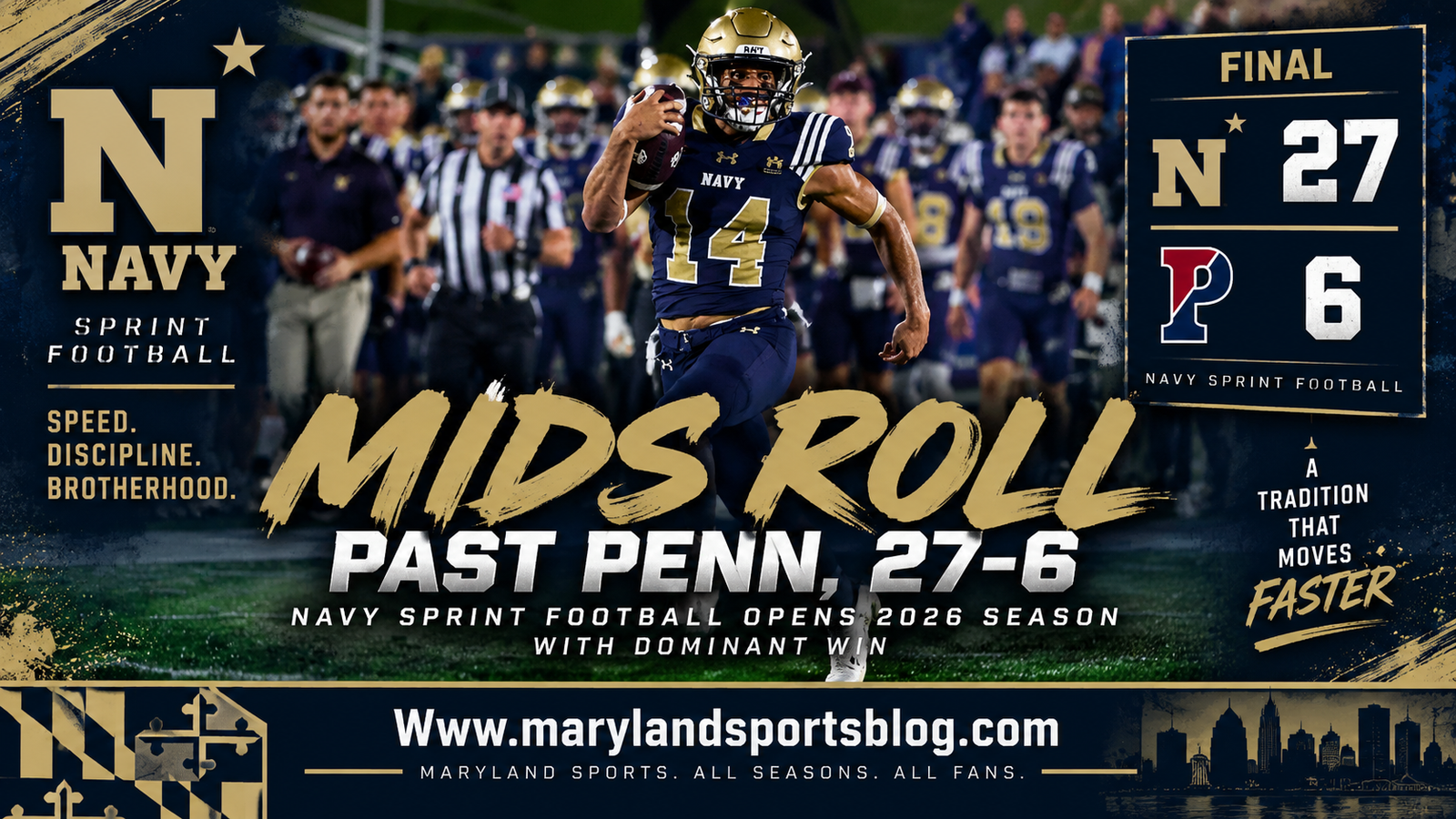
ANNAPOLIS, Md. — Navy sprint football opened the 2026 season with a performance that demonstrated why the Midshipmen remain one of the prominent programs in one of college football’s most distinctive forms of the sport.
Navy controlled Penn on both sides of the football Friday night at Navy-Marine Corps Memorial Stadium, building a 20-0 halftime advantage and cruising to a 27-6 victory in the Collegiate Sprint Football League South Division opener. The Midshipmen generated 382 yards of total offense while holding the Quakers to 180, and Navy did not allow Penn to score until the fourth quarter.
The season opener also produced a significant moment in Navy sprint football history. Senior captain Hunter Gennicks rushed for 97 yards and a touchdown, giving him 2,352 career rushing yards and making him the program’s all-time leader. Gennicks surpassed Eric Wellmon, who accumulated 2,263 yards from 2012-15.
Quarterback Luke O’Connell added an efficient performance through the air, completing 10 of 14 passes for 194 yards and two touchdowns. Andrew Daly turned his first collegiate reception into a 63-yard touchdown and finished with a team-high 89 receiving yards, while Ibi Denson added a 30-yard touchdown reception.
What Exactly Is Sprint Football?
For readers unfamiliar with the sport, sprint football is not flag football, seven-on-seven football or a recreational version of the game. It is a full-contact intercollegiate varsity sport played under essentially the same rules as conventional college football, with the defining difference being weight restrictions on the players. The Collegiate Sprint Football League traces its history to before World War II and currently lists nine member programs, including Navy, Army West Point, Penn and Cornell.
The current weight rules are more detailed than the traditional shorthand description of players simply having to weigh 178 pounds or less. Under the CSFL’s 2026 bylaws, returning players must meet preseason practice certification standards, while the regular season uses two official weigh-ins during game weeks. For a Friday game, for example, players must weigh no more than 183 pounds at both the Monday and Wednesday certifications; failing either weigh-in makes the player ineligible for that week’s game.
The preseason rules also incorporate body composition and hydration safeguards. A returning player can qualify for practice by weighing 175 pounds or less, or by weighing no more than 188 pounds while meeting minimum body-fat and hydration standards specified by the league. The measurements are overseen by medical or appropriate administrative personnel rather than simply being left to the coaching staff.
Once the game begins, however, this is recognizable football. There are quarterbacks, running backs, offensive and defensive linemen, linebackers, defensive backs, kickers and special teams. Blocking and tackling are full contact, and teams run conventional offensive and defensive systems. The lighter roster composition tends to place additional emphasis on speed, technique, execution and conditioning rather than the sheer size commonly associated with modern college football.
The CSFL currently consists of Army West Point, Caldwell University, Chestnut Hill College, Cornell University, Mansfield University, Molloy University, Navy, Penn and St. Thomas Aquinas College.
For Navy, sprint football also carries a substantial tradition of its own. It is a separate varsity program from Navy’s Football Bowl Subdivision team, meaning the athletes and schedule are different even though both represent the Naval Academy.
Navy Strikes First
Friday’s game remained scoreless for much of the opening quarter before Navy found its first explosive play.
O’Connell connected with Daly for a 63-yard touchdown with 4:05 remaining in the first. The three-play drive covered 75 yards in only 1:30, and Jacori Sutton converted the extra point to put Navy ahead 7-0.
The play was particularly memorable for Daly because the 63-yard touchdown was his first collegiate reception. Instead of easing his way into the offense with a short completion, Daly immediately provided one of Navy’s biggest plays of the night.
Penn could not produce a similar response. Navy’s defense pressured freshman quarterback John Franchini during his collegiate debut and prevented the Quakers from developing a consistent rushing attack.
That defensive performance allowed Navy to remain patient offensively rather than feeling pressure to score on every possession.
Gennicks Makes Navy History
The second quarter belonged in large part to Gennicks.
He entered the season needing only nine rushing yards to surpass Wellmon for Navy’s career record. Gennicks quickly cleared that number and continued running effectively throughout the evening, eventually finishing with 97 yards on 15 carries for an average of approximately 6.5 yards per attempt.
His night also included a touchdown.
Navy put together an eight-play, 54-yard drive during the second quarter, and Gennicks finished it with a one-yard touchdown run with 4:15 remaining. Sutton added the extra point, increasing Navy’s advantage to 14-0.
The touchdown gave Gennicks 27 rushing scores for his career. He finished the opener only one shy of the Navy sprint football record of 28 shared by Alex Totta and Wellmon.
For a senior captain beginning his final season, breaking one major program record while moving within one touchdown of another represented an impressive opening night.
Gennicks’ production also helped Navy control Penn without becoming dependent exclusively on its passing game. The Midshipmen ultimately rushed for 178 yards while holding Penn to only 47.
O’Connell Delivers Before Halftime
Navy already had control of the game late in the second quarter, but O’Connell delivered another major blow immediately before halftime.
Taking possession with little time remaining, the Midshipmen needed only four plays to travel 81 yards. O’Connell connected with Denson for a 30-yard touchdown with six seconds remaining, extending the advantage to 20-0.
The drive lasted just 51 seconds.
That touchdown was particularly damaging for Penn because the Quakers had been within two possessions moments earlier. Instead, Navy entered halftime with three touchdowns on the board and a defense that had yet to surrender a point.
O’Connell’s efficiency made the performance even more impressive. He finished 10-for-14 for 194 yards with two touchdowns, repeatedly creating explosive plays despite attempting only 14 passes.
Navy did not need high passing volume because it consistently made those attempts count.
Midshipmen Deliver Another Quick Strike
Any possibility of a dramatic Penn comeback disappeared almost immediately after halftime.
Navy received the ball and marched 70 yards in four plays. Broderick Freeman finished the possession by breaking free for a 19-yard touchdown run only 2:23 into the third quarter. Sutton’s extra point increased the advantage to 27-0.
Freeman finished with 31 rushing yards, giving Navy another productive option behind Gennicks.
The scoring drive demonstrated one of the most impressive aspects of Navy’s offense. The Midshipmen did not dominate possession — Penn actually held the ball for 38:08 compared with Navy’s 21:52 — but Navy was substantially more explosive when it had the football.
Navy’s four touchdown drives included possessions of three, eight, four and four plays. Three of the four covered at least 70 yards.
The Midshipmen therefore did not need lengthy possessions to control the scoreboard.
Defense Smothers Penn
While Navy’s offense produced explosive plays, the defense controlled Penn for most of the night.
The Quakers finished with only 180 total yards, including 47 rushing yards on 37 attempts. That averages just 1.3 yards per carry, an indication of how effectively Navy controlled the line of scrimmage.
Penn managed 133 passing yards while Navy repeatedly pressured Franchini. Lexington Megerle recorded Navy’s interception, Matthew DeVito recovered a fumble, and Cooper Arnold, Drake Murrell and Lex Willson each registered a sack.
Murrell was particularly disruptive, finishing with three tackles for loss totaling 16 yards. Jake Frazier and Sam Stotler shared the team lead with seven tackles apiece, while Christian Conley added six.
Those performances allowed Navy to keep Penn scoreless through the first three quarters.
Penn finally reached the end zone following a long 14-play, 80-yard possession. Franchini connected with Andy Falletta for an eight-yard touchdown with 9:02 remaining in the fourth quarter, but the two-point conversion failed.
By then, Navy’s 27-point advantage had decided the outcome.
The Numbers Show Navy’s Control
The statistical comparison demonstrates just how efficiently Navy played.
The Midshipmen outgained Penn 382-180 and produced 204 passing yards and 178 rushing yards. Penn finished with 133 passing yards and only 47 on the ground. Navy held a narrow 17-16 advantage in first downs despite possessing the football for more than 16 fewer minutes.
That possession disparity is one of the most interesting numbers from the game.
Penn held the football for 38:08 and Navy for only 21:52. Ordinarily, such a difference might suggest Penn controlled the contest. Instead, the opposite happened because Navy produced substantially more yardage and repeatedly scored on explosive possessions.
Navy also did not dominate every situational statistic. The Midshipmen converted three of 10 third downs compared with Penn’s six of 15. Both teams committed two turnovers.
The difference was what Navy did with its successful plays.
A 63-yard touchdown pass, a 30-yard touchdown pass and a 19-yard touchdown run allowed the Midshipmen to score quickly. Meanwhile, the defense consistently prevented Penn from converting its possession advantage into points.
Gennicks Adds His Name to Navy History
Gennicks’ record deserves additional attention because career rushing marks require sustained production rather than one great performance.
His 97 yards moved him to 2,352 for his Navy sprint football career, 89 yards beyond Wellmon’s former record. Gennicks also moved within one rushing touchdown of tying the program record.
He accomplished all of that while serving as a senior team captain.
The performance gave Navy both an immediate victory and an early individual milestone to celebrate. Gennicks did not merely reach the rushing record by collecting the nine yards he needed; he nearly reached 100 yards and averaged 6.5 yards per carry.
That production should keep the rushing-touchdown record in play as the season continues.
Understanding Why Sprint Football Is Different
For fans accustomed to watching Navy’s FBS football team, the easiest mistake is assuming sprint football is simply a lower-level or scaled-down version of the same program. It is better understood as a distinct varsity sport built around a weight-controlled version of full-contact football.
The fundamental rules remain recognizable. Players tackle, block, throw, run, kick and punt, and the standard strategic elements of football remain part of the game. What changes is the physical profile of the athletes.
That difference can create a distinctive style. Linemen cannot rely on being 300-plus pounds, and every position operates within the league’s certification system. Technique, leverage, quickness and conditioning consequently take on added importance.
The CSFL’s detailed certification procedures are also designed with player health in mind. The 2026 bylaws require medical or sports-medicine involvement in preseason certification and establish hydration and body-fat standards for players qualifying under the higher preseason weight threshold. Weekly in-season certifications are also overseen by athletic medicine personnel or appropriate administrators rather than coaches.
That is important context when describing the sport. Sprint football is not about players simply attempting to cut as much weight as possible immediately before kickoff; the league has formal certification procedures governing eligibility.
A Longstanding College Football Tradition
Sprint football may be unfamiliar to many mainstream college football fans, but it is not new. The CSFL says the league existed before World War II, giving the sport a history extending back generations.
Navy and Army are among its most recognizable programs, and their annual meeting carries additional significance because it is part of the broader Army-Navy Star Series.
That makes Navy’s next game particularly interesting.
The Midshipmen will remain at Navy-Marine Corps Memorial Stadium and face Army in the annual Star Game on Friday, Sept. 25, with kickoff scheduled for 6 p.m.
After opening the season with a 21-point victory over Penn, Navy will enter that rivalry game with plenty of momentum.
MSB Take
Sprint football deserves more attention from Maryland sports fans because this is not an exhibition or modified non-contact version of football. It is a longstanding varsity sport featuring full-contact football, and Navy has developed a significant tradition within it. Understanding the weight-certification component makes the speed and technical nature of the game even more interesting.
Friday’s opener showed how effective Navy can be when those elements come together. The Midshipmen produced 382 yards in less than 22 minutes of possession, scored touchdowns on plays covering 63, 30 and 19 yards and held Penn to 47 rushing yards. Navy did not need to dominate time of possession because it dominated efficiency and explosive plays.
Gennicks provided the historical highlight. Becoming Navy’s all-time leading rusher with 2,352 yards would have made this a memorable night regardless of the final score, and he now has an opportunity to add the career rushing-touchdown record as the season progresses. O’Connell’s two touchdown passes and Daly turning his first collegiate reception into a 63-yard score gave Navy several additional reasons for optimism.
The schedule now immediately becomes more intense. Army comes to Annapolis for the Star Game on Sept. 25, giving Navy a rivalry matchup one week after opening its season with a convincing 27-6 victory. For anyone who has never watched sprint football, that Army-Navy matchup would be an excellent introduction to what makes this distinctive version of college football worth following.
|