
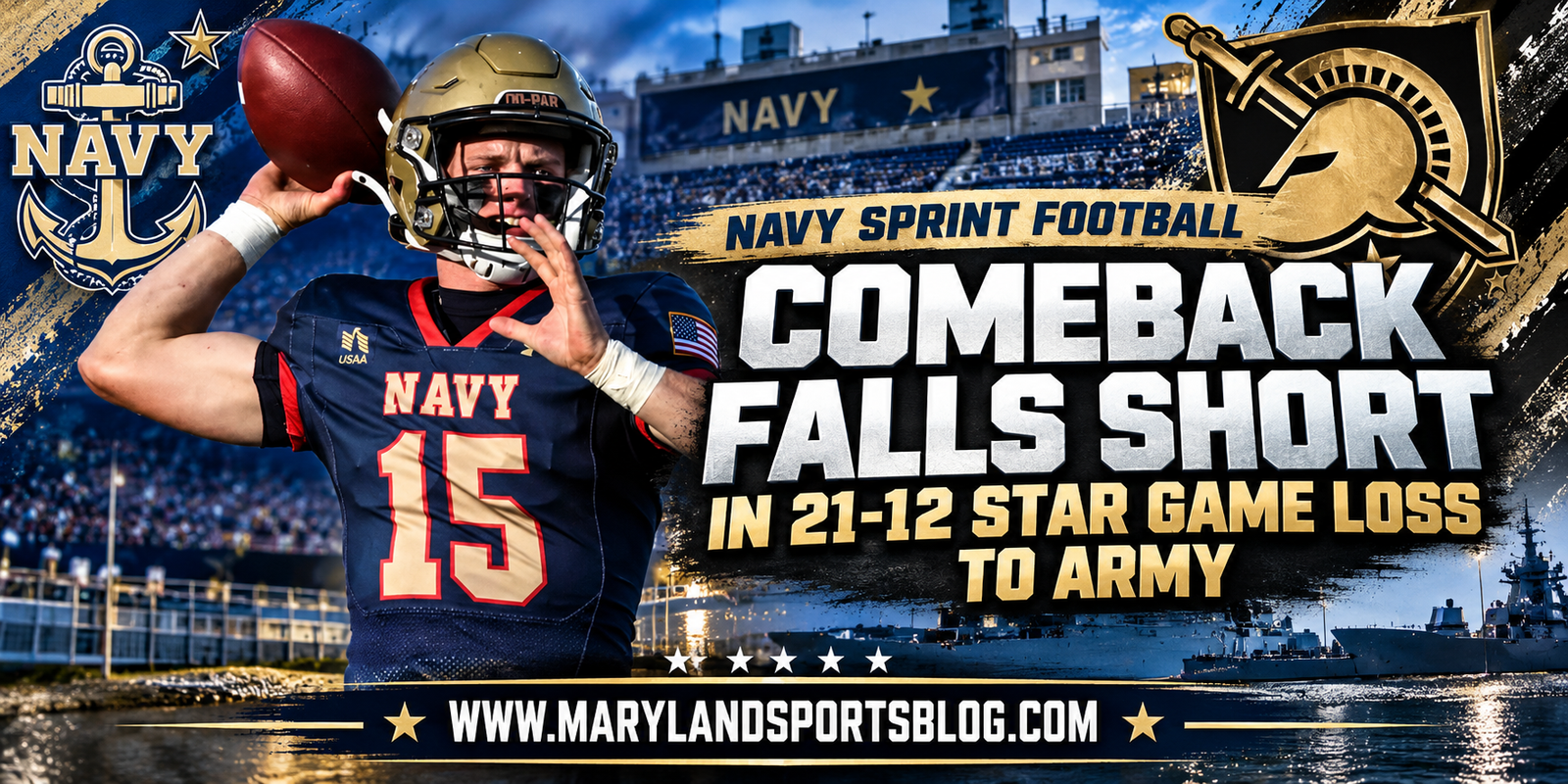
Navy Sprint Football’s Fourth-Quarter Comeback Falls Short in 21-12 Star Game Loss to Army
By Brian Hradsky
The Navy sprint football team nearly produced a dramatic fourth-quarter comeback Friday night, but an early 21-point deficit proved too much to overcome as the Midshipmen fell to Army, 21-12, in the annual Star Game at Navy-Marine Corps Memorial Stadium.
Navy entered the rivalry matchup after opening the 2026 season with an impressive 27-6 victory over Penn. The Midshipmen fell to 1-1 overall with the loss, while Army improved to 2-0 and secured the first Star victory of the 2026-27 Army-Navy Star Series.
The final score does not completely reflect how close Navy came to making things interesting in the closing minutes. Army led 21-0 early in the fourth quarter before quarterback Luke O’Connell threw two touchdown passes in less than three minutes, cutting the deficit to nine. Navy eventually got the football back in the final seconds and advanced into Army territory, but time expired before the Midshipmen could complete the comeback.
Penalties and third-down struggles ultimately hurt Navy more than a lack of production. The Midshipmen actually outgained Army 270-257, but Navy committed 10 penalties for 91 yards and converted only three of 14 third-down opportunities.
Army strikes first
The opening quarter developed into a defensive battle before Army took advantage of favorable field position late in the period.
Following a Navy punt from deep in its own territory, Army needed only three plays to cover 21 yards. JP Ross completed the short drive with a six-yard touchdown run with 3:09 remaining in the first quarter. Nicholas Cueto converted the extra point to give the Black Knights a 7-0 lead.
Navy’s offense struggled to establish consistency during the first half. The Midshipmen had difficulty staying ahead of the chains, while Army controlled possession and prevented Navy from generating the explosive plays that had helped the Mids defeat Penn one week earlier.
Army then put together its best sustained drive of the night during the second quarter.
Quarterback Kyle West and the Black Knights marched 75 yards on 14 plays while taking 7:41 off the clock. Facing fourth-and-one, West kept the football and broke through for a nine-yard touchdown run. The extra point made it 14-0 with 3:58 remaining before halftime.
That drive became particularly damaging because Army controlled nearly eight minutes of game time while keeping Navy’s offense on the sideline.
The Midshipmen did produce one of their biggest special-teams plays late in the half when Drake Murrell blocked an Army punt. Navy, however, could not turn the opportunity into points, and the Black Knights carried their 14-0 advantage into halftime.
Navy’s defense keeps the game within reach
Despite the offensive struggles, Navy’s defense prevented Army from pulling away during the third quarter.
Neither team scored during the period.
Linebacker Tucker Opdahl led an active Navy defensive effort with a game-high 12 tackles, including five solo stops. Sam Stotler and Eliot Trahan each recorded 11 tackles, while Christian Conley added 10. Trahan also registered a tackle for loss.
Senior defensive captain Mick Tabor created consistent pressure up front. Tabor finished with two sacks and 2.5 tackles for loss, providing Navy with one of its strongest individual defensive performances of the night.
Those contributions kept Navy within two scores entering the fourth quarter.
Army’s offense was not particularly explosive statistically. The Black Knights finished with only 257 total yards, including 75 rushing yards on 36 attempts. Navy’s defense held Army to just 2.1 yards per rushing attempt.
However, Army made enough plays in critical situations.
That became evident again almost immediately after the fourth quarter began.
Army takes a 21-0 lead
West delivered Army’s biggest offensive play just one minute into the fourth quarter.
The Black Knights quarterback connected with Marek Arbogast for a 45-yard touchdown pass. The scoring possession lasted only two plays and 28 seconds, and Cueto’s extra point increased Army’s advantage to 21-0 with 14 minutes remaining.
At that point, Navy faced an enormous challenge.
The Midshipmen had gone three quarters without scoring and suddenly needed three touchdowns to potentially tie the game.
Instead of folding, Navy finally found its offensive rhythm.
O’Connell sparks Navy’s comeback
O’Connell began attacking through the air as Navy increased its tempo.
The Midshipmen eventually put together their best sustained possession of the night, driving 73 yards on 12 plays. Facing third-and-goal, O’Connell found Biamungu Nkere for a four-yard touchdown with 4:13 remaining.
Army blocked the ensuing extra point, leaving Navy behind 21-6.
The Midshipmen were not finished.
Less than two minutes later, O’Connell struck again.
Navy needed only three plays and 57 seconds to move 36 yards. O’Connell found Ibi Denson for a 25-yard touchdown, suddenly cutting what had been a 21-point Army advantage to 21-12 with 2:05 remaining.
Denson emerged as O’Connell’s top target, finishing with six receptions for 68 yards and the touchdown. Nkere caught five passes for 39 yards and a score.
Andrew Daly contributed four receptions for 37 yards while also making a major impact on special teams, returning four kickoffs for 96 yards. Philip Drexler supplied Navy’s longest offensive play with a 33-yard reception.
Suddenly, Navy had life.
The Midshipmen attempted an onside kick following Denson’s touchdown, but Army recovered it. The Black Knights were able to run the clock below 30 seconds before eventually turning the football over on downs.
Navy still made one final push.
The Midshipmen advanced 25 yards into Army territory in the closing seconds, but there simply was not enough time remaining. The clock expired before Navy could reach the end zone again, securing Army’s 21-12 victory.
O’Connell delivers strong second half
Although Navy did not get the result it wanted, O’Connell’s fourth-quarter performance provided an encouraging sign for the offense.
The quarterback completed 22 of 36 passes for 208 yards and two touchdowns without throwing an interception. He also contributed 15 rushing yards.
The absence of turnovers was important.
Navy did not hand Army possessions through interceptions, but the Midshipmen repeatedly hurt themselves with penalties and unsuccessful third downs.
Hunter Gennicks led Navy on the ground with 38 yards. Overall, however, Navy managed only 62 rushing yards on 20 attempts, averaging 3.1 yards per carry.
That put considerably more responsibility on O’Connell and the passing game, particularly after Navy fell behind.
He responded.
His fourth-quarter performance gave Navy a legitimate chance to make what once appeared to be a comfortable Army victory extremely uncomfortable in the final minutes.
Penalties prove costly
The biggest frustration for Navy will likely come when reviewing its own mistakes.
Ten penalties for 91 yards represent nearly the equivalent of an additional football field of lost yardage. Navy also finished three-for-14 on third down.
Those problems prevented the Midshipmen from maintaining drives despite finishing with more total offense than Army.
Head coach Major Carter Reading, USMC, acknowledged afterward that Navy started slowly and struggled with penalties and consistency. He emphasized that those problems were correctable as the Midshipmen prepare to move forward.
That may be the most important takeaway.
Navy was not dominated statistically.
The Midshipmen outgained Army. Navy’s defense held the Black Knights to 75 rushing yards. O’Connell threw for more than 200 yards without an interception. Navy generated a blocked punt and scored twice in the fourth quarter.
The difference came in execution.
Army converted its opportunities into touchdowns, while Navy spent much of the first three quarters trying to establish offensive momentum.
Army takes the Star
The rivalry implications made the loss more painful.
Friday night’s game represented the sprint football competition in the annual Army-Navy Star Series presented by USAA. Army’s victory gave the Black Knights the first Star win of the academic year. Navy responded the following day by defeating Army 26-14 in men’s rugby, leaving the overall 2026-27 Star Series tied 1-1 through the first two competitions.
Navy continues to hold the historical advantage in sprint football’s rivalry with Army. Following Friday’s result, Navy leads the all-time sprint football series 50-42-1.
The loss also came after Navy defeated Army 20-17 in overtime at West Point on Nov. 15, 2025.
Army therefore earned a measure of revenge in Annapolis.
Navy now turns its attention to Chestnut Hill
The Midshipmen do not have much time to dwell on the rivalry loss.
Navy travels to Conshohocken, Pennsylvania, for its first road game of the season against Chestnut Hill on Saturday, Oct. 3. Kickoff is scheduled for 4 p.m.
The objective will be straightforward: carry the fourth-quarter offensive execution into the opening quarter.
Navy has already demonstrated two very different versions of itself through two games. The Midshipmen dominated Penn 27-6 in their opener, building a 27-0 lead through three quarters. Against Army, Navy found itself on the opposite side of that situation, trailing 21-0 before finally breaking through.
Finding greater consistency between those extremes will be important as CSFL play continues.
MSB Take
Navy will look back at this game knowing the opportunity was there.
The Midshipmen outgained Army 270-257, held the Black Knights to only 75 rushing yards and did not throw an interception. Normally, those numbers give a team an excellent chance to win.
But 10 penalties, a three-for-14 performance on third down and three scoreless quarters were ultimately too much to overcome.
There were still positives.
O’Connell never stopped competing and looked particularly sharp when Navy finally opened the offense in the fourth quarter. Denson and Nkere each delivered touchdown receptions, Tabor was disruptive along the defensive line, and Opdahl led a Navy defense that gave the offense opportunities to get back into the game.
Most importantly, Navy did not quit at 21-0.
The Midshipmen turned a seemingly decided game into a situation where Army still had to protect the football and finish the job in the final minutes.
Now Navy needs to take the urgency it showed during those final four minutes and bring it to Pennsylvania from the opening kickoff.
At 1-1, there remains plenty of season ahead.
But against Army, particularly with a Star on the line, this is one Navy will wish it could have back.