
Towson Athletics Mourns the Loss of Hall of Fame Wide Receiver Dale Chipps at 61
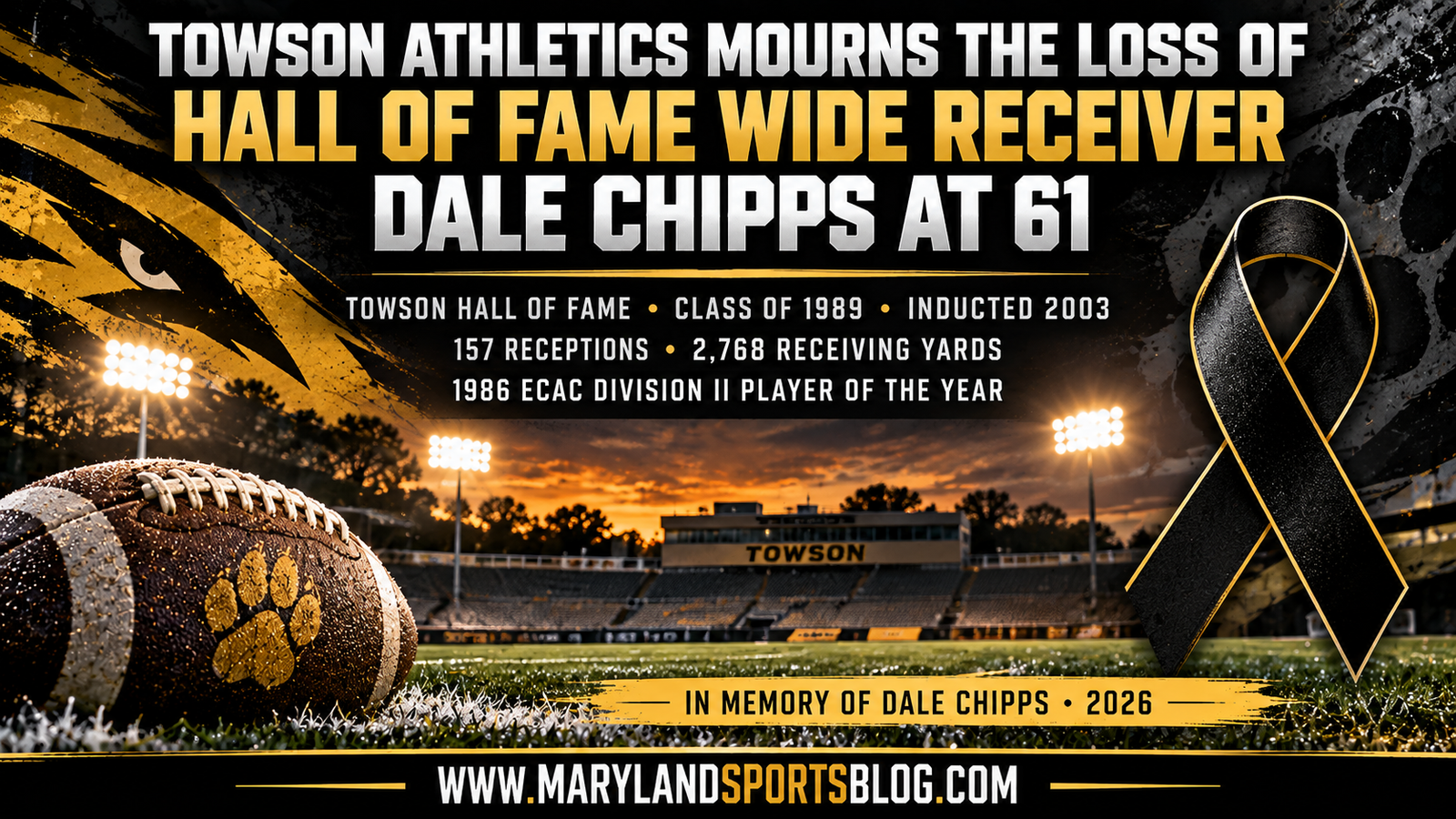
The Towson University community is mourning the loss of one of the most accomplished wide receivers in Tigers football history. Dale Chipps, a Towson Athletics Hall of Famer and former All-American receiver, died Sept. 17 at the age of 61.
Chipps became one of the premier receivers of Towson’s NCAA Division II era after originally arriving at the university as a defensive back. He developed into a record-setting offensive weapon, helped the Tigers reach the NCAA Division II postseason twice and eventually received an opportunity to continue his career in professional football.
From Defensive Back to Star Receiver
Chipps came to Towson from Gwynn Park High School in Brandywine, Maryland, and was initially recruited to play defensive back. It did not take long for the Tigers’ coaching staff to realize that his speed and ability with the football could make him even more valuable on offense.
Former Towson defensive coordinator Gordy Combs recalled that Chipps showed the speed and receiving ability necessary to make the transition to wide receiver. The move ultimately helped produce one of the most productive pass catchers in program history.
Chipps became a three-year starter and led Towson in receiving during both his sophomore and junior seasons. His combination of speed, hands and big-play ability made him a major part of the Tigers’ offense during one of the strongest periods of Towson’s Division II history.
Chipps Breaks Out in 1985
Chipps emerged as one of the best receivers in NCAA Division II football during the 1985 season. He caught 54 passes for 1,001 yards, averaging more than 18 yards per reception while ranking ninth nationally in Division II receiving.
Reaching 1,000 receiving yards was a significant accomplishment, particularly during an era when college offenses generally did not throw the football at the volume seen today. Chipps established himself as Towson’s primary downfield threat and entered the following season positioned for an even bigger year.
He delivered exactly that.
Historic 1986 Season
Chipps produced one of the greatest receiving seasons in Towson football history in 1986. He finished the year with 63 receptions for 1,135 yards and six touchdowns, establishing what was then Towson’s single-season record for receptions.
His performance earned him Associated Press honorable mention All-America recognition along with first-team All-Eastern College Athletic Conference honors. Chipps was also named the 1986 ECAC Division II Player of the Year, becoming the only Towson player from the program’s Division II era to receive conference Player of the Year honors.
Those accomplishments placed Chipps among the top players at his level of college football. They also helped establish his place among the greatest receivers to play for Towson.
Senior Season Cut Short
Chipps entered his senior season with an opportunity to add even more records to his résumé and immediately demonstrated that he remained one of Towson’s biggest offensive threats. In the Tigers’ season opener against Northeastern, Chipps caught an 82-yard touchdown pass that established a program record for the longest reception at the time.
Chipps also caught 12 passes in that game, tying Towson’s single-game record for receptions. Unfortunately, an injury later brought his final college season to a premature end and prevented him from building on his already impressive career totals.
Despite the shortened senior season, Chipps finished his Towson career with 157 receptions for 2,768 yards. His 157 receptions established a school record at the time and still rank sixth in program history, while his 2,768 receiving yards remain third on Towson’s career list.
An Important Part of Towson’s Division II Success
Chipps’ individual accomplishments came during an important period for Towson football. The Tigers reached the NCAA Division II postseason twice during his career, and Chipps became one of the primary offensive weapons on teams that helped establish Towson as a strong program at that level.
His statistics remain particularly impressive considering how college football has changed. Modern offenses generally produce considerably more passing attempts and receiving opportunities, yet Chipps remains near the top of Towson’s record book decades after his final game.
That longevity speaks to the level at which Chipps performed. He did not simply have one productive season; he put together multiple years of elite receiving production and became one of the defining offensive players of Towson’s Division II era.
Professional Football Opportunity
Chipps graduated from Towson in 1989 and received an opportunity to continue playing football professionally. He signed as a free agent with Washington’s NFL franchise and participated in training camp before being released prior to the regular season.
Although Chipps never appeared in an NFL regular-season game, reaching an NFL training camp represented another accomplishment in a career that began with him being recruited as a college defensive back. His development into a professional-caliber receiver showed how dramatically his career changed after arriving at Towson.
Years later, the university formally recognized everything Chipps accomplished as a Tiger. He was inducted into the Towson Athletics Hall of Fame in 2003, permanently placing him among the most accomplished athletes in school history.
Towson Remained an Important Part of His Life
Chipps maintained strong connections to Towson long after his playing career ended. Football remained one of his passions, and the relationships he developed with teammates and coaches continued to hold significant meaning throughout his life.
Former Towson head coach Phil Albert remained especially important to Chipps. His obituary described Albert as much more than a football coach to Chipps, who considered his former coach an important mentor and influence.
Chipps also remained connected with former teammates and members of the Towson football community. The stories and memories shared following his death reflected the relationships he developed during his playing career and maintained decades after leaving the field.
Away from football, Chipps worked in several industries during his life, including sales, mortgages and the electrical trade. Family and friends remembered him for his determination, loyalty, toughness, personality and sense of humor.
A Legacy That Remains in the Towson Record Book
More than three decades after Chipps played his final game, his name remains prominent throughout the Towson football record book. His career totals of 157 receptions and 2,768 receiving yards continue to place him among the most productive receivers in school history.
His 1986 season remains one of the defining years of his career. Recording 1,135 receiving yards, earning All-America recognition and being named ECAC Division II Player of the Year demonstrated just how dominant Chipps became at his position.
Chipps arrived at Towson as a defensive back and left as an All-American wide receiver, record holder and future professional football free-agent signing. His 2003 induction into the Towson Athletics Hall of Fame ensured that his contributions to the program would remain permanently recognized.
MSB Take
Dale Chipps’ statistics alone establish him as one of the greatest receivers in Towson football history. Producing 157 receptions and 2,768 receiving yards during the 1980s was a tremendous accomplishment, and the fact that those numbers remain near the top of Towson’s record book decades later makes them even more impressive.
His 1986 season deserves particular recognition. Chipps surpassed 1,100 receiving yards, earned All-America honors and became the ECAC Division II Player of the Year during one of the most successful periods in Towson football history.
However, the reaction from former teammates, coaches, friends and the Towson community shows that Chipps left behind much more than statistics. His relationships with the people around the program continued long after his playing career ended, and Towson remained an important part of his life.
Towson has lost a Hall of Famer, a record-setting receiver and an important member of Tigers football history. Dale Chipps was 61.