
Towson battles South Carolina before Gamecocks pull away for 45-9 victory
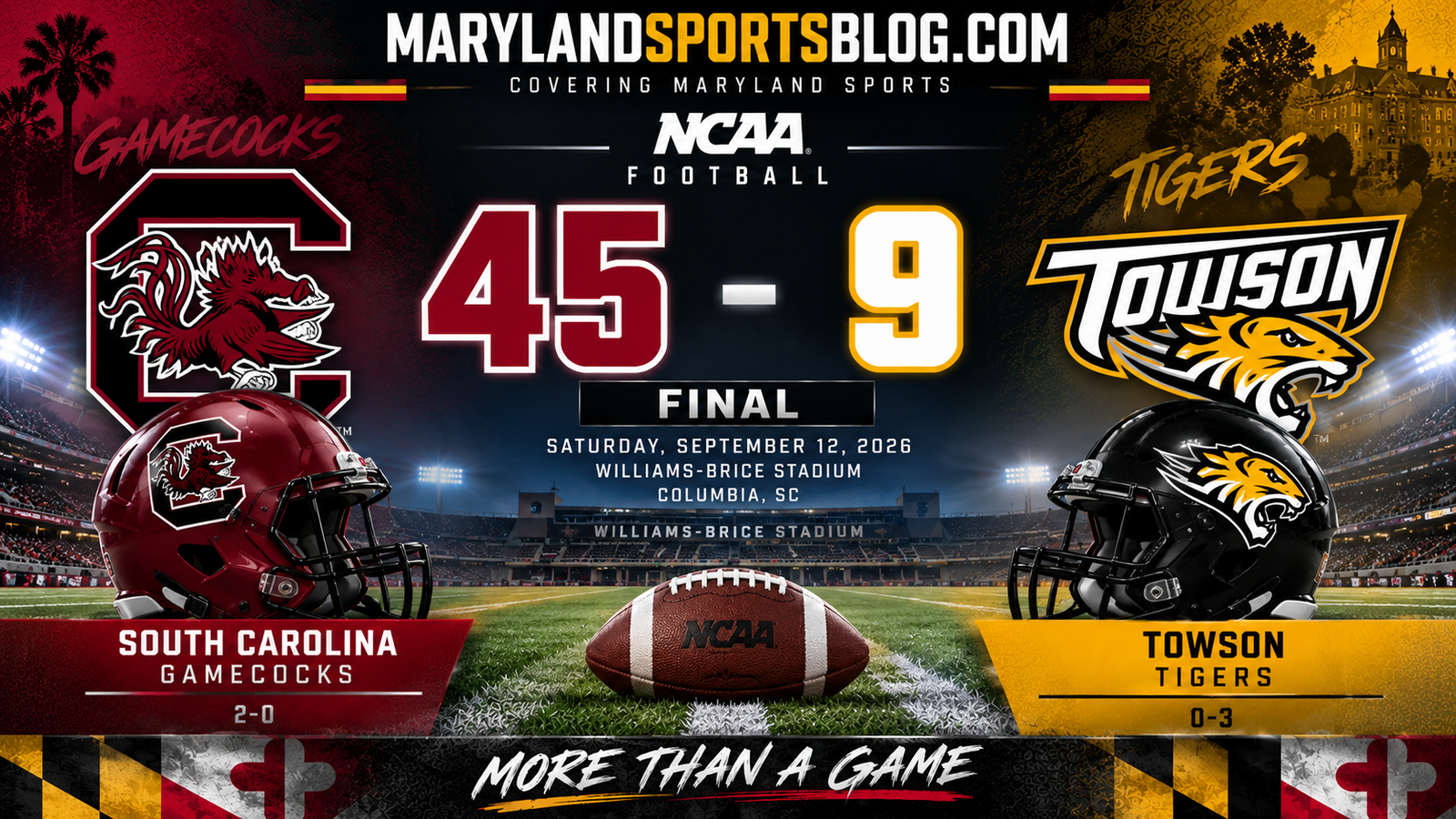
The Towson Tigers faced their second consecutive Football Bowl Subdivision opponent Saturday night and battled South Carolina before the Gamecocks pulled away for a 45-9 victory at Williams-Brice Stadium in Columbia, South Carolina.
The final score does not completely illustrate how competitive Towson managed to make portions of the game. The Tigers trailed 17-3 at halftime and pulled within 24-9 midway through the third quarter following Andrew Indorf’s touchdown pass to Aaron Enterline. Towson was still within two scores before South Carolina took control late in the third quarter and scored the game’s final 21 points.
South Carolina ultimately overwhelmed Towson with its size, speed and rushing attack. The Gamecocks accumulated 405 rushing yards while Towson managed only 21 yards on the ground, creating a massive difference in the teams’ ability to consistently move the football. Towson finished with 203 total yards, with 182 coming through the air.
The Tigers fell to 0-3 with the loss, but their opening stretch has been anything but easy. Towson opened with a 21-18 CAA loss against Maine before traveling to Annapolis and losing 42-15 against Navy. Saturday’s game represented the second consecutive FBS opponent for Towson and the first meeting in program history between the Tigers and South Carolina.
Swain immediately changes the game
Towson’s defense actually started the game well enough to give the Tigers an opportunity to settle into the difficult environment at Williams-Brice Stadium.
The problem was South Carolina did not need its offense to produce the first touchdown.
Vicari Swain returned a Towson punt 58 yards for a touchdown with 9:37 remaining in the opening quarter. Max Kelley converted the extra point, and South Carolina suddenly owned a 7-0 advantage despite the Tigers preventing the Gamecocks offense from scoring on the possession.
It became the beginning of a historic evening for Swain.
The South Carolina defensive back eventually returned another punt for a touchdown late in the third quarter, giving him five punt-return touchdowns in his career. That broke the South Carolina career record previously held by Dickie Harris, who had four between 1969 and 1971. Swain also blocked an extra point following Towson’s only touchdown, making him one of the biggest reasons South Carolina was able to create separation.
Special teams became particularly important because South Carolina’s offense was not nearly as sharp as the final score might suggest.
Towson’s defense forced the Gamecocks to work for points throughout much of the first half. South Carolina eventually put together an 11-play, 66-yard possession in the second quarter, but Towson kept the Gamecocks out of the end zone. Kelley kicked a 33-yard field goal with 12:44 remaining in the half to extend South Carolina’s lead to 10-0.
For an FCS team playing on the road against an SEC opponent, being down only 10 points deep into the second quarter represented a respectable start.
One play changes the first half
Towson’s biggest problem throughout the night was South Carolina’s ability to generate enormous plays on the ground.
That showed up with 3:44 remaining in the second quarter.
Matt Fuller found a crease in Towson’s defense and exploded for a 55-yard touchdown run. Instead of forcing South Carolina to continue grinding through another long possession, the Tigers surrendered seven points on a single snap. Kelley’s extra point increased the Gamecocks’ advantage to 17-0.
Fuller eventually finished with 125 rushing yards despite losing two fumbles. His explosiveness was part of a South Carolina rushing attack that became increasingly difficult for Towson to contain as the game progressed.
Towson did not allow the touchdown to end its first-half fight.
Indorf responded by directing one of Towson’s best possessions of the night. The Tigers marched 52 yards in eight plays and gave kicker Zaydaan Faridi an opportunity to put points on the board before halftime.
Faridi delivered.
The redshirt freshman connected on a 41-yard field goal with 1:04 remaining, cutting South Carolina’s lead to 17-3. It was an important response for a Towson offense that had struggled to consistently move the football against the Gamecocks’ defensive front.
South Carolina held a 254-81 advantage in total offense during the opening half, illustrating how difficult the matchup had been for Towson. Yet the Tigers were only down 14 points going into halftime because their defense had prevented several South Carolina opportunities from turning into touchdowns.
The Gamecocks had their own problems.
Fuller fumbled twice, Kelley missed a field-goal attempt and South Carolina quarterback LaNorris Sellers threw an interception before halftime with the Gamecocks threatening to score again. South Carolina also had receivers drop passes in the end zone, leaving head coach Shane Beamer with plenty to correct despite his team’s comfortable statistical advantage.
Sellers breaks loose
South Carolina came out of halftime determined to establish control.
It took the Gamecocks just three plays.
Sellers broke free for a 58-yard touchdown run with 12:07 remaining in the third quarter, completing a 67-yard drive that consumed only 1:06. Kelley added the extra point and South Carolina’s lead grew to 24-3.
Sellers was far more dangerous with his legs than his arm Saturday.
The veteran quarterback finished with 119 rushing yards and the touchdown while completing only 10 of 23 passes for 96 yards with an interception. It was his lowest passing-yardage total as South Carolina’s starting quarterback, but the Gamecocks did not need a dominant passing performance because of their overwhelming rushing production.
Then the game stopped.
Lightning and heavy rain forced a weather delay lasting approximately 74 minutes shortly after Sellers’ touchdown. Players and spectators waited out the storm before the teams eventually returned to the field under difficult conditions.
For Towson, the delay could have destroyed any remaining momentum.
Instead, the Tigers produced their best offensive sequence of the night.
Indorf and Enterline answer
Once play resumed, Indorf directed an 11-play scoring drive that demonstrated why the sophomore quarterback remains one of the most important pieces of Towson’s offense.
The Tigers moved 75 yards and consumed more than five minutes before Indorf found Enterline for a 23-yard touchdown with 7:03 remaining in the third quarter. The touchdown cut South Carolina’s advantage to 24-9 and briefly brought Towson back within two scores.
Swain blocked Faridi’s extra-point attempt, keeping Towson at nine points.
Still, the drive represented a significant moment for the Tigers.
Towson was playing an SEC opponent in one of college football’s more difficult road environments, had already endured a lengthy weather delay and had just surrendered a 58-yard quarterback touchdown. Instead of folding, the Tigers responded with a long touchdown drive of their own.
Indorf finished the night with 171 passing yards and one touchdown. Although South Carolina’s defense prevented Towson from establishing any meaningful rushing attack, Indorf continued competing through the air and gave the Tigers their best chance of generating offense.
Enterline once again demonstrated his value in Towson’s passing game.
He entered the matchup after already producing two touchdown receptions through Towson’s first two games, including a 48-yard touchdown against Navy. His touchdown against South Carolina gave him another scoring connection with Indorf and continued an encouraging start for a largely rebuilt Towson receiving corps.
Towson suddenly trailed 24-9 with more than a quarter remaining.
Against an SEC opponent, that was a respectable position.
Unfortunately for the Tigers, the game changed dramatically over the final 15 minutes.
Swain delivers another crushing special-teams play
Towson’s defense continued trying to keep the Tigers within striking distance, but Swain changed the game again with three seconds remaining in the third quarter.
Punting from deep in its own territory, Towson sent the football to Swain. The South Carolina returner moved left, broke through the coverage and hurdled Towson punter Owen Scheihing on his way to a 45-yard touchdown return.
The score increased South Carolina’s lead to 31-9.
More concerning than the touchdown was what happened to Scheihing.
The Towson punter was injured during the play and left the field on a cart. Towson head coach Pete Shinnick said afterward that Scheihing would be evaluated when the Tigers returned to campus and indicated that the injury appeared significant enough that his arm could require a cast.
Scheihing had entered the game as an important piece of Towson’s rebuilt special-teams unit. The Loyola Blakefield graduate averaged 44.6 yards per punt through the Tigers’ first two games and ranked second in the CAA, including three punts of at least 50 yards.
Swain’s second return touchdown effectively changed the complexion of the game.
Towson had just fought its way back to within 24-9. Instead of entering the fourth quarter down 15 and still having an outside opportunity to make things interesting, the Tigers suddenly faced a 22-point deficit.
South Carolina’s rushing attack finishes it
South Carolina’s depth took over in the fourth quarter.
Jabree Coleman scored on a three-yard run with 8:29 remaining, extending the Gamecocks’ lead to 38-9. The touchdown came at the end of a short three-play, 27-yard possession and pushed Towson into an increasingly difficult situation.
South Carolina struck again less than two minutes later.
Isaiah Augustave ripped off a 55-yard touchdown run with 6:32 remaining. The Gamecocks needed only two plays and 22 seconds to cover the 55 yards, giving them their final 45-9 advantage.
The explosive touchdown summarized Towson’s biggest defensive problem.
South Carolina did not simply run the football effectively. The Gamecocks repeatedly generated chunk plays that immediately changed the game.
Fuller scored from 55 yards.
Sellers scored from 58.
Augustave scored from 55.
Those three plays alone accounted for 168 rushing yards and three touchdowns.
South Carolina eventually finished with 405 rushing yards. Fuller led the Gamecocks’ running backs with 125 yards, while Sellers contributed 119 on the ground. Towson’s defense was forced to defend an SEC offensive line and a collection of explosive runners for four quarters, and the physical difference became increasingly apparent late in the game.
Towson’s offense could not establish the run
Towson’s inability to run the football created another major problem.
The Tigers finished with only 21 rushing yards.
That made Towson almost completely dependent on Indorf and the passing game to generate offense. Against South Carolina’s speed and defensive talent, becoming one-dimensional made sustaining drives exceptionally difficult.
Towson finished with 203 total yards compared with South Carolina’s overwhelming production on the ground.
Indorf still found ways to produce 171 passing yards and the touchdown to Enterline, but the Tigers needed more balance to consistently threaten the Gamecocks. South Carolina could pressure the quarterback without worrying about Towson controlling the game between the tackles.
The matchup also highlighted just how young and inexperienced this Towson roster remains.
Towson entered the season returning only three starters among its combined 22 offensive and defensive starting positions from 2025: Indorf and offensive linemen KJ Brooks and Joden Nelson. The Tigers essentially rebuilt most of their starting lineup while simultaneously facing one of the most difficult early-season schedules an FCS program could reasonably assemble.
An unforgiving opening schedule
Towson’s 0-3 record requires context.
The Tigers opened against CAA opponent Maine before facing Navy and South Carolina in consecutive weeks.
Playing two FBS opponents in the same season is extremely unusual for Towson. The only previous season in which the Tigers played two FBS teams was 2012, when they faced Kent State and LSU. Towson has consistently challenged itself against FBS competition, playing at least one such opponent every fall season since 2008 outside of the pandemic-altered 2020 campaign.
Saturday also represented Towson’s third game against an SEC opponent.
The Tigers lost 38-22 at LSU in 2012 and 38-0 at Florida in 2019 before Saturday’s first-ever meeting with South Carolina.
Towson has demonstrated in the past that it can beat an FBS opponent. The most famous example came in 2013 when the Tigers defeated Connecticut 33-18 during the season that ultimately ended with Towson reaching the FCS national championship game.
South Carolina, however, presented a considerably different challenge.
The Gamecocks entered Saturday after destroying Kent State 57-0 in their opener. They improved to 2-0 and have now started 2-0 in three consecutive seasons.
Towson finally returns home
The Tigers can now leave their brutal two-game FBS road stretch behind them.
Towson returns to Johnny Unitas Stadium on Saturday, Sept. 19, for the Battle for Greater Baltimore against Morgan State.
That matchup suddenly becomes one of the most important games on Towson’s early schedule.
Morgan State enters the contest with momentum after destroying Virginia University of Lynchburg 55-0 Saturday. Towson, meanwhile, desperately needs its first victory after opening 0-3.
Recent history strongly favors the Tigers.
Towson defeated Morgan State 27-22 last season when John Dunmore caught an 18-yard touchdown pass with 24 seconds remaining. The Tigers have won eight consecutive games against Morgan State dating to 2011 and hold a 24-6 advantage in the all-time series. Morgan State’s last victory over Towson came in 2009.
The Sept. 19 game will also represent a dramatic change in competition for Towson.
After facing Navy and South Carolina on the road, the Tigers return to the FCS level and their home stadium. That should provide a much clearer evaluation of what Shinnick’s young team can become during the remainder of the season.
MSB Take
A 45-9 loss never looks good on paper, but this was not a game Towson was realistically expected to win. South Carolina is an SEC program with superior size, speed and depth, and Towson was playing its second FBS opponent in eight days. The Tigers were always facing an enormous challenge.
There were nevertheless some legitimate positives. Towson was down only 17-3 at halftime and responded to South Carolina’s quick third-quarter touchdown with an impressive 75-yard scoring drive. At 24-9, Towson was still hanging around deep enough into the game to force South Carolina to continue playing meaningful football.
The two punt-return touchdowns were killers. Take those 14 points off the board and the game looks substantially different for much longer. Towson’s offense and defense were already dealing with a major talent disadvantage, and surrendering two special-teams touchdowns eliminated almost any margin for error.
The 21 rushing yards are a much bigger concern going forward. Towson does not need to run for 200 yards every week, especially with a quarterback as talented as Indorf, but the Tigers have to establish enough of a running game to keep defenses honest. Asking Indorf to carry the offense almost entirely through the air is not a sustainable formula once CAA play resumes.
Indorf continues to give Towson something to build around. He was the CAA Co-Offensive Rookie of the Year as a true freshman in 2025 after throwing for 2,344 yards and 16 touchdowns against only four interceptions. His connection with Enterline has become another encouraging development early this season.
The biggest concern coming out of Columbia may actually be Scheihing’s health. Towson’s young punter had been performing well through the opening weeks, and losing him for any significant amount of time would create another challenge for a special-teams unit already replacing several important players from last season.
Now the season essentially resets.
Towson is 0-3, but two of those losses came against Navy and South Carolina. Nobody should judge an FCS team’s potential solely on what happens during consecutive road games against FBS programs.
Morgan State is different.
Saturday’s Battle for Greater Baltimore is an FCS game, a home game and a rivalry game. Morgan State arrives at 2-1 after scoring 55 points this weekend, while Towson returns home looking for its first victory.
For the first time since the opener, Towson will be playing an opponent on a much more comparable level. That makes Sept. 19 the game where the Tigers need to start showing exactly what this rebuilt 2026 team can be.