
Orioles’ Top Prospect Rankings Look Completely Different After Draft, Trade Deadline Shakeup
The Baltimore Orioles’ farm system has undergone a remarkable transformation in only a few months.
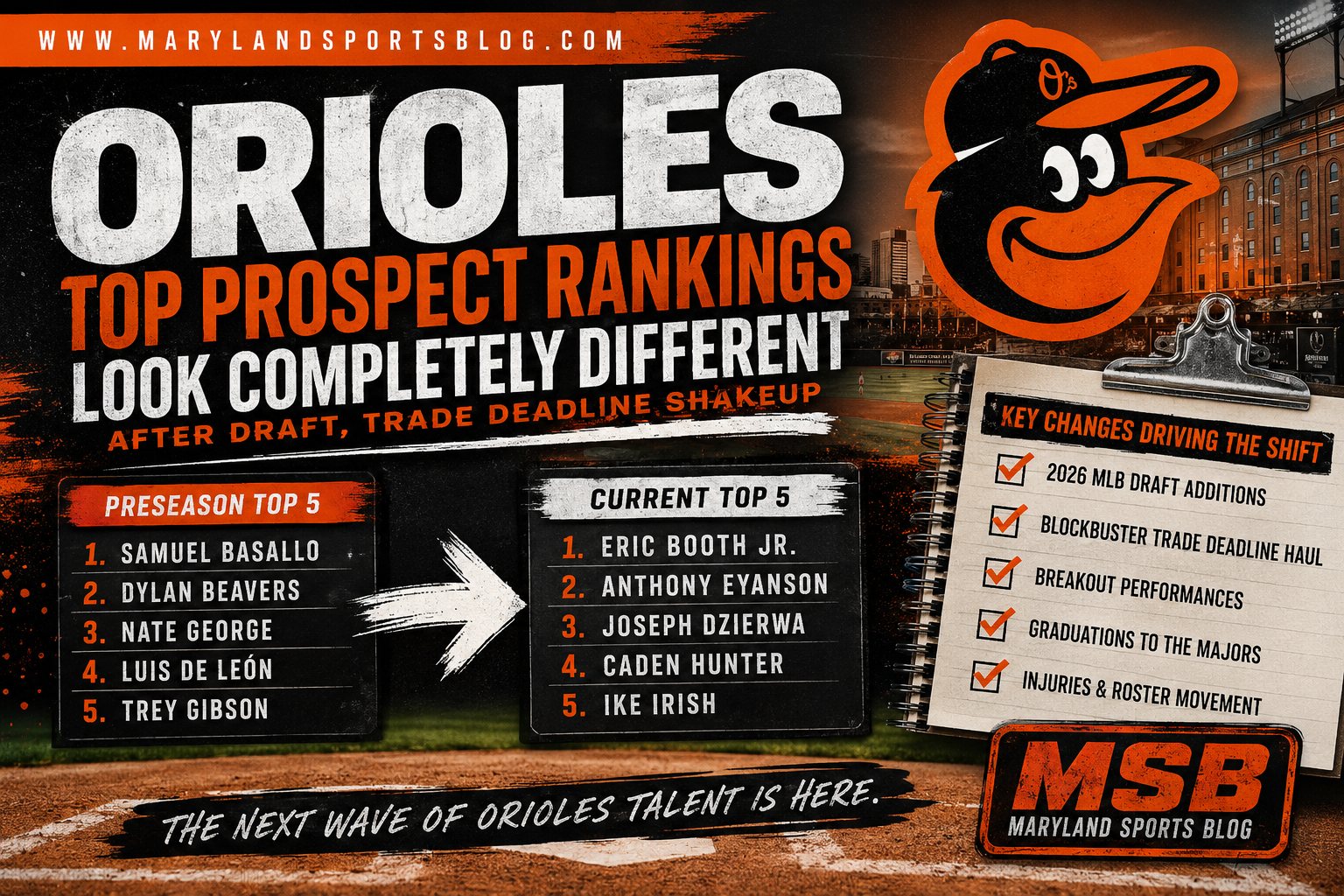
When MLB Pipeline released its preseason Orioles Top 30 in March, Samuel Basallo, Dylan Beavers and Nate George occupied the first three spots. Luis De León and Trey Gibson rounded out the top five.
Fast forward to mid-August and almost everything has changed.
Graduations, injuries, breakout seasons, the 2026 MLB Draft and Baltimore’s aggressive trade deadline have reshaped the organization. MLB Pipeline’s current Orioles prospect page lists 2026 first-round selection Eric Booth Jr. as Baltimore’s No. 1 prospect, followed by newly acquired pitcher Anthony Eyanson, Joseph Dzierwa, Caden Hunter and Ike Irish.
That means not one member of Baltimore’s preseason top five remains in the current top five.
It is one of the most dramatic prospect-list changes the Orioles have experienced during the Mike Elias era.
Orioles’ preseason top five
MLB Pipeline’s March 2 rankings looked like this:
- Samuel Basallo, C/1B
- Dylan Beavers, OF
- Nate George, OF
- Luis De León, LHP
- Trey Gibson, RHP
Basallo was MLB Pipeline’s No. 8 overall prospect, Beavers ranked No. 69 and George entered the season at No. 93. George’s rise was especially noteworthy because the former 16th-round selection had not even been ranked entering 2025.
Baltimore’s system was already beginning to become more pitching-heavy. MLB Pipeline noted in March that 10 of the organization’s top 20 prospects were pitchers, including De León and Gibson in the top five.
That trend has accelerated considerably.
Eric Booth Jr. takes over at No. 1
Baltimore used the seventh overall selection in July’s MLB Draft on Mississippi high school outfielder Eric Booth Jr., and he has immediately become the centerpiece of the Orioles’ next wave of position players.
MLB Pipeline ranked Booth as the No. 6 overall prospect available in the 2026 Draft and the top outfielder in the class. His athleticism is his calling card, with Pipeline giving his running ability a 70 grade on the traditional 20-80 scouting scale.
Booth hit .441 with a .612 on-base percentage and .803 slugging percentage during his high school career at Oak Grove. He received the third-largest signing bonus in Orioles history, trailing only Jackson Holliday and Adley Rutschman.
He is only 18 years old, so this is a long-term investment rather than someone Baltimore expects to see at Camden Yards next season. MLB Pipeline currently gives him a 2030 estimated arrival.
Still, his placement at No. 1 says plenty about the ceiling Baltimore believes it added with the seventh pick.
Anthony Eyanson changes the pitching outlook
The biggest deadline addition was right-hander Anthony Eyanson, acquired from the Boston Red Sox in the blockbuster deal that sent Adley Rutschman and Jake Rogers to Boston.
At the time of the trade, Eyanson ranked No. 49 on MLB Pipeline’s overall Top 100 and was Boston’s No. 2 prospect. Baltimore also received right-hander Kyson Witherspoon, outfielder Enddy Azocar, catcher Carlos Narváez and a player to be named later.
Eyanson was having one of the best breakout seasons of any pitching prospect in baseball before the trade.
He posted a 1.32 ERA with 94 strikeouts in 68 1/3 innings between High-A and Double-A in Boston’s organization. MLB Pipeline highlighted his slider, curveball and developing splitter along with a fastball capable of reaching triple digits.
His first outing for Double-A Chesapeake showed why the Orioles valued him so highly.
Eyanson struck out nine over five innings in Chesapeake’s 5-2 victory over Harrisburg. He generated 16 swings and misses while allowing four hits and two runs.
It would not be surprising if Eyanson becomes a serious candidate for Baltimore’s rotation sometime in 2027.
More importantly, the Orioles suddenly have the type of high-end pitching prospect their system has often lacked.
Joseph Dzierwa has become one of Baltimore’s biggest development victories
Perhaps nobody already in the Orioles organization has improved his stock more than Joseph Dzierwa.
The 2025 second-round selection has rapidly climbed through Baltimore’s system and into the organization’s upper tier.
Dzierwa currently owns a 2.01 ERA with 132 strikeouts, a 0.86 WHIP and a .173 batting average against across two levels. Those numbers lead qualified Orioles minor-league pitchers in ERA, strikeouts, WHIP, opponent average and OPS allowed.
The 6-foot-8 left-hander has been especially dominant recently.
Dzierwa extended his scoreless streak to 17 innings Wednesday, throwing six shutout innings for Chesapeake while allowing one hit and striking out seven. Since July 1, his 36 strikeouts rank second in the Orioles organization.
Opposing hitters have managed just a .457 OPS over his last seven starts.
That is no longer simply an interesting developmental story.
Dzierwa is becoming a legitimate major-league rotation prospect.
Caden Hunter goes from unranked to elite Orioles prospect
The other enormous riser is left-hander Caden Hunter.
Hunter did not even appear on Baltimore’s preseason Top 30.
Now he sits near the very top.
The Orioles selected Hunter in the sixth round of the 2025 Draft after he pitched at USC, but his stuff has taken a significant step forward as a professional.
Hunter opened 2026 at Single-A Delmarva and posted a 1.17 ERA with 40 strikeouts in 23 innings. After a promotion to High-A Frederick, he recorded a 1.60 ERA across his first 10 appearances there.
His strikeout rate has been among the best anywhere in professional baseball.
At the time MLB Pipeline highlighted Hunter’s rise, 38.1 percent of the plate appearances against him had ended in strikeouts, third among qualifying minor-league pitchers. His 2.66 FIP ranked second.
Baltimore has also helped Hunter add velocity. His fastball, which generally sat in the low 90s at USC, has reached 97 mph as a professional.
He has since advanced to Double-A Chesapeake.
Hunter may be the most important development story in the entire organization because he represents exactly what Baltimore has struggled to consistently produce: an internally developed starting pitcher with legitimate swing-and-miss stuff.
Ike Irish continues to hit
While the system is increasingly pitching-oriented, Ike Irish remains one of Baltimore’s better offensive prospects.
The 2025 first-round selection has continued to demonstrate why Baltimore valued his left-handed bat.
During a monster July performance, Irish went 4-for-7 with two home runs and six RBIs. That performance gave him 15 home runs and raised his season slash line to .279/.383/.511 at the time.
Baltimore has also experimented with Irish defensively. Originally drafted as a catcher, he has spent significant time at first base and in the outfield, allowing the organization to prioritize his bat.
The Orioles already have considerable organizational catching depth, so Irish’s offensive development remains more important than determining one permanent position right now.
Nate George’s season takes unfortunate turn
George entered 2026 as one of the most exciting prospects in the organization.
After hitting .337 with an .896 OPS and stealing 50 bases across three levels in 2025, he climbed all the way from outside the rankings to Baltimore’s No. 3 prospect during the preseason.
His 2026 performance was still solid.
George hit .293 with a .372 on-base percentage, 15 stolen bases and a .738 OPS in 82 at-bats for Frederick.
But his season was derailed by injury.
Frederick placed George on the injured list May 7 and transferred him to the 60-day injured list July 8.
That has prevented him from continuing the rapid ascent that made him Baltimore’s No. 1 prospect following the graduations of Basallo and Beavers.
George remains an important part of Baltimore’s future, but the combination of his absence, Booth’s arrival and several pitching breakouts has dramatically reshuffled the organization around him.
Trade deadline injects even more pitching
Eyanson was not Baltimore’s only significant deadline acquisition.
The Orioles also acquired Kyson Witherspoon from Boston in the Rutschman trade. The No. 15 overall pick in the 2025 Draft entered that season as a Top 100 prospect before struggling somewhat during his first full professional season.
In his Orioles organizational debut, Witherspoon allowed one unearned run over 4 1/3 innings for Frederick. He generated 13 swings and misses, although five walks showed there is still command work to be done.
Baltimore also reacquired right-hander Michael Forret from Tampa Bay in exchange for Tyler Wells.
That is an interesting transaction because Baltimore had traded Forret to Tampa Bay during the offseason as part of its deal for Shane Baz.
Forret returned to Baltimore after producing a 3.29 ERA with 102 strikeouts in 93 innings between Double-A and Triple-A. MLB Pipeline described him as a potential future No. 4 starter with a deep arsenal containing at least six pitches.
The Rutschman trade also brought 19-year-old outfielder Enddy Azocar, another player who immediately moved into the upper tier of Baltimore’s system.
Overall, MLB Pipeline counted eight prospects acquired by the Orioles around the deadline, five of whom entered Baltimore’s Top 30.
That is a massive injection of talent.
A farm system that looks completely different
The most striking part of Baltimore’s updated rankings is not simply that the names changed.
The makeup of the organization changed.
For years, Baltimore’s farm system was defined by position players. Rutschman, Gunnar Henderson, Jordan Westburg, Colton Cowser, Heston Kjerstad, Jackson Holliday, Coby Mayo, Basallo and Beavers all came through an organization that became exceptionally good at identifying and developing hitters.
Pitching was another matter.
That may finally be changing.
Eyanson gives Baltimore a legitimate Top 100 pitching prospect.
Dzierwa has dominated in his first professional season.
Hunter has made one of the biggest jumps of any pitcher in the minors.
Witherspoon remains a first-round talent with considerable upside.
Forret is already approaching the upper minors.
Then there are pitchers such as Boston Bateman, Luis De León and Trey Gibson throughout the system.
It is a much different collection of talent than Baltimore had even six months ago.
The graduations matter too
The rankings should not be interpreted as evidence that the system declined simply because Basallo and Beavers disappeared from the top.
Both graduated into Baltimore’s major-league picture.
That is the purpose of a farm system.
It also means the Orioles have effectively replaced two elite prospects at the top with an entirely new group consisting of draft picks, breakout players and deadline acquisitions.
Baltimore went from Basallo-Beavers-George-De León-Gibson in March to a group now headlined by Booth, Eyanson, Dzierwa, Hunter and Irish.
That is extraordinary turnover in less than half a season.
MSB Take
There are plenty of reasons for Orioles fans to be frustrated with how the 2026 trade deadline unfolded.
Trading Adley Rutschman to an American League East rival was always going to be controversial, regardless of the return.
However, separating that debate from the quality of the prospects Baltimore acquired, it is difficult to argue that the Orioles did not substantially strengthen their farm system.
Eyanson immediately gives Baltimore one of the better pitching prospects it has possessed during the Elias era. Witherspoon carries first-round upside. Forret provides another legitimate starting option, while Azocar adds another talented young position player.
Combine those additions with Booth, Dzierwa and Hunter, and Baltimore suddenly has another wave forming underneath the major-league roster.
What makes this wave different is the pitching.
The Orioles do not need another farm system containing 15 exciting hitters and almost no viable starting pitching. They need arms capable of eventually pitching meaningful innings at Camden Yards.
For the first time in a while, Baltimore appears to have several of them developing simultaneously.
The names atop the prospect rankings may look almost unrecognizable compared with Opening Day.
That might actually be the most encouraging thing about the Orioles’ farm system right now.
Sources: MLB Pipeline, MLB.com, MiLB.com, Baltimore Orioles, Chesapeake Baysox.