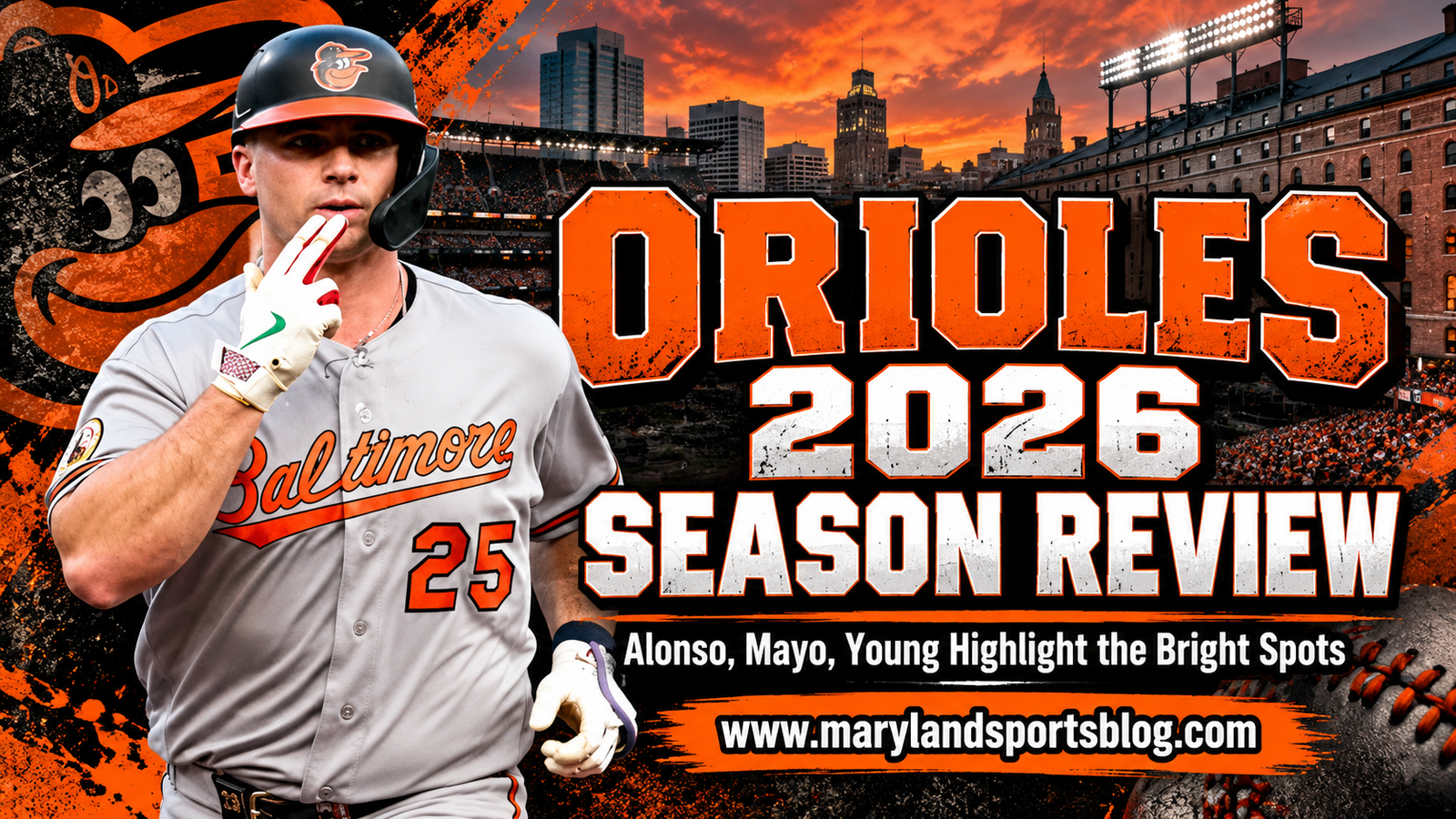
Orioles Finish 2026 at 79-82: Pete Alonso, Coby Mayo and Young Core Provide Bright Spots in Disappointing Season
By Brian Hradsky
The Baltimore Orioles’ 2026 season officially ended without a Game 162.
Baltimore’s scheduled regular-season finale against the New York Yankees at Yankee Stadium was canceled Sunday because of sustained inclement weather associated with the nor’easter affecting the region. Major League Baseball determined the game would not be rescheduled, leaving the Orioles with a 79-82 record over 161 games.
It was a strange ending to what became another frustrating season for Baltimore. The Orioles entered the year hoping to return to postseason contention, but injuries, inconsistency and disappointing performances from several important players prevented them from taking the next step. Baltimore was eliminated from postseason contention before the final weekend and finished with a losing record for the second consecutive season.
Still, 2026 was not without encouraging developments.
Pete Alonso immediately became the centerpiece of Baltimore’s offense and produced one of the better power seasons in franchise history. Coby Mayo finally began translating his enormous raw power into major-league production. Brandon Young established himself as a legitimate starting pitcher, while several other players provided reasons to believe the Orioles still have enough talent to rebound in 2027.
The Orioles now enter an important offseason with plenty of questions, but also considerably more information about which players should be part of their future.
Pete Alonso Was Everything the Orioles Hoped For
Baltimore signed Alonso to a five-year, $155 million contract during the offseason because the lineup desperately needed a dependable middle-of-the-order power hitter.
Alonso delivered.
The 31-year-old first baseman finished his first Orioles season batting .267 with 43 home runs, 113 RBIs, 100 runs, 161 hits and an .885 OPS. He played in all 161 Orioles games and led Baltimore in virtually every significant offensive category.
Alonso’s 43 home runs placed him among some of the biggest power seasons in Orioles history. Earlier in September, he became only the ninth different Baltimore hitter to produce a 40-home-run season. That put Alonso in a group that includes Chris Davis, Brady Anderson, Frank Robinson, Mark Trumbo, Jim Gentile, Anthony Santander, Rafael Palmeiro and Nelson Cruz.
His run production was even more historically significant.
Alonso’s 113 RBIs led the American League. Having previously led the National League with 131 RBIs for the New York Mets in 2022, Alonso became the first player in MLB history to have separate seasons leading each league in RBIs.
There was little question who Baltimore’s best player was.
Local media members unanimously selected Alonso as the 2026 Most Valuable Oriole, making him the Orioles’ first unanimous MVO winner since Cedric Mullins in 2021.
More importantly, Alonso provided something Baltimore had lacked: stability.
He was in the lineup every day. He hit in the middle of the order every day. Opposing pitchers had to account for him every day.
In a season in which injuries constantly forced Baltimore to shuffle its lineup, Alonso became the one piece manager Craig Albernaz could consistently build around.
His contract looked like a major gamble when Baltimore committed $155 million to a power-hitting first baseman entering his 30s. After Year 1, however, Alonso has given the Orioles exactly what they paid for.
Coby Mayo Finally Started Showing His Power
Perhaps no development outside Alonso’s season was more encouraging than Coby Mayo beginning to establish himself as a major-league power hitter.
Mayo finished the season batting .228 with 24 home runs, 63 RBIs, 18 doubles, three triples and a .758 OPS over 132 games.
The batting average and strikeout numbers show Mayo remains a work in progress. He struck out 138 times in 412 at-bats, and his .297 on-base percentage needs improvement.
But the power is real.
After struggling to establish himself during his first opportunities in the majors, Mayo finally showed why he spent years ranked among Baltimore’s most intriguing prospects. Twenty-four home runs in 412 at-bats is legitimate major-league power production, particularly from a player who does not turn 25 until December.
Mayo also gives the Orioles flexibility heading into 2027. Alonso is locked in at first base, meaning Mayo can receive regular opportunities at third base or designated hitter depending on how Baltimore constructs the roster.
There will still be growing pains.
The next step is improving his plate discipline, making more consistent contact and becoming less vulnerable to major-league pitching adjustments. But Baltimore can enter the offseason viewing Mayo differently than it did a year ago.
He is no longer simply a prospect with power potential.
Mayo demonstrated that he can hit major-league pitching out of the ballpark.
Brandon Young Emerges in the Rotation
Brandon Young was another significant bright spot.
Baltimore entered the year needing young starting pitchers to establish themselves alongside the more experienced members of its rotation. Young answered that challenge and became one of the Orioles’ most dependable starting options.
He made at least 27 starts, joining Shane Baz, Kyle Bradish and Trevor Rogers among the Baltimore starters who provided substantial innings during the season.
Young’s progress became increasingly noticeable as the season continued. Even when Baltimore’s offense struggled to provide support, he gave the Orioles opportunities to win.
One example came against Milwaukee late in September. Young delivered an impressive start, but Baltimore was shut out 3-0 as its offense extended a scoreless streak to 19 innings.
For a franchise that has spent years searching for sustainable starting pitching, Young’s emergence matters.
The Orioles do not need every young pitcher to develop into an ace. They need pitchers capable of taking the baseball every fifth day, working deep enough into games and keeping the club competitive.
Young showed signs that he can become one of those pitchers.
That gives Baltimore another internal rotation option heading into 2027 and reduces some of the pressure on the front office to completely rebuild the pitching staff through free agency and trades.
Colton Cowser Took Another Step
Colton Cowser also deserves recognition for his 2026 season.
Cowser became one of Baltimore’s most dependable defensive players and showed that he can handle center field on a regular basis. His athleticism became particularly valuable for a club that dealt with constant injuries elsewhere on the roster.
One of the season’s defining defensive moments came Aug. 31 in Colorado, when Cowser made a game-saving catch that helped Baltimore reach .500. Unfortunately for the Orioles, they proceeded to lose their next six games.
Cowser still has offensive questions to answer, particularly against left-handed pitching, but his defense and durability gave Baltimore stability at an important position.
The Orioles need to determine whether Cowser can become an everyday center fielder offensively or whether he is better used in a matchup-oriented role.
Either way, his defensive value gives him a significant role moving forward.
Samuel Basallo Showed More of His Potential
Samuel Basallo’s season did not end the way anyone wanted.
The young catcher finished at .222 with 18 home runs and 54 RBIs in 112 games before his season ended following a concussion.
Those numbers do not jump off the page, but context matters.
Basallo remains one of the youngest important players in Baltimore’s organization and continued gaining experience against major-league pitching. Eighteen home runs over 360 at-bats illustrates the type of offensive ceiling Baltimore believes he possesses.
There were also growing pains.
Basallo struggled during the second half, and his development behind the plate remains important. However, young catchers rarely develop in a straight line, particularly those being asked to handle major-league pitching staffs while simultaneously adjusting offensively.
Baltimore should remain patient.
A future lineup containing Alonso, Mayo and Basallo has enormous raw power potential.
Gunnar Henderson Had a Down Year by His Standards
One of Baltimore’s biggest disappointments was Gunnar Henderson.
Henderson played 158 games but finished at .226 with 24 home runs, 60 RBIs and a .715 OPS.
Those would be respectable numbers for many major-league shortstops.
They are not the numbers Baltimore has come to expect from Henderson.
Henderson remains one of the Orioles’ most important players, but Baltimore needs his offense to return to an elite level. Alonso cannot carry the middle of the lineup by himself, and Henderson possesses the talent to form one of baseball’s more dangerous combinations with Alonso.
A bounce-back season from Henderson would dramatically change the complexion of Baltimore’s lineup.
Injuries Changed Everything
It is impossible to properly evaluate Baltimore’s 2026 season without discussing injuries.
Jordan Westburg never got an opportunity to establish himself before undergoing Tommy John surgery in May. Ryan Mountcastle appeared in only eight games because of a broken foot and later an oblique injury. Tyler O’Neill managed only 85 games and missed the final portion of the season with a right shoulder injury.
Jackson Holliday dealt with a left wrist problem that ultimately required surgery. Basallo’s season ended because of a concussion. Bradish finished the season on the injured list with a sports hernia.
Zach Eflin’s season lasted only into the fourth inning of his first start before an injury eventually led to Tommy John surgery.
The bullpen was hit hard as well.
Ryan Helsley pitched in only 17 games. Félix Bautista finally returned late in the year following major shoulder surgery but made only two appearances.
Injuries do not completely excuse a 79-82 season.
Every organization deals with them.
But Baltimore rarely had the roster it envisioned during the offseason, and the sheer number of significant injuries made establishing continuity extremely difficult.
Shane Baz and Trevor Rogers Added Rotation Stability
Young was not the only positive development among Baltimore’s starting pitchers.
Shane Baz and Trevor Rogers also provided innings and helped prevent the rotation from completely unraveling. Both reached at least 27 starts, something that became particularly important after Eflin went down almost immediately.
Baltimore’s rotation might not have an obvious traditional ace heading into the offseason, but there are pieces.
Baz, Rogers, Young and Bradish give the organization several legitimate starting options when healthy.
The question is whether the Orioles will finally add a top-of-the-rotation starter capable of pushing everyone else down one spot.
The Bullpen Found Unexpected Contributors
The injuries to Bautista and Helsley could have completely destroyed Baltimore’s bullpen.
Instead, the Orioles found useful pitching in unexpected places.
Rico Garcia emerged as one of the players who helped stabilize the relief corps and even received votes in Most Valuable Oriole balloting.
That does not mean Baltimore’s bullpen is finished.
The Orioles need to know what they can realistically expect from Bautista following major shoulder surgery, and Helsley’s health will be another important consideration.
But finding effective relief pitchers from outside the most obvious names is exactly what good organizations must continue doing.
A Roster That Constantly Changed
Perhaps the best statistic illustrating Baltimore’s season is 60.
The Orioles used 60 players during 2026. Only eight players from the Opening Day roster remained continuously with the major-league club: Alonso, Henderson, Mayo, Cowser, Leody Taveras, Baz and Garcia were among that small group.
That is an extraordinary amount of turnover.
It also explains why the Orioles often looked like completely different teams from one month to another.
Players were injured. Others were promoted. Some were sent down. New pitchers arrived. Roles constantly changed.
For Albernaz, his first season managing Baltimore became less about operating the roster envisioned during spring training and more about adapting to whichever players were available.
The Orioles Were Better Than 2025 — But Not Good Enough
Baltimore’s final record of 79-82 represents improvement, but that cannot be the organization’s standard.
The Orioles were not rebuilding in 2026.
They signed Alonso to a $155 million contract because they expected to compete. They had Henderson, Holliday, Mayo, Basallo, Cowser and other young players either established in the majors or approaching that level.
Instead, Baltimore will watch the postseason from home again.
The Orioles finished fourth in the American League East, behind the Tampa Bay Rays, New York Yankees and Boston Red Sox.
That is the reality Mike Elias and the baseball operations department must address this winter.
The Final Weekend Was a Strange Ending
Baltimore’s season ended in unusual fashion.
The Orioles and Yankees moved Saturday’s scheduled game into a Friday doubleheader because of the approaching storm. Baltimore won the opener 10-2 before losing the nightcap 6-3.
Sunday’s finale was originally scheduled for 3:20 p.m. before being moved to 1:05 p.m. in an attempt to beat the weather.
It did not work.
After a delay of nearly three hours, the game was canceled. With Baltimore eliminated and New York already locked into its postseason position, MLB determined there was no reason to reschedule it.
The Orioles therefore officially finished 79-82 after 161 games.
It was Baltimore’s first 161-game season since 2008, when weather also prevented the Orioles from completing their full schedule.
What Baltimore Has to Build Around
For all the disappointment, the Orioles are not starting over.
Alonso is under contract and just hit 43 home runs.
Mayo hit 24.
Basallo hit 18 despite playing only 112 games.
Henderson still hit 24 during what qualifies as a disappointing season by his standards.
Cowser gives Baltimore premium outfield defense. Young showed he belongs in a major-league rotation. Baz, Rogers and Bradish give the Orioles additional starting pitching options.
There is a foundation here.
The problem is that Baltimore has reached the point where having a talented foundation is no longer enough.
The Orioles need results.
MSB Take
The 2026 Orioles were disappointing, but this season was not a complete disaster.
Pete Alonso was outstanding. Baltimore finally spent major money on a legitimate middle-of-the-order hitter, and Alonso responded with 43 home runs, 113 RBIs and one of the best power seasons by an Oriole in years.
Coby Mayo might be the most encouraging development for the future. The batting average needs to improve and the strikeouts need to come down, but 24 home runs in 412 at-bats from a 24-year-old should have Orioles fans excited. The power Baltimore spent years hearing about finally appeared consistently at the major-league level.
Brandon Young belongs in that conversation as well. Baltimore desperately needs to develop its own starting pitching, and Young showed enough this season to enter 2027 with a legitimate opportunity to remain in the rotation.
There were other positives. Cowser continued developing. Basallo flashed his power. Baz and Rogers provided innings. The bullpen uncovered some useful arms.
But 79-82 is still 79-82.
The Orioles cannot enter another offseason talking only about potential.
Alonso is 31 years old and coming off a 43-home-run season. Henderson is already an established major-league player. Mayo, Basallo and Cowser are no longer distant prospects. Baltimore should be attempting to win while this group is together.
That means adding pitching, improving the depth behind the starting lineup and finding a way to survive injuries without the entire roster falling apart.
The Orioles did not play Game 162 in 2026.
Their season instead ended at 161 games, with the tarp covering Yankee Stadium and Baltimore already eliminated from postseason contention.
That is not how anyone envisioned the season ending in March.
The bright side is that Alonso, Mayo, Young and several others gave the Orioles legitimate pieces to build around.
Now the organization has to prove it can build enough around them to make 2027 different.