
Nationals Let Late Lead Slip as Mookie Betts Powers Dodgers to 7-5 Comeback Win
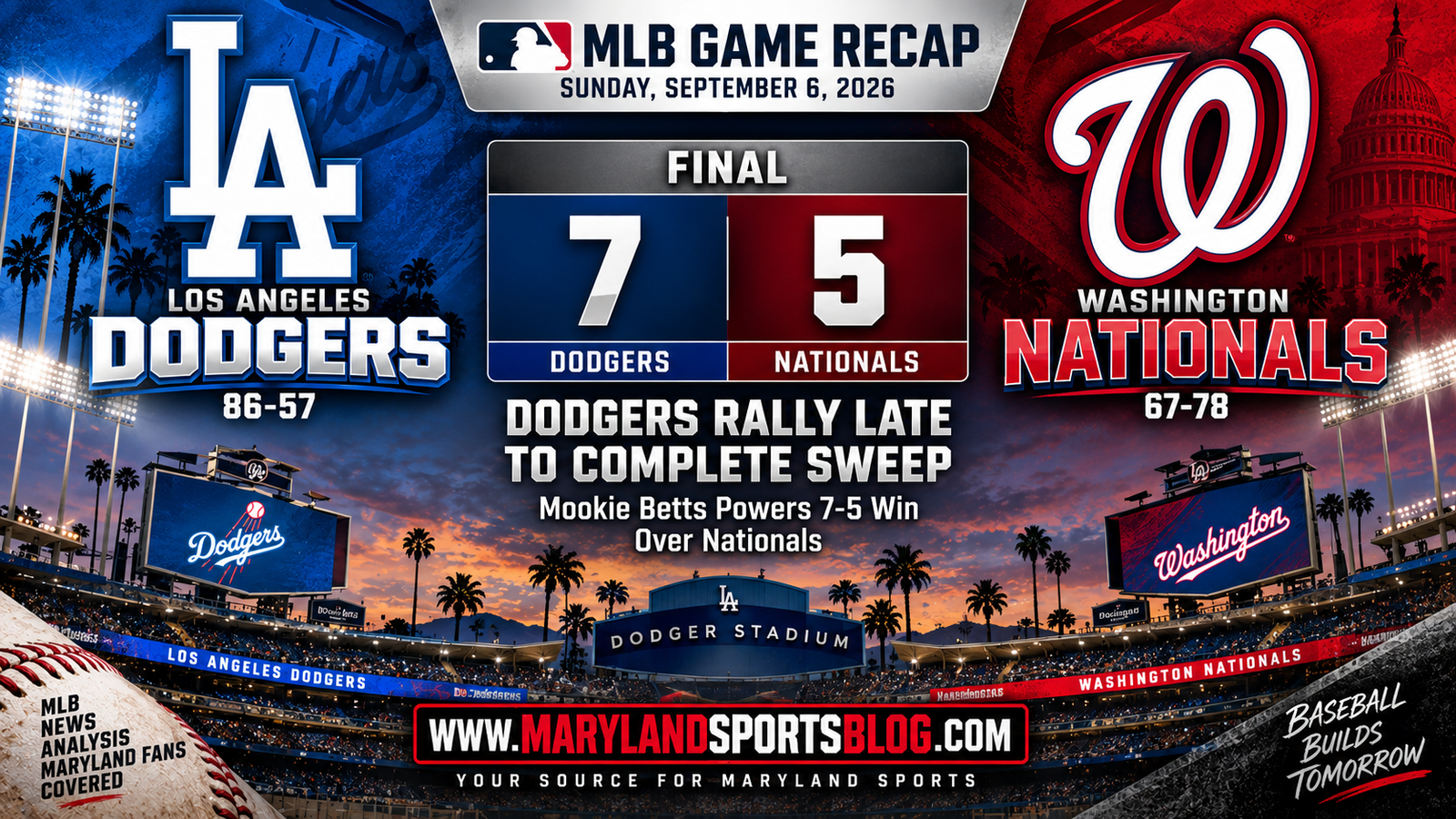
The Washington Nationals put themselves in position to steal the series finale at Dodger Stadium on Sunday night, but another late-inning collapse turned a promising performance into a frustrating 7-5 loss to the Los Angeles Dodgers. Washington led 4-1 and later reclaimed a 5-4 advantage, only to watch Mookie Betts crush a decisive three-run home run with two outs in the eighth inning.
The Nationals fell to 67-78 with the loss, while Los Angeles improved to 86-57 and extended its winning streak to four games. The Dodgers finished the 2026 season a perfect 6-0 against Washington, sweeping both series between the clubs. Despite another competitive effort from the Nationals, Washington again failed to finish a game it had a legitimate chance to win.
Abrams reaches the 30-home run mark
Washington’s biggest individual moment came from CJ Abrams, who reached a major career milestone in the fourth inning. Abrams led off the frame by launching a home run off Dodgers starter Justin Wrobleski, giving him 30 home runs for the first time in his career. The blast tied the game at 1-1 and sparked Washington’s biggest offensive inning of the night.
Abrams reaching 30 home runs is an important development for a Nationals organization still building toward its next competitive core. His combination of speed and increasing power has made him one of Washington’s most dangerous offensive players, and reaching the 30-homer plateau represents another significant step in his development. Even in a losing season, milestones like this matter because they give Washington tangible evidence that foundational pieces are continuing to progress.
The Nationals were not finished after Abrams’ home run. Brady House and Daylen Lile followed with singles, setting the stage for Harry Ford to rip a two-run double that gave Washington a 3-1 lead. Jacob Young then delivered an RBI single, pushing the advantage to 4-1 as the first five Nationals hitters of the inning reached base.
That sequence was exactly the kind of sustained offensive inning Washington has been trying to produce more consistently. Instead of relying entirely on one swing, the Nationals combined Abrams’ power with consecutive hits and pressure throughout the lineup. Against one of baseball’s best teams, Washington briefly had complete control of the game.
Dodgers answer quickly
Los Angeles had scored first in the third inning when Max Muncy doubled, advanced to third on Tommy Edman’s infield single and scored on a Betts groundout. Washington’s four-run response flipped the game dramatically, but the Dodgers did not allow that deficit to last long. By the end of the fifth inning, Los Angeles had completely erased Washington’s three-run advantage.
Edman started the rally with an RBI double, and Will Smith and Teoscar Hernández each added RBI singles. Those three runs tied the game at 4-4 and once again exposed one of Washington’s recurring problems this season: holding leads after the offense creates them. The Nationals had generated one of their better innings of the road trip, but the advantage disappeared almost immediately.
Los Angeles produced the comeback despite playing without Shohei Ohtani for a fourth consecutive game. Ohtani remained out because of left knee and right biceps discomfort, yet the Dodgers’ lineup still found enough production from Betts, Edman, Muncy and Hernández. That depth is one of the major differences between a championship-caliber roster such as Los Angeles and a Washington club still trying to develop enough reliable offense throughout its lineup.
Muncy was particularly effective after missing Saturday’s game because of illness. He finished with three hits and scored twice, while Edman collected two hits, drove in a run and scored twice. Los Angeles did not need one player to carry the entire offense, which ultimately helped the Dodgers survive Washington’s early push.
Nationals regain the lead
Washington deserves credit for responding after Los Angeles tied the game. The Nationals loaded the bases in the sixth inning and pushed the go-ahead run across when Dylan Crews was hit by a Bobby Miller curveball. That gave Washington a 5-4 advantage and once again placed the Nationals in position to finish off one of the National League’s strongest clubs.
The manner in which Washington scored also mattered. Crews did not need to produce a big swing; the Nationals simply created traffic on the bases and forced Los Angeles into a mistake. Young teams learning how to win close games have to be able to manufacture runs in exactly those situations.
Unfortunately for Washington, the Nationals could not build on the lead. A one-run advantage against the Dodgers is rarely comfortable, particularly with the depth Los Angeles possesses throughout its batting order. That became painfully clear two innings later.
Alvarez battles in hometown start
Nationals starter Andrew Alvarez made a meaningful start geographically, pitching approximately 25 miles from where he grew up in Los Alamitos, California. Alvarez worked 4 1/3 innings and allowed three runs on four hits before Washington turned the game over to the bullpen. It was not a dominant performance, but he gave the Nationals enough of an opportunity to compete.
The fourth inning showed what Washington’s offense can do when several young hitters contribute at the same time. Alvarez then returned to the mound with a three-run advantage, but the Dodgers gradually worked their way back into the game. Los Angeles’ ability to pressure pitchers throughout the lineup eventually shortened Alvarez’s outing.
There was also value in Alvarez handling that environment. Dodger Stadium drew 54,211 fans for the game, creating a postseason-type atmosphere against one of baseball’s most successful organizations. Experiences like that can be useful for a young pitcher expected to become part of Washington’s future.
Bobby Miller keeps Dodgers alive
Los Angeles received an unexpected boost from Bobby Miller, who made his season debut and eventually earned the victory. Miller allowed one run across three innings after entering in relief and helped stabilize the game while the Dodgers waited for their offense to produce another comeback. His performance allowed Los Angeles to remain within striking distance until the eighth.
The Nationals managed to score the go-ahead run against Miller in the sixth, but they never broke the game open. That became significant because Los Angeles’ bullpen only needed to keep the deficit at one run. Against a lineup featuring Betts and several other established veterans, a single-run cushion never felt secure.
Washington needed one additional offensive push after going ahead 5-4. Another run or two might have changed the way the Nationals managed the late innings and forced Los Angeles to become more aggressive. Instead, the Dodgers remained one swing away.
Betts delivers the decisive blow
The game turned permanently with two outs in the bottom of the eighth. Alex Call singled against Nationals left-hander Will Dion, and Edman followed with a walk, putting two runners aboard for Betts. Dion then delivered a 1-0 fastball that Betts drove into the left-field seats for a three-run home run.
Just like that, Washington’s 5-4 lead became a 7-5 deficit. Betts’ home run was his 18th of the season, and he finished the night with four RBIs. For a veteran star who has spent years delivering in high-pressure moments, it was another example of how quickly elite hitters can punish a mistake late in a game.
The most frustrating part for Washington was how close it came to escaping the inning. Both Call’s single and Edman’s walk occurred with two outs, meaning Dion was one out away from preserving the Nationals’ lead. Instead, Los Angeles extended the inning long enough to put its most dangerous hitter at the plate with runners aboard.
That is the kind of sequence rebuilding teams must eventually learn to finish. Washington had the matchup where it wanted it, had two outs and still had the lead. One mistake changed the entire night.
Late-game execution remains the problem
Washington’s offense scored five runs against an 86-win team, which should have been enough to provide a legitimate chance to win. The Nationals produced nine innings of competitive baseball and held multiple leads. Yet the game ultimately followed a familiar pattern: strong stretches followed by one critical late mistake.
That is why the final score is more frustrating than a routine loss. Washington did not get overwhelmed from the opening pitch. The Nationals created a three-run lead, responded after losing it and entered the late innings ahead.
The difference came down to execution. Los Angeles delivered when its biggest opportunity arrived, while Washington failed to create enough separation to absorb a mistake. Against elite teams, that margin becomes extremely small.
Edgardo Henriquez retired Washington in the ninth to record his second save of the season. The Nationals therefore never received a final chance to answer Betts’ three-run homer. Washington had already used its opportunities and simply did not convert enough of them into a victory.
Ford continues to show promise
Harry Ford’s two-run double was another encouraging development for Washington. Ford drove in two runs and scored twice, contributing directly to three of the Nationals’ five runs. For a young catcher trying to establish himself at the major league level, producing against a team such as Los Angeles is meaningful.
His fourth-inning double also came during Washington’s best rally of the game. After House and Lile reached base, Ford delivered rather than allowing the inning to stall. Young players who can hit with runners in scoring position are exactly what Washington needs as it continues constructing its next competitive roster.
The Nationals have spent much of this season evaluating which young players can become dependable major league contributors. Ford is still developing, but games like Sunday provide evidence that his bat can become an important part of Washington’s lineup. His ability to contribute offensively from the catcher position would give the Nationals another valuable piece going forward.
Young core shows life despite the loss
Abrams, House, Lile, Ford, Crews and Young were all involved in Washington’s scoring. That is arguably the most encouraging part of an otherwise disappointing night. The Nationals did not generate their offense entirely through aging veterans or temporary roster pieces.
That matters for a team sitting below .500 in September. Washington entered the night knowing the postseason was extremely unlikely, so development remains a major priority over the final weeks. Seeing several players who could be part of the long-term roster contribute in the same game provides something meaningful to evaluate.
Abrams reaching 30 home runs is the headline, but the larger picture is that Washington’s younger hitters were competitive against Los Angeles. House and Lile helped create the four-run fourth, Ford delivered a major extra-base hit, Crews produced the go-ahead run in the sixth and Young drove in a run. That is the type of collective production the Nationals need to see more frequently.
Washington swept despite competitive games
The most frustrating part of the series is that Washington was not completely overmatched. The Nationals lost the opener 5-3, fell 6-5 Saturday and then lost 7-5 Sunday. Each game remained competitive, but Los Angeles repeatedly made the bigger play when it mattered most.
Saturday followed a similar script. Washington led 4-2 before Tommy Edman’s three-run home run in the seventh helped Los Angeles rally for the victory. The Nationals even brought the tying run to third in the ninth before falling short.
Friday was different but produced the same result. Blake Snell threw six scoreless innings before Washington finally rallied for three runs in the ninth, but the Nationals could not completely erase the deficit in a 5-3 loss.
Those three games illustrate the current gap between the organizations. Washington competed. Los Angeles finished.
Dodgers remain among baseball’s elite
Los Angeles improved to 86-57 and moved within 1 1/2 games of Milwaukee for the best record in Major League Baseball. The Dodgers also extended their winning streak to four games despite playing without Ohtani during this stretch.
That is an impressive display of organizational depth. Losing a player of Ohtani’s caliber would dramatically change most lineups, but Los Angeles continued winning because Betts, Edman, Muncy, Hernández and others stepped forward. It also explains why the Nationals had such difficulty protecting narrow leads.
Washington can learn something from that depth as it continues building. Championship contenders cannot rely entirely on two or three stars. They need contributions from throughout the roster, especially during a long 162-game season when injuries inevitably occur.
Abrams’ season deserves attention
The final result should not overshadow what Abrams accomplished. Thirty home runs from a shortstop with his speed is a major offensive benchmark, and it is particularly meaningful because power was not always considered the defining element of his game. He has continued adding strength and impact without sacrificing the athleticism that makes him dangerous on the bases.
Washington needs players who can eventually become legitimate stars, not simply competent regulars. Abrams has increasingly demonstrated that type of upside. Reaching 30 home runs gives the Nationals another reason to believe he can remain near the center of their lineup as the organization moves forward.
There will still be areas to refine, particularly consistency and defensive execution, but offensive milestones of this magnitude matter. A 30-home-run season creates expectations that Abrams can become a recurring middle-of-the-order threat rather than simply a table-setter.
What comes next
Washington leaves Los Angeles with a four-game losing streak and a 67-78 record. At this stage of the season, development remains a major measuring stick for a club that is not realistically positioned for a postseason run.
That does not mean wins stop mattering. Washington needs to learn how to finish games like Sunday’s, because those lessons become critical when the organization eventually expects to contend. Losing close games repeatedly can become a habit if late-inning execution does not improve.
The Nationals showed enough in Los Angeles to prove they can compete with a championship-level opponent. The next step is turning those competitive performances into victories.
MSB Take
This loss hurts because Washington absolutely had a chance to win it. The Nationals led 4-1, watched the Dodgers tie it and then showed some real fight by taking the lead again in the sixth. When a rebuilding team goes into Dodger Stadium and puts itself in that position, it has to find a way to finish.
The positive side is that the players Washington needs to develop were heavily involved. Abrams reached 30 home runs, Ford drove in two, House and Lile helped create the big fourth inning, Crews forced home the go-ahead run and Young added an RBI. That is exactly what the Nationals should want to see in September, even if the result was disappointing.
The problem is that competitive losses eventually need to become wins. Washington was close in all three games of this series and still got swept. Los Angeles made the decisive play every time, while the Nationals failed to close when they had the opportunity.
Abrams reaching 30 home runs is a legitimate accomplishment and should not get buried beneath the loss. If he continues becoming the kind of offensive force capable of producing 30-homer seasons from shortstop, Washington has an important piece of its future already in place. Now the Nationals need more of their young core to take similar steps and, eventually, learn how to finish games against teams like the Dodgers.