
Maryland Dominates Hampton 62-0 in Statement Season-Opening Win
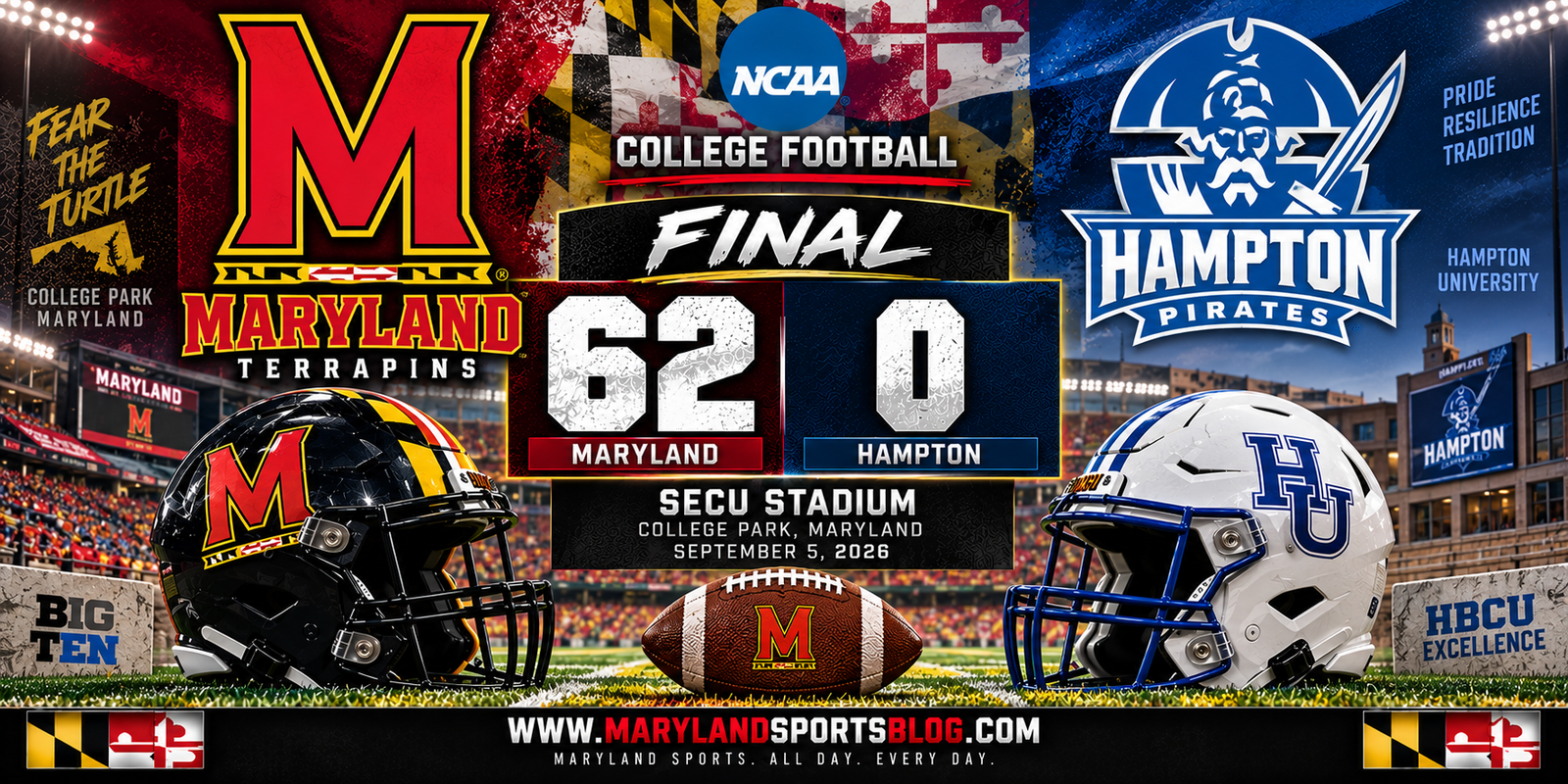
COLLEGE PARK, Md. — The Maryland Terrapins could not have asked for a much more complete start to the 2026 season. Maryland overwhelmed Hampton, 62-0, Saturday night at SECU Stadium, dominating on offense, defense and special teams while extending its nation-leading non-conference winning streak to 19 games. The Terrapins piled up 646 yards of total offense, rushed for 365 yards and held the Pirates to only 85 total yards in front of 43,421 fans.
Maryland scored in every quarter and never allowed Hampton to seriously threaten the end zone. The Terps led 17-0 after the first quarter, 34-0 at halftime and 55-0 after three before adding one final touchdown early in the fourth. It was Maryland’s first season-opening shutout since beating Howard 79-0 in 2019, and the 62 points were the program’s most in a game since another 62-0 victory over Howard in 2021.
The victory also continued Maryland’s remarkable run against non-conference competition. The Terps have now won 19 consecutive non-conference games and improved to 24-0 all-time against FCS opponents. Maryland has also won 16 straight season openers against non-conference opponents and improved to 27-5 in season openers since 1995.
Williams Breaks the Game Open
Maryland’s first offensive possession did not provide much indication of what was about to happen. Hampton forced the Terps into a three-and-out, giving the Pirates an early defensive win against a Big Ten opponent playing its first game of the season. Maryland’s second possession, however, completely changed the tone of the night.
DeJuan Williams took a handoff and exploded through the Hampton defense for a 94-yard touchdown run with 9:30 remaining in the first quarter. The run became the second-longest rushing play in Maryland football history, trailing only Steve Atkins’ 98-yard run against Clemson in 1978. Williams needed just three carries to finish with a career-high 116 rushing yards and two touchdowns.
The touchdown immediately gave Maryland momentum, and the Terps never gave it back. Williams struck again later in the first quarter, finishing a five-play, 36-yard possession with an eight-yard touchdown run that pushed the lead to 14-0. His two rushing scores made him Maryland’s first player with multiple rushing touchdowns in a game since Billy Edwards Jr. did it against Rutgers in 2023.
Maryland’s defense then began turning field position into additional scoring opportunities. Jayden Shipps intercepted Hampton quarterback Jalen Woods and returned possession to the Maryland offense at the Pirates’ seven-yard line. The Terps settled for Sean O’Haire’s 26-yard field goal, but the sequence still gave Maryland a 17-0 advantage before the first quarter ended.
Maryland’s Defense Takes Over
The first half became as much a showcase for Maryland’s defense as its offense. DD Holmes recorded back-to-back sacks on one Hampton possession, while Eyan Thomas added another sack late in the first quarter. Maryland consistently collapsed the pocket and prevented Hampton from establishing anything resembling a consistent rushing attack.
By halftime, the Pirates had produced only 45 total yards and had actually rushed for minus-11 yards. Maryland finished the night allowing only 10 rushing yards on 31 Hampton attempts, the fewest rushing yards the Terps had allowed in a game since holding Howard to minus-1 in 2019. Hampton averaged only 1.7 yards per offensive play for the game.
Maryland also forced three interceptions without committing a turnover of its own. Messiah Delhomme intercepted two passes, becoming Maryland’s first defender with two interceptions in a game since Dante Trader Jr. and Tarheeb Still both accomplished the feat in 2023. Shipps added the other interception, and Maryland finished with a plus-three turnover margin.
The Terps also collected five sacks and limited Hampton to only six first downs. Hampton converted only four third downs and finished with 75 passing yards to go with its 10 rushing yards. Maryland had not held an opponent under 100 total yards since 2019, which puts the defensive performance in historical context even considering the difference in competition level.
Offense Keeps Pouring It On
Maryland continued adding points early in the second quarter. Chris Durr Jr. ripped off a 30-yard reverse that helped put the offense in scoring position, and O’Haire converted a 36-yard field goal to make it 20-0. The Terps showed they could attack Hampton vertically, horizontally and with their traditional running game.
Sophomore quarterback Malik Washington then reached an important career milestone. A nine-yard completion to Kaleb Webb pushed Washington past 3,000 career passing yards, making him the 20th quarterback in Maryland history to reach that mark. Washington finished the game completing 19 of 31 passes for 186 yards, one touchdown and no interceptions.
Washington now has 3,149 career passing yards and ranks 19th in Maryland history in that category. He also moved to 292 career completions, ranking 15th in program history. Those milestones came during a game where Maryland did not need Washington to carry the offense because the rushing attack was controlling the night.
Iverson Howard became the next Maryland running back to reach the end zone. Howard capped an 11-play, 75-yard drive with an 11-yard touchdown run, giving the Terps a 27-0 advantage with 5:54 remaining in the first half. Howard finished with 66 rushing yards and two touchdowns on 12 carries.
The Terps were not finished before halftime. Delhomme intercepted Hampton with 1:34 remaining, and Washington converted the turnover into points when he connected with Na’eem Abdul-Rahim Gladding for a 10-yard touchdown with only seconds remaining. Maryland entered the locker room ahead 34-0 after gaining more than 350 yards and completely controlling the game.
No Letup After Halftime
Any possibility that Maryland would simply coast through the second half disappeared almost immediately. Thomas opened the third quarter by sacking Hampton for an eight-yard loss, continuing the pressure Maryland had applied throughout the opening half. Delhomme then intercepted another Hampton pass and gave the Terrapins another short field.
Howard capitalized with his second rushing touchdown, scoring from eight yards out to increase Maryland’s lead to 41-0. Harry Dalton III followed with a nine-yard touchdown run later in the quarter to make it 48-0. The Terps continued cycling different running backs into the game without losing offensive efficiency.
Cardell Williams took over much of the quarterback work in the second half and also played efficiently. Williams completed four of five passes for 60 yards and one touchdown while adding 49 rushing yards on five carries. His 16-yard touchdown pass to Jordan Scott pushed Maryland’s advantage to 55-0 late in the third quarter.
Maryland’s depth became increasingly evident as the game moved toward the fourth quarter. The Terps were able to remove many starters without allowing Hampton to gain any meaningful momentum. That matters in a season opener, because Maryland managed to build confidence and game experience across the roster while also avoiding the need to keep its primary players on the field deep into a blowout.
Terps Finish With Six Rushing Touchdowns
Jianni Davis added Maryland’s final score with a five-yard touchdown run early in the fourth quarter. The touchdown was the sixth rushing score of the game for Maryland, the program’s highest total since scoring six rushing touchdowns against Syracuse in 2019. The extra point gave Maryland the final 62-0 margin.
The Terps finished with 365 rushing yards on 40 attempts, averaging more than nine yards per carry. That represented Maryland’s most rushing yards in a game since producing 431 against Illinois in 2018. The combination of explosive runs and consistent production made the ground game the defining offensive story of the night.
Maryland had multiple contributors beyond Williams and Howard. Cardell Williams added 49 yards, Dalton scored once, Davis reached the end zone and several reserves received meaningful late-game carries. The Terps showed both high-end explosiveness and considerable backfield depth, two encouraging developments entering the heart of the 2026 schedule.
Maryland also produced 281 passing yards, giving the Terps 646 total yards on 78 plays. Washington threw for 186 yards, Cardell Williams added 60 and Jack Capaldi completed both of his attempts for 35 yards. Maryland averaged 8.3 yards per play and finished with 31 first downs.
Gladding Leads Deep Receiving Group
Gladding led Maryland’s receiving corps with six catches for 57 yards and a touchdown. Durr also caught six passes for 44 yards, while DeJuan Williams contributed two catches for 35 yards in addition to his huge rushing performance. The distribution allowed Washington and Maryland’s backup quarterbacks to involve numerous weapons rather than relying heavily on one receiver.
That balance could become particularly important once Maryland enters Big Ten play. Hampton could not consistently pressure the quarterback or contain the running game, but tougher opponents will force Washington to make more contested throws and sustain longer drives. Getting multiple receivers involved immediately gives the Terps a foundation to build upon as the competition improves.
Hampton Overwhelmed in First Power Four Game
For Hampton, Saturday represented a historic challenge. The Pirates were playing their first game against a Power Four opponent after opening their season with a 45-0 victory over Virginia University of Lynchburg. Maryland quickly demonstrated the enormous difference in size, speed and depth between the two levels.
Woods completed seven of 12 passes for 56 yards but threw two interceptions. Tre’Von Taylor completed three of seven attempts for 19 yards with another interception, while Gracen Goldsmith led Hampton on the ground with 26 yards. Chaz Portis was the Pirates’ leading receiver with two catches for 40 yards.
Hampton possessed the ball for 30:57, slightly longer than Maryland’s 29:03, but the statistic was misleading because Maryland created so many explosive plays and frequently worked with short fields after turnovers and returns. The Pirates ran 50 offensive plays and managed just 85 yards. Meanwhile, Maryland accumulated 646 yards despite possessing the football for less time.
The Pirates will have additional opportunities against major-conference opponents in future seasons. Hampton is scheduled to play Georgia Tech in 2027 and Virginia in 2029, with an FBS matchup against Old Dominion scheduled for 2028. Saturday’s game provided a difficult but valuable measuring stick for the program.
Maryland Wins Every Phase
The 62-point margin tells only part of the story. Maryland outgained Hampton by 561 yards, finished with 25 more first downs and committed no turnovers while forcing three. The Terps also got impact plays from special teams, including Gladding’s 34-yard punt return that helped set up Williams’ second touchdown.
O’Haire was perfect on both of his field-goal attempts, converting from 26 and 36 yards. Those kicks moved him to 23 career field goals and 14th on Maryland’s all-time list. Maryland therefore received meaningful contributions from all three units rather than relying solely on the offense to overwhelm Hampton.
Perhaps most importantly, Maryland never gave the Pirates the kind of mistake that can allow an overmatched opponent to remain competitive. The Terps did not turn the ball over, surrendered only six first downs and responded to Hampton’s opening three-and-out by scoring 62 unanswered points. For a heavily favored team, that is exactly how an opener like this should look.
What Comes Next
Maryland will now leave College Park for its first road game of the season. The Terps travel to East Hartford to face UConn on Saturday, Sept. 12, with kickoff scheduled for 3:30 p.m. on CBS Sports Network. Maryland will enter that matchup trying to extend its non-conference winning streak to 20 games.
The challenge for Maryland will be carrying the same efficiency forward while recognizing that every week presents a different test. A 62-0 victory over an FCS opponent does not answer every question about a team with Big Ten ambitions, but Maryland accomplished virtually everything it reasonably could Saturday. The offense created explosive plays, the defense dominated, the quarterbacks protected the ball and a large portion of the roster received meaningful game action.
MSB Take
There is no reason to overcomplicate Maryland’s season opener: this was exactly the kind of performance the Terrapins needed. When a Big Ten team faces an FCS opponent, winning is expected, but dominating every phase and avoiding costly mistakes is still meaningful. Maryland did that Saturday night and looked prepared, physical and focused from the moment Williams broke loose for his 94-yard touchdown.
The rushing attack stands out the most. Maryland ran for 365 yards, produced six rushing touchdowns and received productive performances from multiple backs instead of relying on a single player. Williams supplied the biggest highlight, but Howard, Dalton and Davis all showed the kind of depth that could become important later in the season.
The defense deserves just as much attention. Holding any Division I opponent to 85 total yards is an impressive accomplishment, and Maryland did it while forcing three interceptions and collecting five sacks. Delhomme, Shipps, Holmes and Thomas all made impact plays, and the Terps never allowed Hampton to build any sustained offensive rhythm.
Washington also gave Maryland exactly what it needed from its starting quarterback. He protected the football, surpassed 3,000 career passing yards and delivered a touchdown before giving way to the backups with the outcome already decided. Maryland did not need him to put up enormous passing numbers because the running game and defense controlled everything.
The bigger tests are still ahead, and nobody should confuse a dominant win over Hampton with proof that Maryland is ready to contend at the top of the Big Ten. What Saturday provided was a strong starting point. The Terrapins looked deep, athletic and disciplined while extending a non-conference winning streak that has become one of the program’s most consistent accomplishments.
For Maryland, 62-0 is not merely a comfortable win. It is a reminder of what this team can look like when the running game is explosive, the defense creates turnovers and the offense avoids giving possessions away. The Terps now have to carry that standard on the road against UConn and continue building before conference play raises the difficulty considerably.