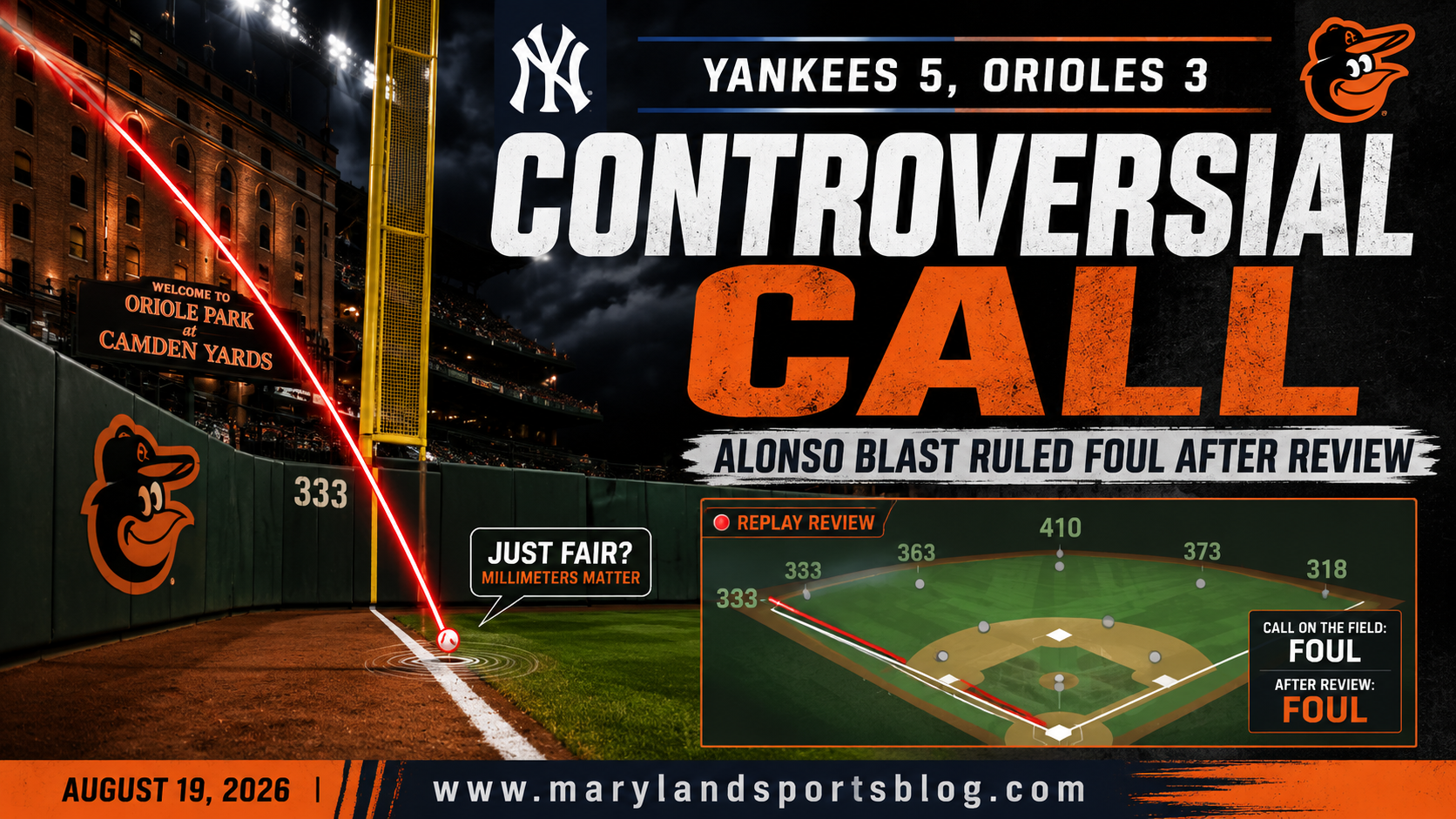
Controversial Replay Call Costs Orioles as Yankees Win 5-3 at Camden Yards
The New York Yankees defeated the Baltimore Orioles 5-3 Wednesday night at Oriole Park at Camden Yards, but the final score does not tell the story of a game that turned on one of the most controversial replay decisions Baltimore has dealt with this season.
With the game tied 3-3 in the bottom of the seventh inning, Pete Alonso appeared to launch his second home run of the night, a towering drive down the left-field line that would have given Baltimore a 4-3 lead.
Instead, home plate umpire Ryan Wills ruled the ball foul.
The play went to replay review, where at least one available camera angle appeared to show the baseball traveling on the fair side of the foul pole. Despite that view, the Replay Operations Center allowed the call to stand. Alonso eventually struck out.
One inning later, the Yankees scored twice.
That was the game.
The Orioles have every reason to be furious.
Alonso Appears to Have Go-Ahead Homer Taken Away
Alonso came to the plate in the seventh with Baltimore and New York tied at three.
He crushed a pitch high down the left-field line. Alonso immediately reacted as though he had homered, and the disputed replay angle appeared to support him.
The original foul call, however, stood after a lengthy review. The Associated Press reported that one replay appeared to show the ball on the fair side of the pole, although the precise angle of the camera made an absolute determination difficult.
That distinction is important.
Major League Baseball did not confirm the ball was foul. The replay ruling was that there was not sufficient evidence under MLB’s replay standard to overturn the call made on the field.
Those are two very different things.
Alonso explained afterward that he was told an overturn required enough corroborating camera evidence and that the best view was essentially the only angle capable of clearly showing where the ball traveled.
“The best view, the only view that shows the ball fair or foul is the one down the line,” Alonso said after the game.
Alonso also questioned why MLB does not have technology positioned specifically to settle plays like this. Orioles manager Craig Albernaz pointed out that teams already have ball-tracking information available on their dugout tablets and questioned why similar technology cannot be incorporated into replay decisions.
He has a point.
It is 2026.
Baseball can electronically determine whether a 99-mph pitch clipped the edge of a three-dimensional strike zone, but apparently it cannot definitively determine whether a baseball traveled to one side of a stationary foul pole.
That is unacceptable.
The Call Changed the Game
There is no way of knowing exactly how the remaining innings would have unfolded had Alonso been awarded the home run.
There is, however, no debating what the situation would have been.
Instead of a 3-3 game, the Orioles would have held a 4-3 lead in the seventh inning.
Alonso instead struck out.
New York immediately took advantage.
Cam Sanders entered in the eighth and never found the strike zone consistently. He loaded the bases without allowing a hit, issuing a walk and hitting two batters. Yennier Cano replaced him with two outs.
George Lombard Jr. then hit a slow grounder and beat it out for an RBI infield single, giving the Yankees a 4-3 lead. Jazz Chisholm Jr. scored moments later on a wild pitch to stretch the lead to 5-3.
Baltimore deserves blame for that inning.
Sanders cannot walk a batter and hit two more in a tie game against the Yankees. The Orioles also went 0-for-6 with runners in scoring position and struck out 11 times, so the controversial call was hardly their only problem.
But that does not erase the significance of what happened in the seventh.
The Alonso call was the turning point.
Albernaz Should Have Gone Nuclear
Craig Albernaz argued the decision, but this was a moment when the Orioles manager had every reason to make his displeasure unmistakable.
Get ejected.
Make MLB answer questions about it.
Protect your player and make sure everyone watching understands how unacceptable the situation was.
There is an important rules distinction here: Albernaz could not actually put the game under protest over the replay decision. MLB’s replay rules state that a replay official’s ruling is final, and judgment decisions by the replay official cannot be protested. Continuing to argue the replay decision after review can also result in an automatic ejection.
So Albernaz could not have legally forced MLB to reconsider the result by declaring the game “under protest.”
He still could have gotten himself thrown out.
And in this situation, that might have been worth it.
Albernaz should have made his frustration impossible to ignore.
MLB’s Replay System Deserves Scrutiny
It is also important to separate two issues.
MLB’s Replay Operations Center is located in New York, and replay officials there make these determinations. That naturally makes the optics particularly ugly when a controversial review benefits the Yankees. MLB’s rules confirm that the replay official’s determination becomes final once the review is completed.
That does not, however, establish that the game was fixed or that replay officials intentionally favored New York.
There is no credible evidence currently showing that.
What can fairly be said is that MLB’s system failed to produce a definitive answer on a play that modern technology should be capable of deciding.
For Orioles fans, the distinction probably provides little comfort.
You watched a ball that appeared fair.
Baltimore’s players had access to information suggesting it was fair.
The Orioles believed it was fair.
One television angle appeared to show it fair.
And yet the ruling remained foul because MLB apparently did not have sufficient camera coverage to overturn the original decision.
That is an MLB problem.
Orioles Had Taken the Early Lead
Baltimore actually opened the scoring with some aggressive baserunning in the first inning.
With Gunnar Henderson breaking for second, Jackson Holliday raced home on a delayed double steal, putting the Orioles ahead 1-0.
New York answered in the second. Ryan McMahon drove home the tying run with an RBI single before Lombard delivered a sacrifice fly to put the Yankees ahead 2-1.
Ben Rice added to the lead in the third with a massive 431-foot home run, his 34th of the season.
Alonso answered almost immediately.
The Orioles first baseman launched his 29th home run of the season in the bottom of the third, extending his hitting streak to 11 games and cutting Baltimore’s deficit to 3-2.
Dylan Beavers eventually tied the game in the sixth with an opposite-field solo home run off Fernando Cruz.
That set the stage for Alonso’s controversial seventh-inning at-bat.
Bassitt Keeps Baltimore in It
Chris Bassitt was not dominant, but he gave Baltimore a chance.
The veteran right-hander allowed three runs over 5 2/3 innings before turning the game over to the Orioles bullpen.
Will Warren lasted only four innings for New York and surrendered two runs.
The Yankees bullpen was ultimately the difference.
Brent Headrick worked a scoreless seventh and earned the victory, while David Bednar retired Baltimore in the ninth for his 29th save in 32 opportunities.
Sanders was charged with the loss.
MSB Take
The Orioles did plenty to lose this baseball game themselves.
They failed with runners in scoring position. Sanders melted down in the eighth. Eleven strikeouts are too many in a game against a division rival.
But Pete Alonso also appeared to hit a go-ahead home run.
Baltimore should not have needed to overcome the Yankees and an inadequate replay system.
There is no evidence supporting the claim that MLB intentionally fixed Wednesday night’s game for New York, and MSB will not present that accusation as fact.
But MLB absolutely deserves criticism.
When a potentially game-changing home run rises above the foul pole, the league needs technology capable of determining where the baseball actually traveled. “Call stands” because there was not a second adequate camera angle is a ridiculous outcome for a multibillion-dollar professional sports league in 2026.
Alonso would have given Baltimore a 4-3 lead.
Instead he returned to the batter’s box, struck out, and the Yankees scored twice minutes later.
That was the turning point of the game.
The loss dropped Baltimore to 61-66 and represented its third consecutive defeat. New York improved to 71-55 and secured another victory in a game the Orioles will probably believe should have looked very different entering the eighth inning.
The Yankees will go for the sweep Thursday with Gerrit Cole scheduled to face Kyle Bradish at Camden Yards.
Final: Yankees 5, Orioles 3