
Baltimore Orioles Sign 16 More Draft Picks, Locking Up 18 Members of 2026 Class
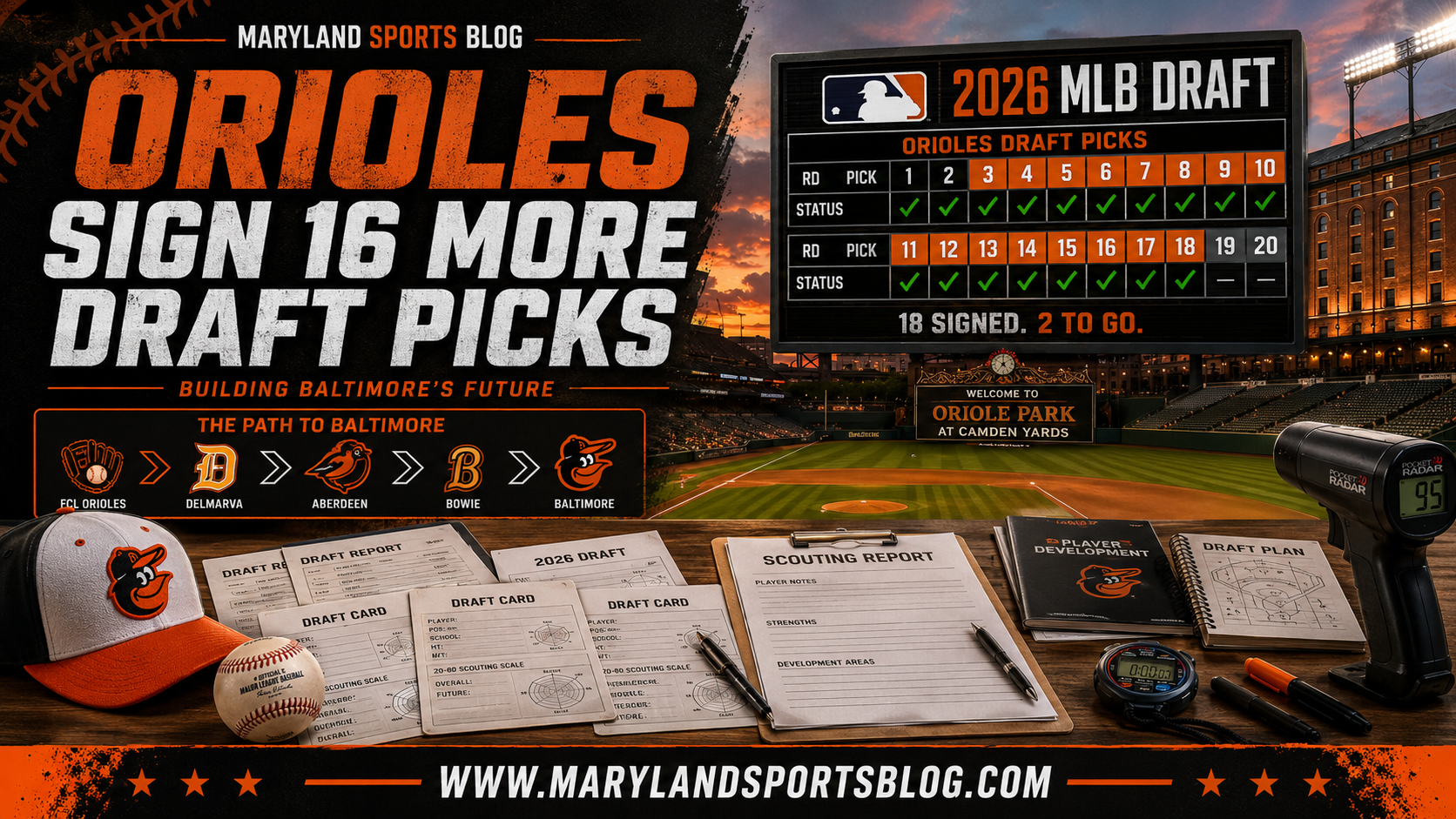
The Baltimore Orioles completed a major portion of their post-draft business Saturday, signing 16 additional players selected during the 2026 MLB First-Year Player Draft.
Baltimore has now signed 18 of its 20 draft selections, including each of its first 18 picks. The only selections who remained without an officially announced agreement as of Saturday were 19th-round outfielder Victor Salazar and 20th-round right-handed pitcher Ross Davis.
The Orioles previously signed first-round outfielder Eric Booth Jr. and second-round center fielder Ty Head. Booth, Head and fourth-round outfielder Kevin Roberts Jr. were scheduled to take batting practice at Oriole Park at Camden Yards on Saturday before meeting with members of the media.
Major League Baseball’s deadline for teams to sign draft selections is Monday, July 27, at 5 p.m. ET.
Orioles add 11 pitchers in latest signing group
Baltimore’s latest group includes right-handed pitchers Dominic Voegele, Ryan Piech, Collin McKinney, Ross Norman, Garrison Sumner, Miguel Hugas, Braden Smith, Diego Gutierrez and Gunnar Garrison.
The organization also signed left-handed pitcher Zane Adams, outfielder Roberts, shortstops Jimmy Anderson, Will Plunkett and Brayden Fry, utility player Carlos Sanchez and catcher Leo Marrero.
Pitching became the Orioles’ primary focus after selecting position players Booth and Head with their first two picks. Eleven of the 16 players announced Saturday are pitchers, giving Baltimore’s player-development staff a large collection of college performers, projectable arms and younger developmental prospects.
The Orioles selected Voegele with the No. 82 overall pick in the third round, making him the highest-drafted pitcher by Baltimore since the organization selected left-hander Joseph Dzierwa at No. 58 in 2025.
Dominic Voegele headlines the pitching additions
Voegele produced one of the most impressive strikeout seasons in University of Kansas history.
The 21-year-old right-hander established a Kansas single-season record with 120 strikeouts across 97 innings during the 2026 season. His fastball generally works between 93 and 96 mph and can reach 98, but Voegele’s breaking pitches may represent his greatest strengths.
Voegele features a curveball that received a 60-grade evaluation from MLB Pipeline and a slider that received a 55 grade. Both pitches give him legitimate swing-and-miss weapons as the Orioles begin developing him as a professional starter.
Baltimore reportedly signed Voegele for $897,500, approximately $103,800 below the assigned value of the No. 82 selection. Those savings gave the organization additional financial flexibility elsewhere in the class.
Voegele had previously been selected by the Arizona Diamondbacks in the 20th round of the 2023 draft but chose to attend Kansas rather than begin his professional career. That decision helped him improve his draft position by nearly 500 selections.
Kevin Roberts Jr. offers significant upside
Roberts may be one of the most intriguing long-term projects in Baltimore’s class.
The 17-year-old outfielder from Jackson Preparatory School in Mississippi stands 6-foot-5 and weighs approximately 220 pounds. Roberts combines that size with above-average running ability, raw power and arm strength.
MLB Pipeline ranked Roberts as the No. 136 prospect available in the draft, but the Orioles selected him at No. 110 because of his athleticism and developmental ceiling. His combination of 55-grade power and 60-grade speed gives him the tools to remain in center field while potentially developing into a middle-of-the-order hitter.
Baltimore reportedly signed Roberts for $1 million, approximately $288,200 above the assigned value of his selection. The overslot agreement illustrates how highly the Orioles value his potential.
Roberts joins Booth and Head in an athletic group of outfielders selected at the top of Baltimore’s draft. All three offer the defensive ability to play center field, although their offensive profiles and stages of development differ.
Zane Adams gives Baltimore a left-handed starter
Adams became the Orioles’ highest-selected left-handed pitcher in this class when Baltimore took him in the sixth round out of Alabama.
The 6-foot-4 left-hander recorded 100 strikeouts in 90 1/3 innings across 17 starts for the Crimson Tide. Adams works with a mid-90s fastball, but his changeup was his most effective offering during the college season.
Opposing hitters missed on 54 percent of their swings against Adams’ changeup, according to MLB Pipeline. The pitch gives him a legitimate weapon against right-handed batters and could help Adams move quickly through the lower levels of Baltimore’s system.
Adams reportedly received a $370,000 signing bonus, approximately $26,300 below the assigned value of the No. 171 pick.
Orioles bring Jimmy Anderson into the organization
Anderson finally joined the Orioles one year after Baltimore originally selected him.
The Orioles drafted the Heartland Community College shortstop in the 19th round of the 2025 draft, but Anderson did not sign. He returned to school, improved his draft position and was selected by Baltimore again in 2026, this time in the fifth round with the No. 142 pick.
The decision to select Anderson for a second consecutive year shows the Orioles maintained their interest after evaluating his progress at Heartland. Junior college players frequently carry additional negotiating leverage because they can return to school, but Baltimore was able to complete an agreement before the deadline.
Anderson adds another middle-infield prospect to a class that also includes Plunkett and Fry.
Ryan Piech and Collin McKinney add college experience
Piech, selected in the seventh round out of Xavier, signed for a reported $277,500. That figure was approximately $34,500 below the value assigned to the No. 200 selection.
The Orioles followed that selection by taking Plunkett in the eighth round and McKinney in the ninth.
McKinney pitched at Arizona and gives Baltimore another experienced college right-hander. The Orioles have consistently targeted pitchers with traits that the organization believes can improve through adjustments to pitch usage, mechanics, velocity development or pitch design.
Baltimore’s recent track record suggests several of these pitchers could move between starting and relief roles early in their professional careers while the organization evaluates their repertoires.
Carlos Sanchez provides defensive flexibility
Sanchez, Baltimore’s 10th-round selection from LSU Shreveport, was announced as a utility player rather than at one permanent position.
That versatility could allow Sanchez to receive playing time at multiple infield and outfield spots as he begins his professional career. Players with defensive flexibility can become especially valuable throughout the minor leagues because they create more lineup options and can move quickly when roster needs arise.
Sanchez reportedly signed for $47,500, approximately $151,400 below the slot value attached to the No. 290 selection. Those savings helped Baltimore accommodate overslot agreements with younger players such as Roberts.
Ross Norman brings premium velocity
Norman may become one of the most closely watched developmental pitchers from the later rounds.
The 6-foot-7 right-hander pitched at Coastal Carolina and possesses one of the strongest fastballs in Baltimore’s class. Norman generally works in the mid-90s and can reach between 97 and 98 mph.
Norman supplements the fastball with an upper-80s cutter and a slider in the mid-80s. The combination gives the Orioles several power pitches to work with, even though his college results were inconsistent.
Norman finished the spring with a 6.46 ERA over 78 innings, but Baltimore’s selection was based heavily on his physical tools and pitch characteristics rather than his traditional statistics.
The Orioles have frequently targeted pitchers with strong underlying traits who may benefit from professional instruction. Norman fits that model particularly well.
Baltimore signs three additional high school players
The Orioles also signed three prep prospects selected after the 10th round: Marrero, Fry and Garrison.
Marrero, a catcher from Hardee High School in Florida, was Baltimore’s 12th-round selection. Young catchers often require longer developmental timelines because they must improve offensively while learning to manage a professional pitching staff.
Fry, a shortstop from Cranford High School in New Jersey, joined the organization as the No. 470 overall selection. He gives Baltimore another young infielder with time to develop physically and refine his offensive approach.
Garrison, a right-handed pitcher from Eaton High School in Colorado, was selected in the 18th round. The prep right-hander was the final member of Saturday’s announced signing group.
Players selected after the 10th round can receive signing bonuses of up to $150,000 without the entire amount counting against a club’s draft bonus pool. Only the amount above $150,000 counts toward the pool calculation.
That structure allows organizations to pursue talented high school players late in the draft, although those prospects may require larger bonuses to give up college commitments.
Diego Gutierrez enters professional baseball with momentum
Gutierrez, Baltimore’s 17th-round selection, pitched at the University of San Diego before producing an impressive summer in the Appalachian League.
The 23-year-old right-hander recorded a 1.26 ERA and struck out 39.7 percent of opposing hitters across 14 1/3 Appalachian League innings. That performance came after a college season in which his overall statistics were less notable.
Gutierrez is older and more experienced than several of Baltimore’s other selections, which could allow the organization to move him aggressively if his recent strikeout production continues.
Orioles continue adding pitching depth
Sumner, Hugas and Smith gave Baltimore three consecutive college right-handers between the 13th and 15th rounds.
Sumner pitched at BYU, Hugas attended Mercer and Smith came from UCF. All three will enter a system that has placed greater emphasis on improving its pitching pipeline over the past several drafts.
Baltimore’s farm system remains known for developing position players, but the organization has increasingly used higher selections on pitchers. The Orioles drafted pitchers in seven of the 13 rounds between the third and 15th, with several possessing either notable velocity or a potential plus secondary offering.
That approach gave Baltimore a balance between immediate college experience and long-term upside.
Orioles have signed each of their first 18 selections
The Orioles’ official 2026 draft class consists of 20 players:
- First round: OF Eric Booth Jr.
- Second round: OF Ty Head
- Third round: RHP Dominic Voegele
- Fourth round: OF Kevin Roberts Jr.
- Fifth round: SS Jimmy Anderson
- Sixth round: LHP Zane Adams
- Seventh round: RHP Ryan Piech
- Eighth round: SS Will Plunkett
- Ninth round: RHP Collin McKinney
- 10th round: UTL Carlos Sanchez
- 11th round: RHP Ross Norman
- 12th round: C Leo Marrero
- 13th round: RHP Garrison Sumner
- 14th round: RHP Miguel Hugas
- 15th round: RHP Braden Smith
- 16th round: SS Brayden Fry
- 17th round: RHP Diego Gutierrez
- 18th round: RHP Gunnar Garrison
- 19th round: OF Victor Salazar
- 20th round: RHP Ross Davis
The Orioles’ official transaction log confirms agreements with all 16 players included in Saturday’s announcement. Booth, Head, Voegele, Piech, Adams, McKinney and Sanchez had been processed on earlier dates, while most of Saturday’s group officially appeared on the transaction list July 25.
Baltimore entered the signing period with a bonus pool of $13,114,200, the 13th-largest allotment in the league. Clubs can exceed their assigned pool by as much as 5 percent while paying a tax on the overage, providing the Orioles with approximately $655,700 in additional flexibility.
With agreements completed for each of the first 18 rounds, Baltimore has already secured nearly all of its 2026 class. Attention now turns to Salazar and Davis as the organization approaches Monday’s deadline.
MSB Take
The Orioles used this draft to address two different organizational needs.
Booth, Head and Roberts give Baltimore another group of athletic outfielders with the potential to remain in center field. Roberts carries considerable risk as a 17-year-old prospect, but his size, speed and raw power make him one of the most exciting players in the class.
Baltimore also devoted much of the draft to pitching. Voegele and Adams have the most complete present repertoires, while Norman represents the type of high-velocity developmental project the Orioles have pursued more frequently in recent years.
Not every member of this class will reach the major leagues, and several will require years of development. Still, signing the first 18 selections ensures the Orioles will have a deep group of players entering their minor league system.
The work now shifts from the scouting department to player development.
Maryland Sports Blog — www.marylandsportsblog.com