
Navy Sailing Battles Challenging Conditions as Cole Fanchi Competes at Nationals and Women’s Offshore Team Finishes Fourth
By Brian Hradsky
November 11, 2026
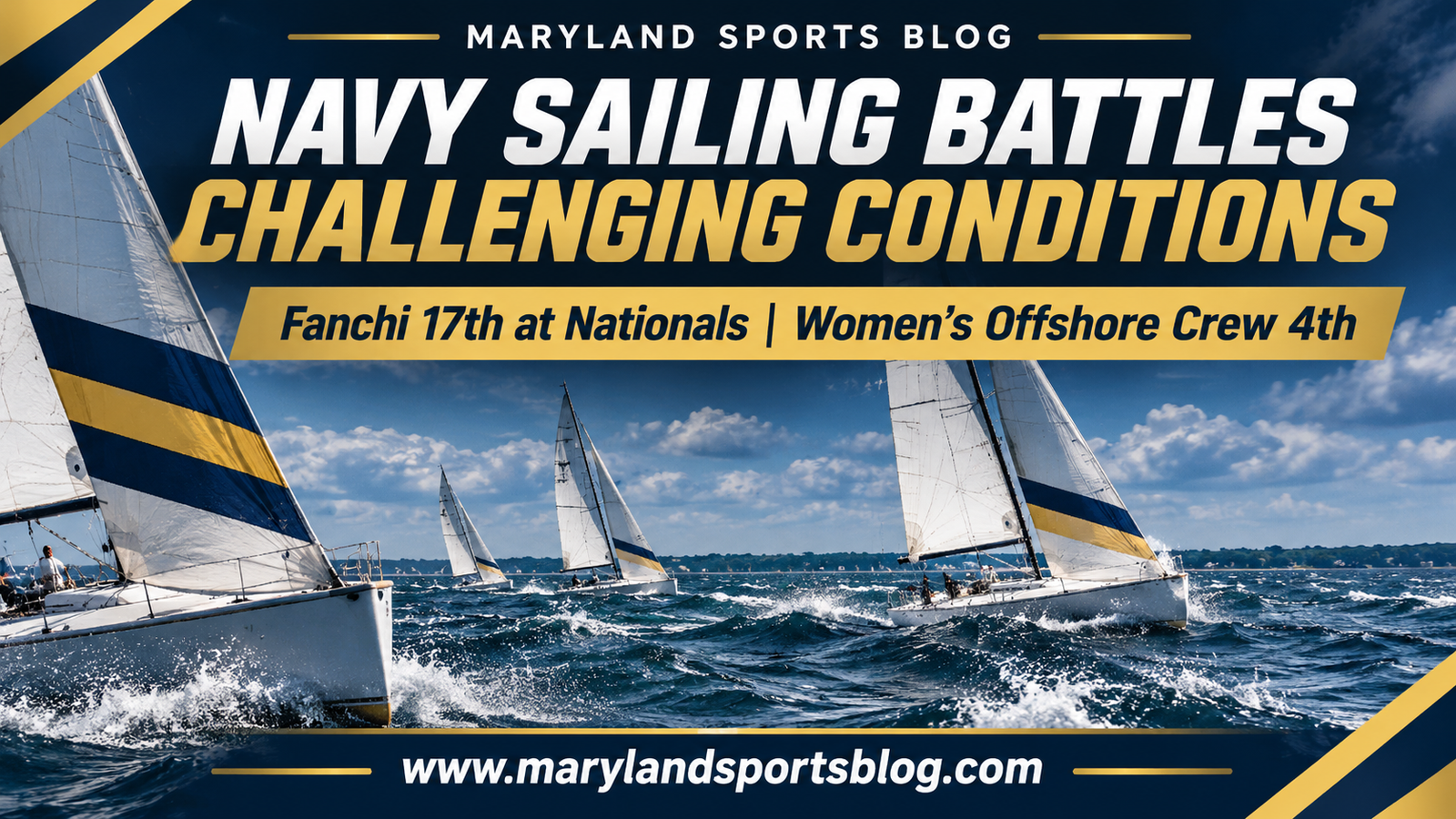
The United States Naval Academy sailing program faced two demanding competitions over the weekend of November 7-8, with freshman Cole Fanchi representing Navy at the Intercollegiate Sailing Association (ICSA) Open Singlehanded National Championship in Rye, New York, while the Midshipmen’s women’s offshore sailing crew earned fourth place at the Coast Guard Women’s J/70 Invitational in New London, Connecticut. Both events tested Navy’s sailors against talented collegiate competition and unpredictable wind conditions. Although the Midshipmen encountered challenges at both regattas, the weekend provided valuable national championship experience and demonstrated the program’s ability to compete across multiple sailing disciplines. With the fall season approaching its conclusion, Navy now turns its attention toward two additional competitions scheduled for November 14-15.
Cole Fanchi Represents Navy at ICSA Singlehanded National Championship
Freshman Cole Fanchi entered the ICSA Open Singlehanded National Championship following an impressive qualification campaign that included winning the Middle Atlantic Intercollegiate Sailing Association (MAISA) Open Singlehanded Championship in October. His conference championship earned him a position among the nation’s top 18 collegiate sailors competing for the Glen S. Foster Trophy. The national championship, hosted by the American Yacht Club and Fordham University, brought together elite competitors for two days of racing on November 7-8. For Fanchi, the competition represented his first opportunity to test himself against the country’s best singlehanded collegiate sailors on the national stage.
Fanchi ultimately finished 17th overall after battling difficult conditions throughout the championship. Offshore winds created unpredictable gusts and significant directional shifts that challenged competitors’ boat handling and tactical decisions. Saturday’s conditions became particularly demanding as winds strengthened to approximately 15 knots, with gusts exceeding 20 knots. Those conditions made it difficult for Fanchi, one of the smaller competitors in the fleet, to maintain the same upwind speed as some of his larger opponents.
The championship required sailors to make constant adjustments to their positioning, sail trim and tactical approach. Stronger winds can create disadvantages for lighter competitors, particularly when sailing upwind, where maintaining sufficient leverage and controlling the boat become critical. Fanchi encountered those challenges as the conditions intensified during Saturday’s races. Despite his efforts to remain competitive, he struggled to stay with the leading group as the championship progressed.
Sunday brought similarly demanding weather, preventing Fanchi from making a substantial move up the standings. He continued competing through the final races before completing the championship in 17th place. The two-day event featured 14 races in the open division, with Tulane University’s Hamilton Barclay claiming the national championship. Although Fanchi did not achieve the finishing position he hoped for, qualifying for the championship as a freshman represented a meaningful accomplishment in his collegiate development.
Conference Championship Demonstrates Fanchi’s Potential
Fanchi’s national championship appearance should be evaluated alongside the accomplishment that earned him a place in the field. Winning the MAISA Open Singlehanded Championship demonstrated his ability to navigate a competitive regional field and perform under championship pressure. His victory secured Navy’s representation at one of the most important individual competitions on the collegiate sailing calendar. For a freshman, reaching that level during his first fall season established an encouraging foundation for future success.
Singlehanded sailing places substantial responsibility on individual competitors because every aspect of boat performance depends on one sailor. Unlike crewed competitions, where teammates divide responsibilities, singlehanded sailors must simultaneously control the boat, interpret wind patterns, evaluate competitors and make tactical decisions. That combination of physical demands and strategic thinking makes the discipline particularly challenging. Fanchi’s experience at nationals exposed him to the higher speeds, tighter competition and changing conditions that distinguish championship-level racing.
His 17th-place finish also illustrates how dramatically conditions can influence results in collegiate sailing. A competitor who excels in one wind range may encounter different challenges when stronger gusts place greater emphasis on body positioning and boat control. Fanchi’s regional success remains an important indicator of his potential, even though the national championship produced a more difficult result. The lessons gained from racing against the country’s strongest singlehanded sailors could prove valuable as he continues his Navy career.
Navy Women’s Offshore Sailing Finishes Fourth at Coast Guard Invitational
While Fanchi competed in New York, Navy’s women’s offshore sailing team traveled to New London, Connecticut, for the Coast Guard Women’s J/70 Invitational. The Midshipmen entered the eight-school competition with senior Lous Herring serving as skipper. Senior Lauren Aaby, junior Margret Bush and sophomore Grace Cutting completed Navy’s four-person crew. The event took place on the Thames River and represented the team’s next-to-last competition of the fall season.
Navy opened the regatta with an encouraging performance Saturday, recording finishes of fourth, second and first in the opening three races. The results demonstrated the crew’s ability to compete near the front of the fleet while adjusting to the light northerly winds that characterized the opening day. Navy finished Saturday in a strong position, with Maine Maritime just one point behind the Midshipmen and Roger Williams occupying third place. That early performance created an opportunity for Navy to challenge for a podium finish during Sunday’s remaining races.
The Midshipmen’s opening-day results were particularly encouraging because the crew was competing in J/70 boats, a class that requires coordinated maneuvering and precise teamwork. Each sailor contributes to the boat’s speed and efficiency, making communication and execution essential. Herring’s responsibilities as skipper included directing the crew and making tactical decisions as the boats maneuvered through the fleet. Aaby, Bush and Cutting supported those efforts as Navy navigated the changing conditions and established itself among the early contenders.
Difficult Sunday Conditions Reshape the Standings
Sunday presented a significantly different challenge for the Midshipmen as the wind shifted to the west-northwest and varied between 5 and 23 knots. Although the weather featured cool temperatures and sunny skies, the changing wind created difficult racing conditions. Sudden gusts were strong enough to knock down many boats in the fleet, forcing crews to react quickly and maintain control. The combination of shifting winds and powerful current made consistency particularly difficult throughout the final six races.
Navy struggled to maintain its opening-day pace as the conditions became increasingly unpredictable. The Midshipmen’s relative unfamiliarity with the J/70 boats contributed to the difficulties, particularly when combined with the strong running current. Maintaining boat speed, selecting favorable routes and executing maneuvers became more challenging as wind strength fluctuated throughout the day. Those obstacles prevented Navy from consistently matching the strongest crews during the decisive portion of the regatta.
The Midshipmen ultimately finished fourth overall, narrowly missing a top-three result in the eight-school field. Host Coast Guard captured first place, followed by Roger Williams in second and Brown in third. Navy’s fourth-place finish reflected both its strong opening performance and the challenges encountered during Sunday’s racing. Although the team fell out of podium contention, the regatta provided valuable experience in managing demanding conditions against competitive collegiate crews.
Leadership and Teamwork Highlight Navy’s Offshore Performance
Navy’s offshore sailing performance offered another opportunity for its experienced sailors to demonstrate leadership. With two seniors aboard, the Midshipmen benefited from Herring’s and Aaby’s experience while continuing to develop younger competitors such as Bush and Cutting. The combination of upperclassmen leadership and underclassmen participation remains important as the program builds continuity between seasons. Competing together under difficult conditions also gives sailors opportunities to improve communication, coordination and decision-making.
Offshore sailing requires a different approach from the singlehanded competition Fanchi encountered in New York. While singlehanded sailors must manage every element of their boats independently, offshore crews distribute responsibilities and depend on synchronized execution. A successful maneuver requires sailors to anticipate one another’s actions and respond immediately to changing conditions. That coordination becomes especially important when sudden gusts threaten boat stability or strong currents alter the expected racing line.
Saturday’s results demonstrated what Navy’s crew could accomplish when its members established a consistent rhythm. A first-place finish in the third race showed that the Midshipmen possessed the speed and teamwork necessary to defeat the competition in individual races. Sunday’s difficulties, however, reinforced the importance of adapting that performance across a wider range of weather conditions. The experience should provide the crew with useful lessons as Navy prepares for its final fall regatta.
Two Different Competitions, One Demanding Weekend
The weekend highlighted the breadth of Navy’s sailing program, with Midshipmen competing in both individual and crewed disciplines hundreds of miles apart. Fanchi’s participation at the national championship represented a significant individual achievement, while the women’s offshore crew demonstrated its competitiveness against a strong regional field. Both competitions demanded tactical awareness, physical endurance and the ability to make rapid decisions in unpredictable environments. Those shared requirements connect the different sailing disciplines despite their distinct formats and equipment.
Wind conditions became a defining storyline at both venues. In Rye, strengthening offshore winds made it difficult for Fanchi to maintain speed against larger competitors. In New London, fluctuating gusts and a powerful current challenged Navy’s offshore crew during the decisive races. The changing weather reinforced one of sailing’s central realities: strong preparation and technical ability must be accompanied by the capacity to adapt when conditions change unexpectedly.
The weekend also provided a useful contrast between individual development and team performance. Fanchi gained experience competing against a national championship field during his freshman season, while Navy’s offshore crew continued building its coordination through a challenging multi-day regatta. Both experiences can contribute to future improvements even when the final standings fall short of expectations. Navy’s ability to send competitors to both events reflects the range of opportunities available within its sailing program.
Navy Sailing Prepares for Final Fall Competitions
Navy’s intercollegiate sailing team will conclude its fall schedule at the ICSA Match Race National Championship in Newport Beach, California, on November 14-15. The championship will bring another opportunity for the Midshipmen to compete against leading collegiate sailing programs. Match racing emphasizes direct competition between boats, placing particular importance on positioning, tactics and maneuvering. The event will provide Navy with another national championship test before the fall season officially concludes.
Meanwhile, Navy’s offshore sailing program will travel to Seattle, Washington, for the Pacific Northwest Intercollegiate Offshore Regatta on November 14-15. The event will mark the conclusion of the Midshipmen’s fall offshore schedule. After encountering challenging winds and currents at the Coast Guard Invitational, Navy will have an opportunity to apply those lessons in its final competition. The team will look to finish the fall with another competitive showing and build momentum for its future racing schedule.
Both upcoming events represent important opportunities for Navy’s sailing program to close the season on a positive note. The Midshipmen have already experienced national championship competition, difficult weather and close battles against talented opponents during the fall. Those experiences can help sailors refine their skills while preparing for the next phase of collegiate competition. The final weekend will offer another measure of the program’s progress before the focus shifts toward the spring season.
MSB Take: Navy Sailing’s Future Remains Promising
Navy’s weekend results may not immediately stand out in the standings, but there are important positives to take from both competitions. Fanchi reached a national championship as a freshman after winning his conference title, an accomplishment that deserves recognition regardless of his final placement. His 17th-place finish demonstrated the challenges of competing against the nation’s best, particularly when the weather created unfavorable conditions. The experience should help him better understand the demands of national championship racing as he continues developing.
The women’s offshore crew also showed encouraging potential despite finishing fourth. Navy’s opening-day results included a race victory and placed the Midshipmen in a strong position entering Sunday. The team encountered more difficult conditions during the final six races, but those challenges should help the sailors identify areas for improvement. With experienced leadership and developing underclassmen, Navy has reasons to remain optimistic about its offshore sailing program.
What makes Navy sailing particularly interesting is the variety of skills required across its different competitions. The program develops athletes capable of handling individual responsibility, complex teamwork and rapidly changing environmental conditions. Those qualities reflect the discipline and adaptability expected of Midshipmen throughout their Naval Academy experience. The weekend’s results were mixed, but the opportunities for growth were substantial.
As Navy approaches its final fall competitions, the focus should remain on development, consistency and applying lessons from demanding racing conditions. Fanchi’s championship appearance established a foundation for his collegiate career, while the offshore crew’s fourth-place finish demonstrated that Navy can challenge strong opponents. The Midshipmen will have opportunities to build on both performances when they return to the water November 14-15. For a sailing program with national championship ambitions, weekends like this can provide valuable experience that extends well beyond the final standings.
Sources and further reading
- https://navysports.com/news/2026/11/8/intercollegiate-sailings-cole-fanchi-finished-17th-at-icsa-singlehanded-nationals.aspx
- https://navysports.com/news/2026/11/9/offshore-sailing-takes-fourth-at-coast-guard-womens-j-70-invite.aspx
- https://singlehanded.collegesailing.org/archive/2026-singlehanded
- https://navysports.com/sports/offsail/schedule