
Navy Sprint Football Dominates Cornell 41-3 Behind 301 Rushing Yards and Five-Touchdown Offensive Explosion
By Brian Hradsky
October 27, 2026
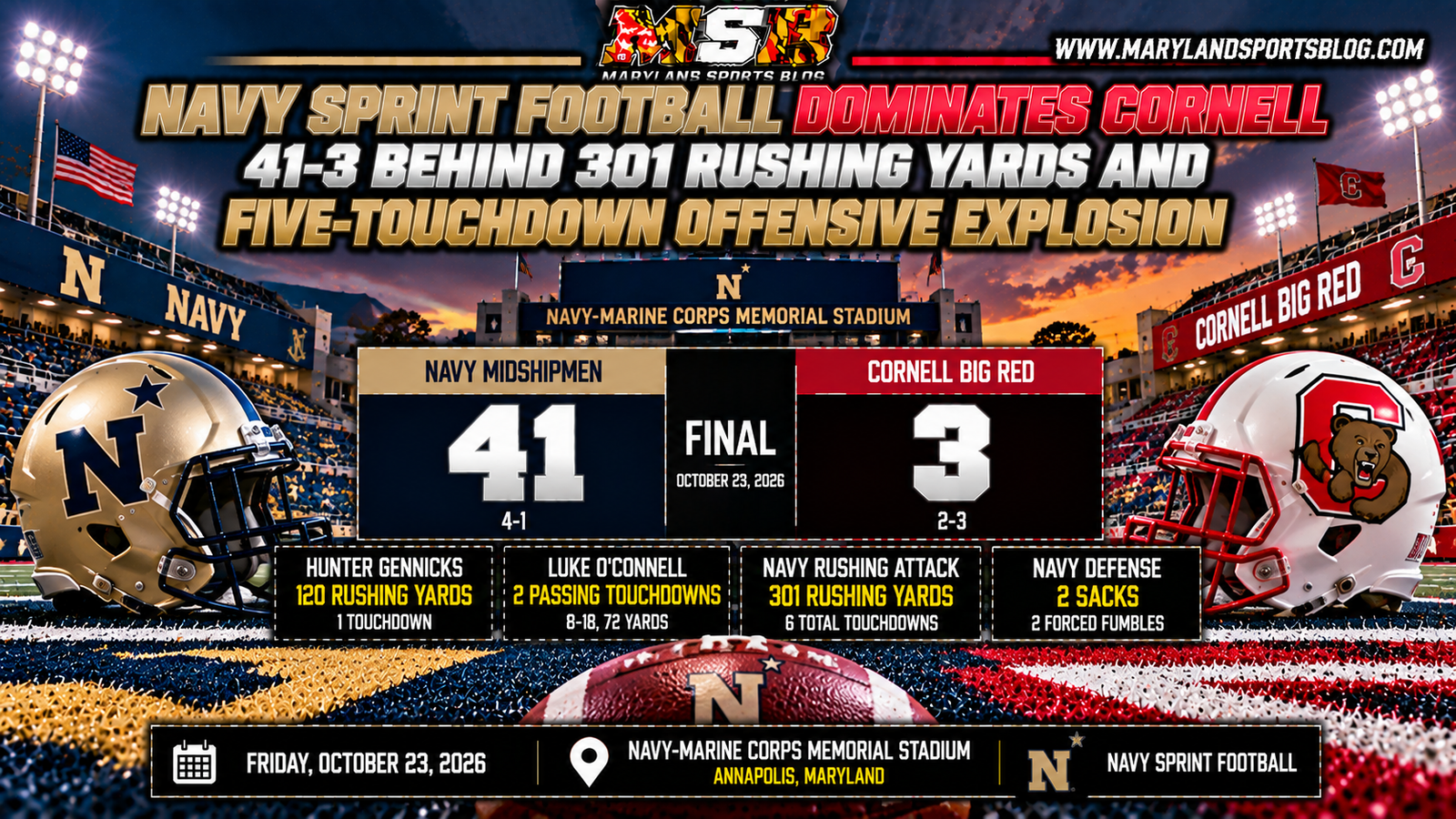
The Navy sprint football team delivered a commanding 41-3 victory over Cornell on Friday, October 23, at Navy-Marine Corps Memorial Stadium in Annapolis, Maryland. The Midshipmen rushed for 301 yards, generated 373 total yards and scored six touchdowns while limiting the Big Red to just 131 yards of offense. Running back Hunter Gennicks led Navy with 120 rushing yards and a touchdown, while quarterback Luke O’Connell threw two touchdown passes to help establish a commanding first-half advantage. The victory improved Navy to 4-1 overall, while Cornell dropped to 2-3 following a difficult afternoon against the Midshipmen’s rushing attack and defensive front.
Navy Establishes Control With Opening Touchdown
Navy wasted little time establishing offensive momentum, scoring on its opening possession to take a 7-0 lead. O’Connell directed a four-play, 45-yard drive that lasted just 2 minutes and 16 seconds before connecting with Philip Drexler for an 11-yard touchdown. Jack Skubin converted the extra point, giving the Midshipmen an early advantage with 11:45 remaining in the first quarter. The scoring drive demonstrated Navy’s ability to move the football efficiently while establishing its offensive identity.
Cornell attempted to respond, but Navy’s defensive unit prevented the Big Red from generating consistent offensive production. The Midshipmen maintained pressure near the line of scrimmage and limited Cornell’s ability to establish a rushing attack. Navy’s defensive execution helped protect the early lead and created opportunities for the offense to continue controlling the contest. The first quarter ended with the Midshipmen ahead 7-0.
The opening period provided an indication of how Navy intended to approach the game. Rather than relying on a high-volume passing attack, the Midshipmen emphasized their offensive line and rushing production. Their ability to gain yardage on the ground forced Cornell to commit additional defenders near the line of scrimmage. That approach created opportunities for O’Connell to contribute through the passing game when necessary.
Gennicks Extends Navy’s Advantage
Navy opened the second quarter with another impressive scoring drive, moving 80 yards in 10 plays to extend its advantage. Gennicks completed the possession with a 10-yard touchdown run at the 14:19 mark, giving the Midshipmen a 14-0 lead following Skubin’s extra point. The drive lasted 4 minutes and 12 seconds and demonstrated Navy’s ability to sustain possession through its rushing attack. Cornell struggled to contain the Midshipmen’s offensive line and physical running backs.
Gennicks continued producing significant yardage throughout the afternoon, finishing with 120 yards on 13 carries. His average of more than nine yards per rushing attempt demonstrated the effectiveness of Navy’s blocking and his ability to create additional yardage after reaching the second level. The running back consistently challenged Cornell’s defense and provided the Midshipmen with an important offensive foundation. His performance helped Navy finish with more than 300 rushing yards.
The touchdown also demonstrated Navy’s ability to capitalize on extended possessions. The Midshipmen converted scoring opportunities while preventing Cornell from generating sustained drives. Their combination of rushing efficiency and defensive pressure created a substantial advantage during the opening half. Navy continued building that lead before halftime.
O’Connell Connects With Nkere for Second Passing Touchdown
Navy extended its advantage to 20-0 midway through the second quarter when O’Connell connected with Biamungu Nkere for a 10-yard touchdown. The scoring play completed an eight-play, 49-yard drive that consumed 4 minutes and 26 seconds. Although the extra-point attempt failed, the Midshipmen maintained a commanding three-score advantage. The touchdown represented O’Connell’s second scoring pass of the afternoon.
O’Connell completed eight passes for 72 yards and two touchdowns, providing enough passing production to complement Navy’s dominant ground game. The quarterback also threw two interceptions, demonstrating that the passing attack was not without mistakes. However, his ability to deliver scoring passes during the opening half helped establish Navy’s advantage. The Midshipmen did not need significant passing yardage because their rushing attack consistently generated positive plays.
Jon Malatesta finished as Navy’s leading receiver in yardage, recording three catches for 31 yards. Drexler and Nkere provided the scoring receptions, giving Navy two different touchdown targets. The balanced contributions helped prevent Cornell from concentrating exclusively on the rushing attack. Navy’s offense generated 373 total yards despite attempting only 18 passes.
Cornell Scores Before Halftime
Cornell finally reached the scoreboard during the closing minute of the second quarter. The Big Red capitalized on an interception return that provided favorable field position, allowing kicker Miles Mariani to attempt a 40-yard field goal. Mariani converted the kick with 56 seconds remaining, reducing Navy’s advantage to 20-3. The possession covered only two yards in four plays, demonstrating Navy’s ability to prevent Cornell from capitalizing fully on the turnover.
The field goal represented Cornell’s only points of the afternoon. Navy’s defense prevented the Big Red from reaching the end zone despite several opportunities created by turnovers and field position. Cornell struggled to establish offensive consistency and could not generate enough explosive plays to challenge the Midshipmen. The visitors entered halftime facing a 17-point deficit.
Navy’s first-half performance demonstrated its superiority in the running game and ability to finish scoring opportunities. The Midshipmen had scored three touchdowns while holding Cornell to one field goal. Their offensive line consistently created running lanes, allowing Gennicks and the other backs to move the football. The defense also maintained control by limiting Cornell’s offensive production.
Freeman Adds Third-Quarter Touchdown
Navy resumed its offensive dominance during the third quarter with another extended scoring possession. The Midshipmen moved 71 yards in 10 plays, consuming 4 minutes and 56 seconds before Broderick Freeman scored on a 15-yard touchdown run. Gennicks converted the two-point attempt, extending Navy’s advantage to 28-3 with 9:59 remaining in the period. The drive reinforced Navy’s ability to control the game through physical rushing.
Freeman finished with 70 rushing yards on 11 carries, providing another important contribution to Navy’s ground attack. His production complemented Gennicks and gave the Midshipmen multiple dependable options in the backfield. Freeman’s ability to generate positive yardage helped Navy sustain drives and maintain offensive momentum. The combination of the two running backs accounted for 190 rushing yards.
Rhett Sypult also contributed 55 yards on just three carries, demonstrating Navy’s ability to generate explosive runs through different players. His average of more than 18 yards per attempt provided another example of the offensive line’s effectiveness. Navy finished with 42 rushing attempts and averaged 7.2 yards per carry. The Midshipmen consistently moved the football on the ground throughout the contest.
Keyt and Melton Finish Dominant Victory
Navy continued controlling the game during the fourth quarter, adding two rushing touchdowns to extend its advantage. Wyatt Keyt completed a seven-play, 53-yard drive with a two-yard touchdown run at the 9:00 mark. Although the extra-point attempt failed, the score gave the Midshipmen a 34-3 lead. Navy’s ability to maintain offensive production deep into the game demonstrated its rushing depth.
The Midshipmen added their final touchdown following a Cornell fumble that provided excellent field position. Navy recovered the loose football and moved 18 yards in four plays before Freddy Melton scored on a two-yard run with 2:06 remaining. Skubin converted the extra point, completing the 41-3 victory. The final touchdown demonstrated Navy’s ability to turn defensive takeaways into points.
The fourth-quarter production also highlighted Navy’s depth beyond its leading offensive contributors. Keyt and Melton joined Gennicks and Freeman as rushing touchdown scorers, giving the Midshipmen four different players with rushing scores. The balanced production made it difficult for Cornell to concentrate on any single runner. Navy finished with six offensive touchdowns, including four on the ground and two through the air.
Navy’s Defense Shuts Down Cornell
Navy’s defensive performance was equally important to the victory, as the Midshipmen limited Cornell to 131 total yards. The Big Red managed only 85 rushing yards on 36 attempts, averaging 2.4 yards per carry. Cornell also completed just seven of 21 passes for 46 yards, demonstrating the difficulty it experienced moving the football. Navy’s defense consistently prevented the visitors from establishing offensive momentum.
The Midshipmen recorded two sacks, with Drake Murrell and Sam Stotler each contributing one. Their pressure helped disrupt Cornell’s passing attack and created additional challenges for the Big Red’s offensive line. Navy also recovered two Cornell fumbles, with Lex Willson and Stotler securing the takeaways. The defensive effort provided additional scoring opportunities and helped prevent Cornell from mounting a comeback.
Cornell converted only three of 16 third-down attempts, reflecting Navy’s ability to finish defensive possessions. The Big Red also converted one of two fourth-down opportunities but struggled to generate sustained drives. Navy’s defensive discipline forced six punts and prevented Cornell from establishing a consistent offensive rhythm. The performance represented one of the Midshipmen’s strongest defensive efforts of the season.
Midshipmen Dominate Statistical Categories
Navy finished with 373 total yards compared with 131 for Cornell, establishing a 242-yard advantage. The Midshipmen also recorded 24 first downs, more than double Cornell’s 11. Navy generated 301 rushing yards while allowing only 85, demonstrating the difference between the teams’ ground attacks. The statistical advantages reflected Navy’s ability to control the line of scrimmage throughout the afternoon.
The Midshipmen also converted all six of their red-zone opportunities into points, demonstrating effective execution near Cornell’s goal line. Navy’s offensive efficiency helped overcome three turnovers, including two interceptions and one lost fumble. Although the mistakes provided Cornell with additional opportunities, the Big Red could not capitalize consistently. Navy’s defense prevented the turnovers from significantly affecting the final outcome.
Cornell controlled possession for 30 minutes and 30 seconds compared with Navy’s 29 minutes and 30 seconds, but the slight advantage did not translate into offensive production. The Midshipmen generated significantly more yardage on fewer plays, averaging 6.2 yards per offensive snap compared with Cornell’s 2.3. Navy’s ability to create explosive rushing plays allowed it to score without needing extended possession advantages. The result demonstrated the importance of efficiency rather than possession time alone.
Navy Improves to 4-1
The victory improved Navy’s record to 4-1 and provided another encouraging result during the 2026 sprint football season. The Midshipmen demonstrated their ability to dominate an opponent through physical rushing, efficient scoring and disciplined defense. Their offensive line played an important role in generating 301 rushing yards, while the defensive front prevented Cornell from establishing its own running game. The performance provided momentum heading into the final portion of the schedule.
Navy’s success also demonstrated the importance of receiving contributions from multiple players. Gennicks led the rushing attack, but Freeman, Sypult, Keyt and Melton also played important roles. O’Connell provided two passing touchdowns, while the defense generated two sacks and recovered two fumbles. The balanced performance allowed Navy to control the contest from the opening quarter.
The Midshipmen will now prepare for another road matchup as they continue pursuing a successful finish to the season. Their ability to maintain rushing efficiency and defensive consistency will remain important against stronger opponents. Navy will also need to reduce turnovers to avoid creating unnecessary scoring opportunities for opposing teams. The Cornell victory provides an encouraging foundation for those adjustments.
Navy Prepares for Mansfield
Navy will travel to Mansfield, Pennsylvania, on Friday, October 30, for a matchup against Mansfield University. Kickoff is scheduled for 7 p.m., giving the Midshipmen another opportunity to build on their strong performance against Cornell. The road contest will test Navy’s ability to maintain its offensive efficiency away from Annapolis. The team will look to extend its winning momentum.
The Midshipmen should enter the contest with confidence following their dominant rushing performance. Gennicks and Freeman have demonstrated the ability to generate significant yardage, while the offensive line has created consistent opportunities. O’Connell will look to improve his passing efficiency while continuing to contribute to the team’s scoring attack. Navy’s defense will attempt to maintain the pressure that limited Cornell to just three points.
The matchup against Mansfield provides another important opportunity for Navy to demonstrate progress. The Midshipmen have established a strong record through their first five games and will look to continue competing effectively during the remainder of the season. Maintaining discipline and protecting the football will be important priorities. Navy will attempt to carry its momentum into another challenging road environment.
MSB Take
Navy’s 41-3 victory over Cornell was an impressive demonstration of the Midshipmen’s ability to dominate through their offensive line and rushing attack. Gennicks delivered an outstanding performance with 120 yards and a touchdown, while Freeman contributed another 70 yards and a score. Sypult added 55 yards on just three carries, providing another explosive option. The team’s 301 rushing yards and 7.2 yards per carry demonstrated the effectiveness of its offensive approach.
The defense deserves equal recognition because limiting Cornell to 131 total yards and three points represented a complete performance. Murrell and Stotler contributed sacks, while Willson and Stotler recovered fumbles to create additional opportunities. Navy’s ability to limit Cornell to 2.4 yards per rushing attempt prevented the Big Red from establishing offensive consistency. The Midshipmen controlled both sides of the line of scrimmage and never allowed the visitors to become competitive after the opening quarter.
The biggest concern was Navy’s three turnovers, including two interceptions by O’Connell. Those mistakes did not change the outcome against Cornell, but stronger opponents could capitalize on similar opportunities. The Midshipmen must improve ball security while maintaining their physical rushing approach and defensive discipline. If Navy can reduce turnovers and continue generating balanced offensive production, the team has an opportunity to finish the sprint football season strongly.