
Maryland Volleyball Swept by Michigan State as Spartans Use Big Runs to Secure 3-0 Victory
By Brian Hradsky
October 26, 2026
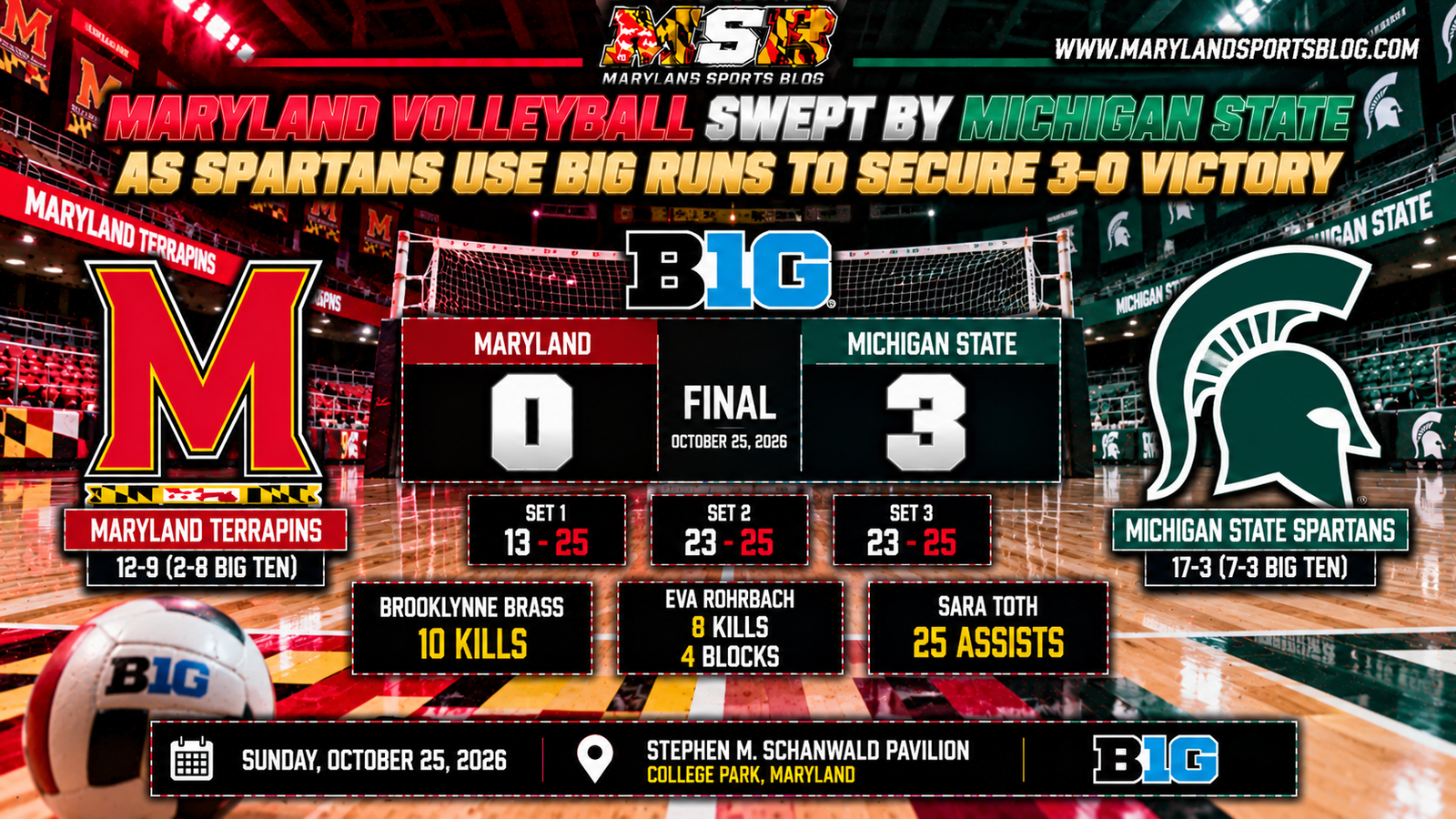
The University of Maryland women’s volleyball team suffered its fourth consecutive defeat Sunday afternoon, falling 3-0 to Michigan State at Stephen M. Schanwald Pavilion in College Park. The Spartans won by scores of 25-13, 25-23 and 25-23, using several decisive scoring runs to overcome Maryland’s resistance during the final two sets. Brooklynne Brass led the Terrapins with 10 kills, while Eva Rohrbach added eight kills and four blocks and Sara Toth recorded 25 assists. The loss dropped Maryland to 12-9 overall and 2-8 in Big Ten competition, while Michigan State improved to 17-3 overall and 7-3 in conference play.
Michigan State Takes Control With Dominant First Set
Maryland opened Sunday’s matchup looking to rebound from Friday’s five-set loss to Illinois, but Michigan State quickly established control during the opening frame. Brass recorded the first kill of the afternoon, and Rohrbach helped the Terrapins establish a 4-3 advantage with another successful attack. The early exchanges suggested that Maryland could challenge a Michigan State team that had entered the weekend receiving votes in the national rankings. However, the Spartans responded with the most decisive scoring run of the match.
Michigan State produced an overwhelming 14-1 run that completely changed the opening set. Maryland struggled to maintain offensive possession and could not consistently challenge the Spartans’ defense during the stretch. The run turned a competitive opening into a commanding Michigan State advantage and forced the Terrapins to spend the remainder of the set attempting to recover. The Spartans maintained control and eventually secured a 25-13 victory.
Elayna Davidson provided a late service ace for Maryland, but the Terrapins could not overcome the substantial deficit. Michigan State’s ability to produce consecutive points demonstrated the importance of limiting opponent scoring runs in Big Ten competition. Maryland needed to improve its passing, attacking efficiency and defensive execution to remain competitive. The Terrapins responded with a much stronger effort during the second set.
Maryland Builds Second-Set Lead Before Spartans Rally
Michigan State opened the second set with three consecutive points, immediately placing Maryland under pressure. Brass responded by recording the Terrapins’ first two kills of the frame, helping stabilize the offense. Sydney Bryant then contributed an important kill during a 6-1 Maryland stretch that gave the home team its first lead of the set. The improved performance demonstrated Maryland’s ability to recover from the difficult opening frame.
The teams continued exchanging scoring runs before Michigan State reclaimed a 13-12 advantage with a service ace. Maryland responded with one of its strongest stretches of the afternoon, using a 5-0 run to move ahead 17-13. Raina Chwialkowski contributed an ace during the sequence, providing an important boost for the Terrapins. Maryland appeared positioned to even the match after establishing a four-point advantage.
However, Michigan State responded with a devastating 9-1 run that erased Maryland’s lead and restored control. The Spartans capitalized on offensive opportunities while the Terrapins struggled to maintain consistency. Rohrbach eventually delivered a kill to give Maryland its 20th point of the set, and Bryant tied the score at 23-23 with another successful attack. Despite the late response, Michigan State claimed the final two points to secure a 25-23 victory.
The second-set defeat was particularly frustrating because Maryland had created an opportunity to change the direction of the match. The Terrapins demonstrated stronger offensive execution and briefly controlled the momentum, but their inability to stop Michigan State’s extended scoring run proved costly. The Spartans entered the third set holding a 2-0 advantage. Maryland needed to win three consecutive frames to complete a comeback.
Terrapins Fight Back During Competitive Third Set
Maryland began the third set with renewed energy, receiving an opening kill from Ava Brown. Brass added another kill to give the Terrapins a 4-3 advantage, while Ioanna Dimitriou contributed a successful attack that moved Maryland ahead 7-6. The early exchanges demonstrated that the Terrapins remained competitive despite trailing in the match. Michigan State responded with a service ace to take a 9-8 lead.
Brass helped Maryland regain momentum by delivering a service ace during a 3-0 scoring run. The Terrapins continued generating offense and established a 15-12 advantage at the media timeout. Maryland appeared capable of extending the contest to a fourth set after building another three-point lead. However, Michigan State once again demonstrated its ability to respond during important stretches.
The Spartans battled back to establish a 17-16 advantage, forcing Maryland to produce another response. Dimitriou recorded a kill to put the Terrapins ahead, while Brown contributed an important attack that gave Maryland its 20th point. The teams continued competing closely during the final exchanges, but Michigan State executed more effectively during the closing points. The Spartans secured another 25-23 victory to complete the three-set sweep.
The narrow second- and third-set results demonstrated that Maryland could compete with Michigan State for extended stretches. However, the Terrapins struggled to protect leads and prevent their opponent from producing decisive scoring runs. Those problems ultimately prevented Maryland from extending the match. The defeat highlighted the importance of maintaining consistent execution throughout complete sets.
Brass Leads Maryland With 10 Kills
Brass finished as Maryland’s leading attacker, recording 10 kills against Michigan State’s defensive unit. The outside hitter also contributed a service ace and provided several important points during the second and third sets. Her ability to generate offense helped Maryland remain competitive after the difficult opening frame. The Terrapins relied on her production during several important scoring sequences.
Brass opened the match with a kill and contributed Maryland’s first two successful attacks during the second set. She also helped the Terrapins establish early advantages during the third frame. Her consistency provided an important offensive option when Michigan State increased its defensive pressure. However, Maryland needed greater production throughout its lineup to challenge the Spartans effectively.
The performance represented another encouraging contribution from Brass during a difficult portion of the conference schedule. Maryland has relied on several attackers to generate offense, but maintaining balanced production has become increasingly important against strong Big Ten opponents. Brass demonstrated that she could contribute during competitive stretches. The Terrapins will look for continued consistency from her during their upcoming road trip.
Rohrbach Provides Strong Defensive Presence
Rohrbach delivered another important performance for Maryland, finishing with eight kills and four blocks. Her defensive contributions helped the Terrapins challenge Michigan State near the net, particularly during the second and third sets. The middle blocker also provided important offensive production when Maryland needed to end scoring runs. Her versatility remained valuable against a physical Spartans lineup.
Rohrbach’s four blocks accounted for a significant portion of Maryland’s six team blocks. Her ability to challenge opposing attackers demonstrated the importance of strong positioning and timing at the net. The Terrapins needed that defensive presence against a Michigan State team that finished with 45 kills. However, the Spartans maintained a substantial advantage in overall blocking production.
Maryland will continue relying on Rohrbach to provide leadership near the net as the conference schedule progresses. Her ability to contribute offensively and defensively gives the Terrapins another dependable option. Improving the team’s overall blocking coordination could help reduce opponents’ scoring opportunities. Rohrbach’s performance provides a foundation for those adjustments.
Brown and Toth Contribute to Maryland’s Offense
Brown finished with seven kills, giving Maryland another important attacking contributor. She opened the third set with a successful attack and later provided the Terrapins with their 20th point during the final frame. Her ability to produce timely kills helped Maryland remain competitive during the closing stages. The Terrapins will need continued production from Brown against upcoming opponents.
Toth recorded 25 assists, directing Maryland’s offense throughout the three-set contest. The setter helped distribute opportunities among Brass, Rohrbach, Brown and the team’s other attackers. Her contributions were important during the second and third sets when Maryland established several leads. However, the Terrapins struggled to maintain consistent offensive efficiency against Michigan State’s defensive pressure.
Bryant contributed four kills, including important attacks during Maryland’s second-set comeback attempt. Dimitriou also provided timely offense during the third set, helping the Terrapins challenge Michigan State’s lead. Those contributions demonstrated that Maryland has several players capable of producing important points. The challenge remains maintaining that production consistently throughout the match.
Michigan State Dominates Key Statistical Categories
Michigan State finished with 45 kills compared with 33 for Maryland, giving the Spartans a substantial advantage in offensive production. The visitors recorded a .276 hitting percentage while holding the Terrapins to .147. Both teams committed 18 attacking errors, but Michigan State generated 12 additional kills on four fewer attempts. The difference demonstrated the Spartans’ ability to convert opportunities more efficiently.
The Spartans also controlled the blocking battle, finishing with 11 team blocks compared with six for Maryland. Michigan State’s defensive presence limited the Terrapins’ attacking options and contributed to several extended scoring runs. The visitors also recorded six service aces while Maryland finished with three. Those statistical advantages helped explain why Michigan State prevailed despite two closely contested sets.
Maryland finished with 31 assists compared with 44 for Michigan State, reflecting the difference in successful attacking opportunities. The Spartans generated 62 total points through kills, aces and blocks, while Maryland finished with 42. The Terrapins demonstrated competitive stretches but could not match Michigan State’s overall efficiency. Improving offensive consistency will be important during the remainder of the season.
Fourth Consecutive Loss Creates Big Ten Challenges
Sunday’s defeat extended Maryland’s losing streak to four matches, continuing a difficult stretch against conference opponents. The Terrapins previously suffered straight-set defeats against No. 6 Wisconsin and No. 21 Minnesota before falling to Illinois in five sets Friday. Michigan State became the latest opponent to capitalize on Maryland’s inconsistency. The four-match skid has dropped the Terrapins to 2-8 in Big Ten competition.
Maryland began the season with a strong 10-1 nonconference record, demonstrating its ability to compete effectively against several opponents. However, the transition to Big Ten competition has presented a much more demanding challenge. The conference features nationally competitive programs with strong offensive systems and defensive depth. Maryland must improve its consistency to produce more conference victories.
The Terrapins have demonstrated that they can compete against quality opponents during individual sets. Their victories over Iowa and Northwestern earlier in conference play showed their ability to finish close matches successfully. However, recent losses have highlighted problems protecting leads and maintaining offensive efficiency. The coaching staff must focus on reducing extended scoring droughts.
Maryland Prepares for Difficult West Coast Road Trip
The Terrapins will travel west for their next two Big Ten matches, beginning Friday, October 30, against No. 25 Oregon. The contest is scheduled for 10 p.m. Eastern and will be available on Big Ten Plus. Maryland will also face Washington during the road trip, creating another challenging stretch against conference opponents. The team will need to make adjustments before facing two competitive programs.
Maryland’s offensive execution will be an important priority following its .147 hitting percentage against Michigan State. The Terrapins must improve their ability to finish attacking opportunities while reducing mistakes during important scoring sequences. Stronger blocking and defensive positioning could also help prevent opponents from establishing extended runs. Those adjustments will be necessary against Oregon and Washington.
The road trip provides Maryland with an opportunity to respond after four consecutive defeats. Although the conference record has become challenging, the Terrapins still have opportunities to demonstrate improvement during the second half of the Big Ten schedule. Brass, Rohrbach, Brown and Toth will remain important contributors. Maryland must combine their individual performances with more consistent team execution.
MSB Take
Maryland’s 3-0 loss to Michigan State was disappointing because the Terrapins demonstrated enough competitiveness during the second and third sets to extend the match. After losing the opening frame 25-13, Maryland responded with improved offensive production and established leads during both remaining sets. However, the Spartans repeatedly produced scoring runs that erased those advantages. The 14-1 run during the first set and 9-1 run during the second demonstrated the biggest difference between the teams.
Brass deserves recognition for leading Maryland with 10 kills, while Rohrbach provided another strong performance with eight kills and four blocks. Toth contributed 25 assists, helping the Terrapins generate opportunities against a difficult opponent. However, Maryland’s .147 hitting percentage was not enough to challenge Michigan State consistently. The Spartans’ 11-6 blocking advantage also demonstrated the importance of improving execution near the net.
The biggest concern is Maryland’s inability to maintain momentum after establishing leads against conference opponents. The Terrapins have shown that they can compete during individual stretches, but successful Big Ten teams consistently finish close sets and prevent extended scoring droughts. Maryland’s upcoming West Coast trip will provide another difficult test, particularly against ranked Oregon. If the Terrapins can improve their attacking efficiency, strengthen their blocking and reduce opponent scoring runs, they have an opportunity to become more competitive during the remainder of the season.