
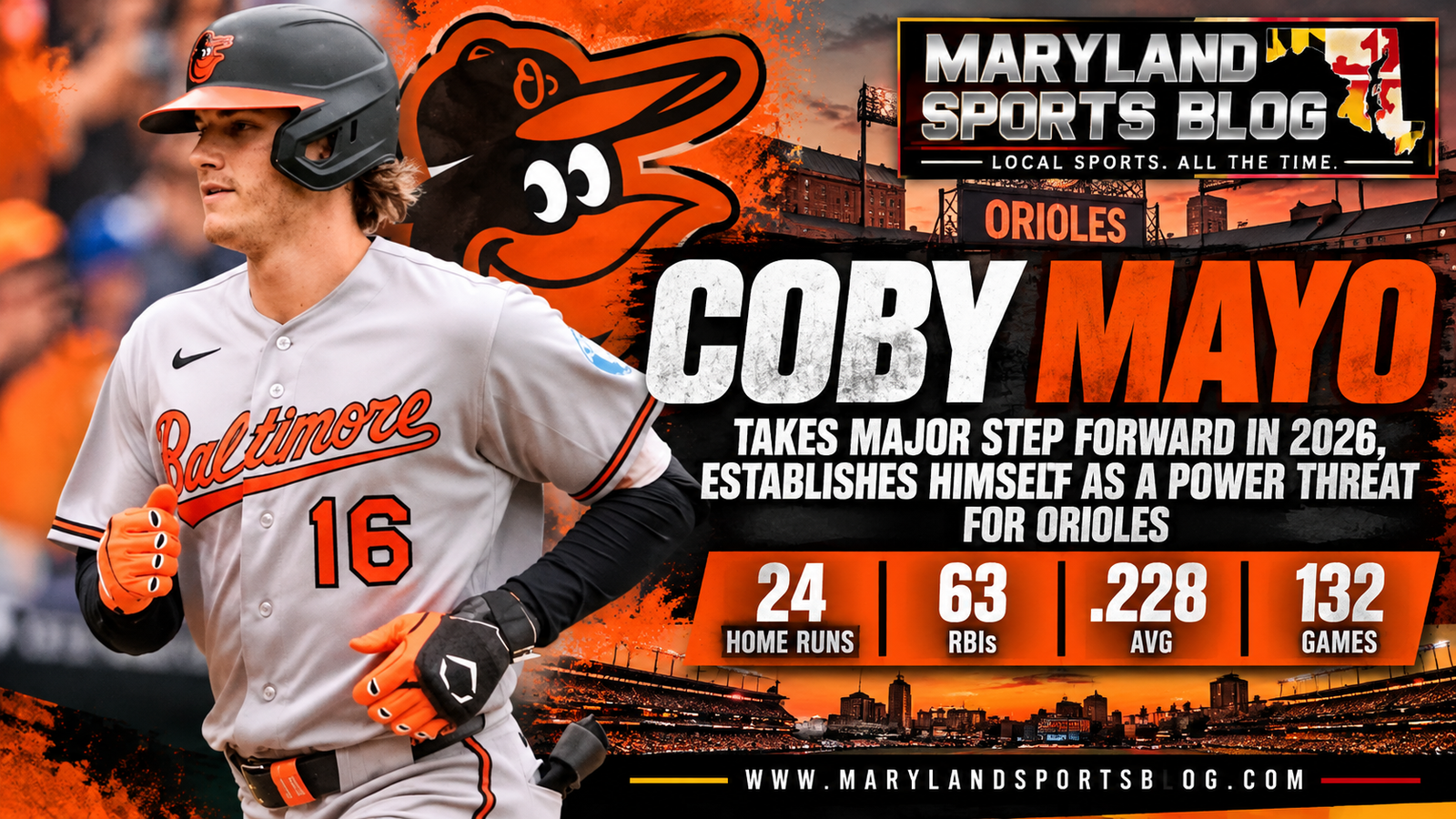
Coby Mayo Takes Major Step Forward in 2026, Establishes Himself as a Power Threat for Orioles
By Brian Hradsky
The Baltimore Orioles entered the 2026 season hoping that Coby Mayo would begin turning his considerable potential into consistent major league production. After a difficult introduction to the big leagues and an uneven 2025 campaign, the former top prospect faced questions about his offensive development, defensive future and long-term role in Baltimore.
By the end of 2026, Mayo had delivered the most productive season of his young major league career. The 24-year-old appeared in 132 games, batting .228 with 24 home runs, 63 RBIs and a .759 OPS. His production represented a significant improvement over 2025, particularly in the power department, where he more than doubled his previous season’s home run total.
Mayo’s season was far from perfect, but his emergence as a legitimate power threat provided Baltimore with an encouraging development. His ability to punish left-handed pitching, improved second-half production and growing defensive versatility demonstrated that he could contribute at the major league level. However, continued struggles against right-handed pitching and uncertainty surrounding his defensive position leave important questions entering 2027.
Coby Mayo’s 2026 Season by the Numbers
Mayo appeared in 132 games during the 2026 regular season, collecting 94 hits, 24 home runs and 63 RBIs while batting .228. He finished with a .297 on-base percentage, .461 slugging percentage and .759 OPS. His 112 OPS+ indicated that his overall offensive production was 12 percent better than the league average after accounting for ballpark factors.
The improvement was noticeable compared with his 2025 campaign, when he appeared in 85 games and batted .217 with 11 home runs, 28 RBIs and a .687 OPS. Mayo more than doubled his home run total and demonstrated greater consistency in generating extra-base hits. However, his strikeout total increased from 84 to 138 as his playing time expanded.
A Difficult Beginning Followed by an Offensive Breakthrough
Mayo’s 2026 campaign began with many of the same problems that had limited his production during his first two major league seasons. He struggled to consistently make contact, experienced difficulties against major league breaking pitches and failed to generate enough offense to complement his impressive raw power.
Through 74 games before the All-Star break, Mayo was batting just .193 with a .659 OPS. Those numbers raised legitimate concerns about whether he was ready to become a dependable everyday contributor. Despite possessing some of the best raw power in Baltimore’s organization, Mayo had yet to demonstrate that he could consistently translate that strength into major league production.
The second half offered a much different picture. During a September report, MLB.com noted that Mayo was batting .274 with a .911 OPS across 44 second-half contests at that point. The improvement suggested that adjustments to his batting stance, swing mechanics and overall approach were beginning to produce results.
Mayo also began demonstrating a greater willingness to use the entire field instead of relying exclusively on pulling the baseball for power. Orioles manager Craig Albernaz praised his development and adjustments, particularly his more upright batting stance. Those changes helped Mayo become a more dangerous hitter as the season progressed and offered encouraging evidence that his improvement was not simply the product of a brief hot streak.
Mayo Becomes One of Baseball’s Most Dangerous Hitters Against Left-Handed Pitching
One of the most remarkable aspects of Mayo’s season was his dominance against left-handed pitchers. The right-handed slugger finished with a .322 batting average, .393 on-base percentage and .712 slugging percentage against lefties. He also launched 16 home runs in just 146 at-bats, making him one of baseball’s most productive hitters in those matchups.
Unfortunately, that success also exposed the biggest weakness in Mayo’s offensive profile. Against right-handed pitching, Mayo batted just .177 with eight home runs and 97 strikeouts in 266 at-bats. The disparity was significant enough to raise questions about whether he can become a consistently productive everyday hitter without making further adjustments.
For Baltimore, the challenge will be helping Mayo become more competitive against right-handed pitchers without sacrificing the power that makes him dangerous. His ability to crush left-handed pitching gives him an important role regardless of what happens next, but a more balanced offensive approach would substantially increase his value.
Strikeouts Remain a Significant Concern
Despite his offensive improvement, Mayo continued to strike out at an alarming rate. He finished 2026 with 138 strikeouts in 454 plate appearances, producing a strikeout rate of approximately 30.4 percent. That represented an increase from his 28.6 percent rate in 2025 and remained well above the major league average.
However, there were encouraging developments beneath those numbers. Mayo increased his average exit velocity to 91.3 mph and posted a 47.3 percent hard-hit rate, both significant improvements over the previous season. His isolated power also jumped from .171 to .233, demonstrating that his increased home run production reflected more consistent hard contact.
The challenge moving forward will be improving his contact rate without compromising his ability to drive the baseball. Mayo does not necessarily need to become a .300 hitter to succeed, but reducing his strikeouts and improving his on-base percentage would make him considerably more valuable. If he can bring his strikeout rate closer to 25 percent while maintaining his power, his offensive ceiling could rise substantially.
Defensive Development and an Uncertain Position
Mayo’s defensive responsibilities changed considerably during the season. After spending much of 2025 learning first base, he returned to third base in 2026 following Jordan Westburg’s injury. The transition gave Mayo an opportunity to establish himself at his original position, but it also exposed some continuing defensive limitations.
Mayo appeared in 76 games at third base, making 67 starts and committing seven errors. His .951 fielding percentage reflected the challenges he faced, while advanced defensive measurements also suggested that his performance at the position remained below average. He additionally appeared at first base and designated hitter, providing the Orioles with some positional flexibility.
There were encouraging individual plays and improvements in his preparation. Mayo worked extensively with infield coach Miguel Cairo and demonstrated a willingness to address his defensive weaknesses. His commitment to improving at third base was evident, although the results suggest he remains a work in progress.
The Orioles will need to determine whether Mayo can become an adequate defensive third baseman or whether his long-term value is better realized at first base or designated hitter. That decision is complicated by Baltimore’s existing personnel, particularly Pete Alonso at first base and the potential return of a healthy Westburg to third.
A Memorable September Moment Against the Mets
One of Mayo’s most memorable moments came September 15 against the New York Mets. With the game tied in the 11th inning, Mayo drove a ball deep into center field that resulted in a three-run, inside-the-park home run. The unusual play helped Baltimore secure a 7-4 victory in extra innings.
The moment highlighted Mayo’s ability to produce a decisive offensive contribution in a close game. Although the inside-the-park home run resulted partly from the center fielder’s difficulty handling the ball near the wall, Mayo’s deep drive ultimately provided the decisive runs. It was the type of memorable moment that can help a young player build confidence and establish himself with a fan base.
Mayo also demonstrated greater consistency during the final months of the season. He batted .272 in August with five home runs and 15 RBIs, then followed with a .269 average, five home runs and a .352 on-base percentage in September. That late-season production helped transform what initially appeared to be another disappointing year into a meaningful developmental success.
What Does 2027 Hold for Mayo?
Mayo enters the offseason having established himself as a major league-caliber power hitter, but the Orioles face difficult decisions regarding his playing time. With Alonso occupying first base, Westburg potentially returning to third and Christian Encarnacion-Strand also deserving opportunities, Baltimore has more corner-infield options than available everyday positions.
The Orioles could use Mayo in a rotating designated hitter role, continue developing him at third base or explore other roster arrangements. Trading one of their young corner infielders is another possibility, although moving Mayo immediately after his offensive breakthrough would carry considerable risk. Baltimore must balance its immediate competitive needs with the long-term development of a player who still possesses considerable offensive upside.
Mayo’s development should remain a priority because his offensive ceiling is still significant. He has already demonstrated the ability to hit more than 20 home runs in a season, and his improved quality of contact suggests that additional production is possible. If Baltimore can find him regular at-bats while helping him improve against right-handed pitching, Mayo could become an important contributor to the next competitive Orioles lineup.
MSB Take: Mayo Has Earned Another Opportunity
Coby Mayo’s 2026 season should be considered a success, even with the obvious flaws in his overall performance. A player who struggled to establish himself in the major leagues finished with 24 home runs, 63 RBIs and an OPS above .750. His power production and second-half improvement provided evidence that the Orioles’ patience with their former top prospect was beginning to pay off.
The biggest concern remains his inability to consistently handle right-handed pitching. A .177 batting average against righties is not sustainable for a player expected to become an everyday middle-of-the-order hitter. Mayo must also improve his defensive consistency, particularly if Baltimore intends to keep him at third base rather than using him primarily as a designated hitter.
Still, the Orioles should not overlook what Mayo accomplished at just 24 years old. His offensive improvement was substantial, his power is legitimate and his willingness to make adjustments offers reason for optimism. Baltimore should enter 2027 committed to finding him consistent playing time rather than allowing another crowded roster situation to stall his development.
MSB 2026 Season Grade: B
Mayo did not deliver a complete breakout season, but he made meaningful progress toward becoming the impact hitter Baltimore envisioned when it drafted him. His next challenge will be proving that his second-half success can translate into a full season of consistent production.
Coby Mayo Takes Major Step Forward in 2026, Establishes Himself as a Power Threat for Orioles