
Jackson Holliday’s Injury-Plagued 2026 Season Leaves Orioles Wanting More: MSB Grade C+
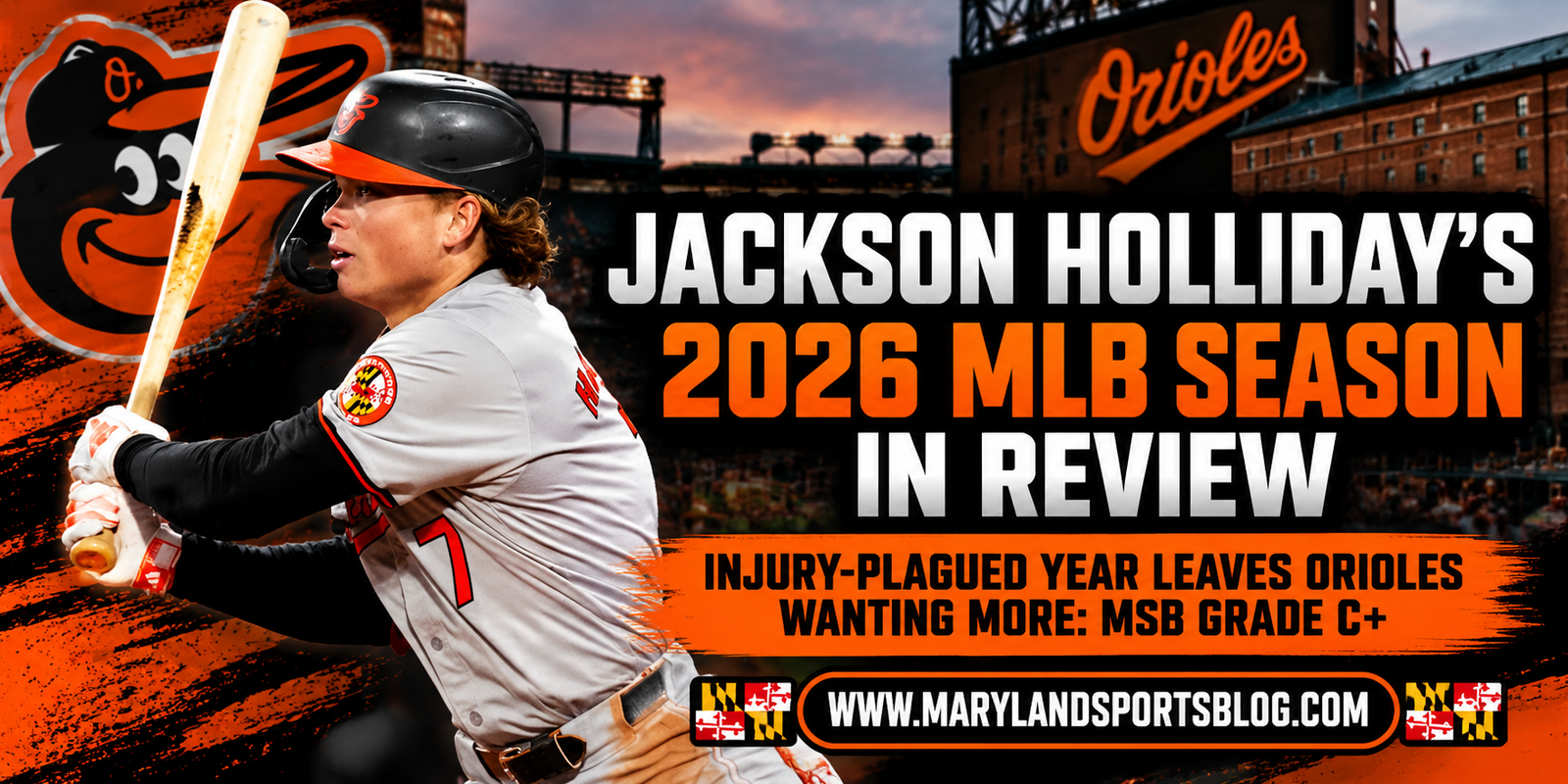
Jackson Holliday entered 2026 needing to take another significant step toward becoming the cornerstone player the Baltimore Orioles envisioned when they selected him No. 1 overall in the 2022 MLB Draft. Instead, his third Major League season became another complicated chapter, as injuries robbed Holliday of valuable time and likely prevented him from ever getting completely comfortable physically. Holliday finished the season batting .229 with seven home runs, 30 RBIs, 45 runs, 12 doubles and eight stolen bases in 98 games, producing a .300 on-base percentage, .340 slugging percentage and .640 OPS.
Those numbers are disappointing when viewed by themselves, particularly after Holliday appeared to establish a foundation during his first full season in 2025. He hit .242 with 17 home runs, 55 RBIs, 17 stolen bases and a .690 OPS across 149 games that year, making 2026 look like a statistical regression. However, Holliday’s season cannot be evaluated fairly without considering how much time he spent dealing with injuries to both hands and wrists.
MSB’s final grade for Holliday’s 2026 season is a C+. There were stretches when he looked like the player Baltimore has been waiting to see, most notably during an outstanding July, but there were also prolonged periods when he struggled to drive the baseball and consistently impact games offensively. The injuries provide legitimate context and keep the grade from dropping further, but a former No. 1 overall pick entering his fourth MLB season in 2027 will need to begin turning flashes into sustained production.
An Injury Before the Season Even Started
Holliday’s problems began before he ever had an opportunity to play a regular-season game. He fractured the hamate bone in his right hand while hitting in the cage after reporting early to Baltimore’s Spring Training complex in Sarasota, Florida, and underwent surgery Feb. 12 to remove the fractured hook of the hamate. The injury immediately eliminated his chance to have a normal Spring Training and forced him onto the injured list to begin the season.
That matters significantly when evaluating what followed because Holliday was a 22-year-old player still trying to establish himself at the Major League level. Instead of spending February and March refining his swing, seeing Major League pitching and preparing normally for Opening Day, he spent much of that period rehabilitating his hand. The Orioles initially hoped he could return around the middle of April, but his recovery proved much more complicated than expected.
Holliday played 11 rehabilitation games with Triple-A Norfolk from March 27 through April 12 before renewed right wrist discomfort forced Baltimore to stop the assignment. He later appeared for High-A Frederick and returned to Norfolk, only to experience another frightening episode when a swing produced enough pain that Holliday said it felt as though he had broken his hand again. MRI, CT and X-ray examinations showed no new structural damage, but inflammation and discomfort continued delaying his return.
That sequence should not be overlooked when judging his season. Holliday did not simply miss Opening Day, recover and immediately return at full strength; he essentially spent the first seven weeks of the regular season trying to get his right hand comfortable enough to withstand Major League swings. Baltimore finally activated him in May, with his season debut coming May 19 against Tampa Bay.
Holliday Finally Returns
Holliday’s first two games produced no hits, but he provided an encouraging moment May 22 against the Detroit Tigers at Camden Yards. He connected for his first home run of the season, a two-run shot down the left-field line that helped Baltimore earn a 7-4 victory. The home run traveled only a Statcast-projected 337 feet, but after everything Holliday endured during his rehabilitation, simply seeing him driving a baseball over a Major League fence was encouraging.
He ultimately played 12 games during May and hit .242 with a .333 on-base percentage and .424 slugging percentage while hitting two home runs and stealing three bases. June proved much more difficult, as Holliday hit only .179 across 23 games despite producing three home runs. He struck out 23 times in 67 at-bats that month, showing that his timing and consistency were still far from where Baltimore needed them.
Considering how little normal preparation Holliday received, some early inconsistency was predictable. Major League pitching is difficult enough for a healthy 22-year-old, and Holliday was essentially trying to conduct his Spring Training during meaningful games. The encouraging part was that Baltimore eventually saw a stretch demonstrating exactly why Holliday remains such an intriguing young player.
July Showed What Holliday Can Become
July was unquestionably the highlight of Holliday’s season and perhaps the most encouraging sustained offensive stretch of his Major League career. Holliday batted .368 with a .500 on-base percentage and .421 slugging percentage during 23 games, collecting 21 hits, drawing 16 walks and scoring nine runs. His .921 OPS during the month showed a much more mature offensive approach than his overall season numbers suggest.
The most impressive part was not power but Holliday’s ability to control the strike zone and reach base. After years of discussion about whether his minor-league plate discipline would translate against Major League pitching, Holliday suddenly looked extremely comfortable taking pitches, working counts and forcing pitchers into the strike zone. His 16 walks against only 11 strikeouts during July represented exactly the type of plate discipline Baltimore hoped would eventually become a defining part of his offensive game.
There were also individual performances that demonstrated how dangerous Holliday could become. He collected four hits against Detroit on July 27 and followed with two-hit games July 28 and July 29, helping him finish the month on an impressive run. For several weeks, Holliday looked less like a talented player trying to survive in the majors and more like a legitimate top-of-the-order hitter.
That month is an important reason MSB is giving Holliday a C+ rather than something lower. A player does not accidentally reach base half the time for nearly an entire month against Major League pitching, even if the sample remains relatively small. Holliday demonstrated that the advanced approach and pure hitting ability that made him baseball’s top prospect still exist.
August Changed the Story
Unfortunately, Holliday could not maintain that production. His average crashed to .185 in August, while his on-base percentage dropped to .226 and his slugging percentage fell to .269 across 28 games. After hitting .368 in July, Holliday suddenly looked like a completely different hitter.
He produced only one home run in August and struck out 26 times while drawing six walks. Baltimore increasingly needed Holliday to become an offensive catalyst as the Orioles fought to remain in the American League Wild Card race, but his production moved sharply in the opposite direction. The contrast between July and August became one of the defining elements of his season.
Holliday never truly recovered offensively before his season ended. He hit .220 with a .220 on-base percentage and .300 slugging percentage in 12 September games, producing one home run and three RBIs. Even more concerning, he did not draw a walk in his final 50 at-bats.
We now know there was additional physical context behind the late-season decline. Orioles manager Craig Albernaz said Holliday had been dealing with his left wrist issue for a while and had continued playing through it before Baltimore finally placed him on the injured list. That does not prove every August and September struggle resulted from the wrist, but it makes it reasonable to question how close Holliday was to full strength while his production deteriorated.
The Injuries Likely Never Allowed Holliday to Reach Full Speed
This is ultimately the biggest takeaway from Holliday’s season. He began the year recovering from surgery on his right hand/wrist, experienced multiple setbacks while trying to return, missed all of April and most of May, and eventually finished the season because of an injury to his left wrist. It is difficult to imagine that Holliday ever had an extended period during 2026 when he felt completely normal physically.
The left wrist problem ultimately proved more significant than inflammation. Holliday was diagnosed with a partial tear of the triangular fibrocartilage complex, commonly called the TFCC, and the Orioles announced that he would undergo surgery after meeting with a wrist specialist. Holliday was told to expect roughly a 10-week recovery, with Baltimore optimistic that he should be ready for Spring Training in 2027.
The Statcast numbers also provide evidence that Holliday was not impacting the baseball as well as he did the previous season. His average exit velocity declined from 88.8 mph in 2025 to 87.0 mph in 2026, while his hard-hit percentage dropped from 40.8 percent to 34.1 percent and his barrel rate decreased from 7.8 percent to 6.6 percent. His expected slugging percentage also fell from .404 to .360.
Those declines are especially noteworthy for a hitter who spent virtually the entire season dealing with hand and wrist problems. Both areas are critical to generating bat speed, controlling the barrel and driving the baseball, so it is reasonable to believe the injuries contributed to his reduced impact. That does not mean every offensive issue can be blamed on health, but Holliday deserves the opportunity to enter 2027 healthy before Baltimore makes any sweeping conclusions about his offensive ceiling.
There Were Still Positive Developments
One positive was Holliday’s walk rate. His Baseball-Reference walk percentage increased from 8.6 percent in 2025 to 9.6 percent in 2026, while his July performance showed what happens when his strike-zone awareness is working at its highest level. Holliday has always possessed advanced plate discipline, and maintaining that skill could eventually allow him to develop into a quality leadoff or No. 2 hitter.
His speed also remained an asset despite the injuries. Holliday stole eight bases in 11 attempts, and Statcast measured his sprint speed at 28.8 feet per second, ranking 74th among Major League players tracked on the leaderboard. That was actually slightly better than his 28.6 feet-per-second mark from 2025.
Holliday also continued gaining experience around the infield. He appeared in 85 games at second base while also seeing action at shortstop and third base, although second base clearly remained his primary position. His defensive metrics were not particularly impressive at second, with Baseball-Reference crediting him with minus-three defensive runs saved there, but the overall defensive picture was less damaging than it had been in 2025.
There is still plenty for Holliday to improve defensively. He committed six errors at second base and posted a .981 fielding percentage compared with a .983 league mark at the position, while Statcast credited him with minus-one Outs Above Average at second. He does not need to become an elite defender to justify an everyday role, but Baltimore needs him to become dependable enough that his glove does not diminish the value he eventually provides offensively.
The Overall Numbers Were Not Good Enough
Ultimately, Holliday’s complete offensive line cannot simply be excused because of injuries. His .229/.300/.340 slash line and .640 OPS represented a decline from the .242/.314/.375 and .690 OPS he produced in 2025. His OPS+ dropped from 95 to 82, meaning his overall offensive production was well below league average after he had come relatively close to average production the previous season.
Holliday also finished with only seven home runs after hitting 17 the previous season. Playing 51 fewer games obviously accounts for a significant portion of that decline, but his isolated power dropped from .133 to .111 and his home-run rate decreased from 2.6 percent of plate appearances to 2.0 percent. He finished the year worth only 0.2 Baseball-Reference WAR after producing 1.1 WAR in 2025.
The strikeouts remain another area Baltimore will want to see improve. Holliday struck out 84 times in 354 plate appearances, and his strikeout percentage increased from 21.6 percent in 2025 to roughly 24 percent in 2026. That is not disastrous for a 22-year-old Major League hitter, but Holliday’s offensive profile becomes much more valuable if he can combine his patience with more consistent contact.
Still, context matters when evaluating a young player, and Holliday’s context was unusually difficult. He did not have a normal Spring Training, underwent surgery before Opening Day, experienced pain during multiple rehabilitation attempts, returned in late May and eventually played through an injury to the opposite wrist. Asking him to simultaneously develop as a Major League hitter while navigating all of that was a difficult assignment.
Comparing Holliday’s First Three Seasons
The broader concern is that Baltimore is now three seasons into Holliday’s Major League career without seeing the sustained breakout many expected. He debuted in 2024 and hit .189 with five home runs and a .565 OPS across 60 games, improved considerably to .242 with 17 home runs and a .690 OPS across 149 games in 2025, then slipped to .229 with seven home runs and a .640 OPS during this injury-shortened season. Through his first 307 Major League games, Holliday owns a career .229/.300/.354 slash line with 29 home runs, 108 RBIs and an 86 OPS+.
That is clearly below what anyone expected from a player once considered the best prospect in baseball. However, Holliday also just completed his age-22 season, meaning there remains substantial developmental time ahead of him. The Orioles should be concerned about the lack of sustained production without becoming impatient enough to forget how young he still is.
The July stretch should particularly encourage Baltimore. Holliday showed for an entire month that he can recognize pitches, draw walks, hit for average and become extremely difficult to retire. The challenge in 2027 will be transforming that month from an isolated hot streak into something closer to his normal offensive identity.
2027 Becomes a Very Important Season
The most important thing Holliday needs this offseason is health. After undergoing procedures involving both wrists/hands during 2026, a normal winter and full Spring Training could be more valuable than any mechanical adjustment Baltimore attempts to make. Albernaz has expressed optimism that Holliday’s expected recovery timetable will allow him to be ready for Spring Training.
Once healthy, expectations should increase considerably. Holliday will enter his age-23 season with more than 1,200 Major League plate appearances behind him, so Baltimore can reasonably expect the transition period from elite prospect to established Major Leaguer to begin producing more tangible results. A healthy Holliday should be capable of significantly improving upon a .640 OPS.
Baltimore does not necessarily need Holliday to become a 30-home-run superstar. A season in which he reaches base consistently, produces 15-to-20 home runs, uses his speed, improves defensively and stays healthy would represent meaningful progress. His July performance demonstrated that the on-base component could eventually become the foundation of that profile.
MSB Final Grade: C+
A C+ accurately reflects Holliday’s 2026 season because the final production was below expectations while the circumstances were difficult enough to prevent the year from being classified as a complete failure. A .229 average, .640 OPS, seven home runs and 0.2 WAR are not the numbers Baltimore expected from Holliday entering his third season, particularly after the progress he showed in 2025. At the same time, grading him without accounting for surgeries and injuries involving both wrists would ignore one of the biggest factors influencing his season.
July raises the grade because Holliday gave Baltimore a legitimate glimpse of the hitter he can become. Hitting .368 with a .500 on-base percentage over 23 games demonstrated elite on-base ability when his approach and swing were working together. The dramatic decline afterward prevents that stretch from carrying more weight, but it remains an encouraging piece of evidence heading into next season.
The Orioles should enter 2027 believing there is considerably more in Holliday’s bat than they saw this season. He is still only 22, he retained his speed, his plate discipline flashed at a high level and there is legitimate reason to believe the hand and wrist injuries affected his ability to drive the baseball. What Baltimore needs now is a healthy season that finally allows Holliday to prove it.
MSB Take
Jackson Holliday’s 2026 season was disappointing, but MSB is not ready to label it alarming. It is difficult to judge a young hitter’s power and consistency when he underwent right hamate surgery before the season, experienced setbacks during rehabilitation and eventually required surgery on his left wrist after playing through discomfort. The injuries likely prevented Holliday from ever truly getting up to full speed, and his declining exit velocity and hard-hit rate provide additional reason to wonder how much his physical condition affected his production.
At the same time, 2027 needs to be different. Holliday has now accumulated three seasons of Major League experience, and while he remains remarkably young, the Orioles eventually need their former No. 1 overall selection to become an above-average everyday player rather than someone whose potential appears only in flashes. July showed that Holliday possesses the talent to make that jump, and a healthy offseason should finally give him the opportunity to prove whether he can sustain it.
Final 2026 MSB Grade: C+