
Navy Men’s Rugby Battles Past Army for 26-14 Star Match Victory
By Brian Hradsky
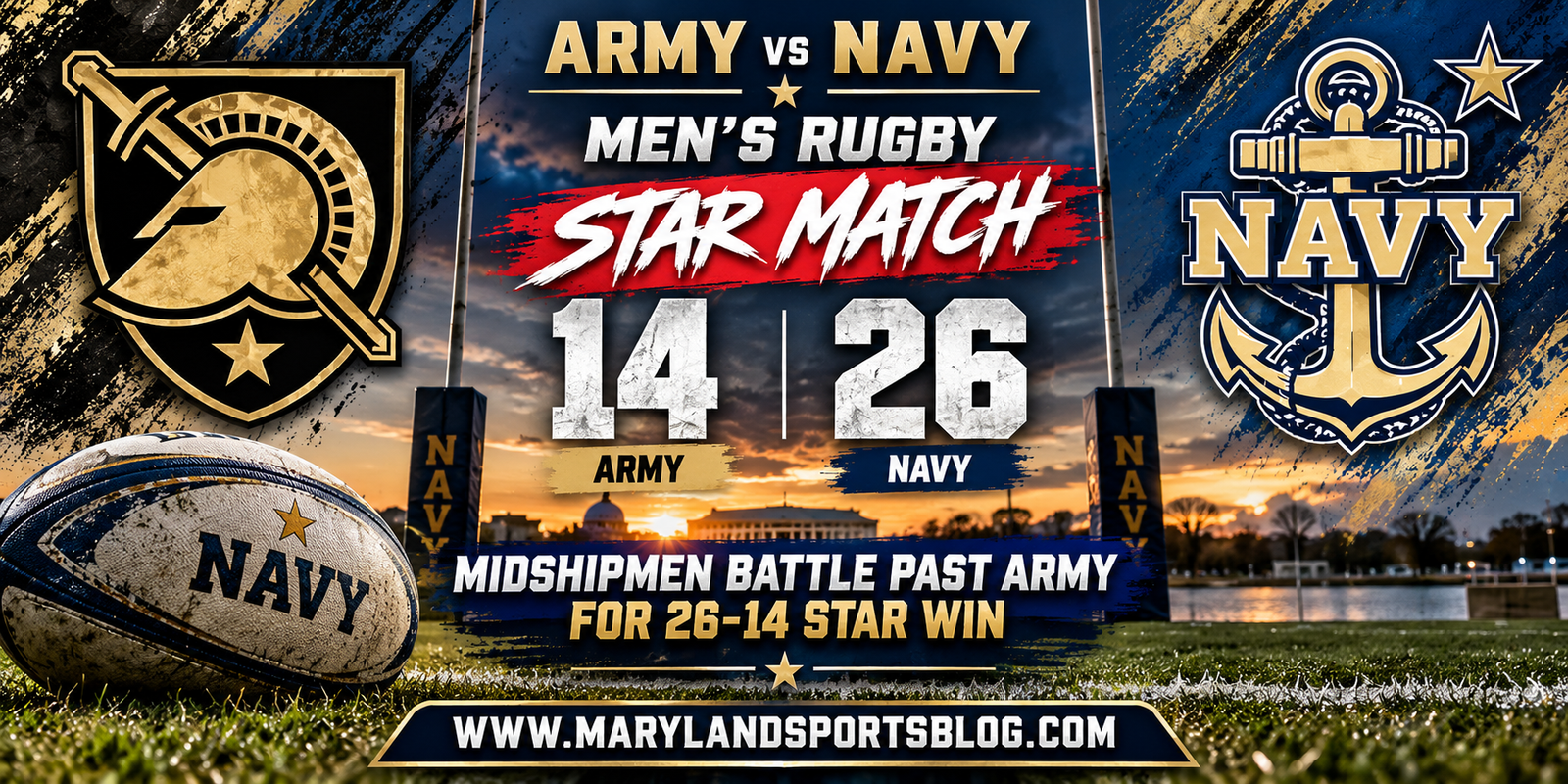
The Navy men’s rugby team continued its dominance over Army on Saturday, defeating the Black Knights 26-14 in a physical Star Match at the Prusmack Rugby Center in Annapolis.
Army scored first and remained within one possession deep into the second half, but the Midshipmen answered every challenge. Avion Ganse scored twice, Andrew Baublitz and captain Trevor Gayron added tries, and Kade Williams converted three kicks as Navy earned its fourth consecutive Star Match victory over its service-academy rival. Navy’s official recap listed the Midshipmen at 4-0 overall and 2-0 in Rugby East following the victory.
The victory also continued a remarkable run in the rivalry. Navy improved to 8-0 all-time against Army and evened the 2026-27 Army-Navy Star Series at 1-1 after Army had defeated Navy in sprint football the previous night.
This one was anything but easy.
Army pressured Navy early, the Midshipmen played part of the first half down a man, and the Black Knights pulled within 19-14 with approximately 16 minutes remaining. Navy’s defense repeatedly survived pressure near its own try line before Ganse finally put the game away with his second try in the final minute.
Army lands the first punch
The Black Knights controlled the opening stages and forced Navy to play from deep inside its own territory. Wind complicated Navy’s efforts to kick clear, allowing Army to maintain pressure inside the Midshipmen’s 22.
Army turned that field position into the opening score.
Howie Heller crossed the try line at the 7:57 mark, becoming the first player to score a try against Navy’s defense this season. Nick Trout converted the kick, giving Army a 7-0 advantage less than eight minutes into the match.
For a Navy team that had dominated defensively through the opening portion of its season, it represented an unfamiliar position.
The Midshipmen did not panic.
Instead, Navy began winning field position and applying pressure of its own.
Ganse gets Navy even
Navy delivered its response in the 17th minute.
Working out of a scrum, Sean Donohue moved the ball to Ganse, who worked his way around the Army defense and crossed the try line for his first try of the season. Williams converted the ensuing kick, erasing Army’s early advantage and tying the match 7-7.
Ganse’s score changed the momentum.
The Midshipmen began spending more time in Army territory and forced the Black Knights to defend rather than dictate the match. Navy’s pressure eventually produced another opening approximately 10 minutes later.
Baublitz took advantage.
Following a lineout, Baublitz broke through the middle of Army’s defense and powered his way to the try zone at 27:30. Williams again converted, putting Navy ahead 14-7.
Baublitz’s score continued an impressive individual streak. He has scored a try in each of Navy’s first four matches according to the Academy’s postgame account.
Suddenly, Army had gone from controlling the opening minutes to chasing Navy.
Navy survives critical sequence before halftime
The Midshipmen still had work to do before reaching halftime.
Army mounted another attack deep in Navy territory and received an additional advantage when a Navy defender was shown a yellow card for an intentional knock-on near the try line. Navy therefore had to defend while playing a man down.
It became one of the most important sequences of the match.
Army had an opportunity to potentially tie the score before halftime. Instead, Navy’s defense held.
The Black Knights attacked near the line but eventually committed a penalty during a clearout, allowing the Midshipmen to escape without surrendering points. Navy took its 14-7 advantage into halftime.
Director of rugby Gavin Hickie said afterward that Navy had made Army work for everything it received offensively, pointing specifically to his team repeatedly repelling Army possessions near the try line.
That defensive resilience ultimately became one of the biggest differences in the game.
Army had opportunities.
Navy refused to let many of them become points.
Rain complicates second half
The conditions became another factor after halftime.
Rain contributed to handling errors as both teams struggled to establish extended offensive sequences early in the second half. Navy nevertheless came close to extending its advantage and eventually attempted a long-range penalty kick.
Williams struck the ball well, but his attempt drifted wide.
Army then began hurting itself with penalties.
Navy used one of those infractions to gain field position and eventually created another scoring opportunity from a lineout. This time the Midshipmen used their forwards and a powerful maul to drive Army backward.
Gayron finished it.
The senior flanker touched down at 55:10, extending Navy’s lead to 19-7.
Williams did not convert the ensuing kick, keeping Army within two scores.
That became important because the Black Knights were far from finished.
Army makes it a five-point game
Army responded with its strongest sustained pressure of the second half.
The Black Knights kept hammering at Navy’s defense until Luke Leech finally broke through at 63:45. Trout converted, and suddenly Navy’s 12-point advantage had been reduced to five.
Navy 19, Army 14.
More than 15 minutes remained.
The Star Match was completely up for grabs.
Army needed only one converted try to move ahead, while Navy had to find a way to regain control after spending significant portions of the afternoon defending its own goal line.
This was where Navy’s experience in major matches showed.
The Midshipmen did not surrender another serious scoring opportunity. Instead, they began using field position and the wind more effectively while forcing Army to play from farther away from the Navy try line.
Army had made it a one-score match.
It would get no closer.
Navy defense delivers when it matters most
The 26 points will receive attention, but Navy’s defensive performance deserves just as much credit.
Army spent several sequences threatening near the Navy try line. The Midshipmen survived one particularly dangerous opportunity while down a man in the first half and then protected a five-point advantage for the final portion of the second.
That defense has become one of Navy’s defining strengths.
Two days after the Army victory, Navy Athletics reported that junior John Masino played all 80 minutes and recorded a team-high 27 tackles against the Black Knights. The Academy also noted that Navy had surrendered only two tries through that point of the season.
Masino’s effort earned him NAAA Co-Athlete of the Week honors.
Twenty-seven tackles in an Army-Navy rivalry game demonstrates the type of physical battle Navy had to survive.
Army had possession.
Army had field position.
Army had chances.
But Navy repeatedly tackled, reset and forced the Black Knights to keep working.
That kept the Midshipmen in control even when the scoreboard remained uncomfortable.
Ganse delivers the finishing blow
Army still trailed only 19-14 as the clock approached 80 minutes.
Navy finally ended the suspense with one last attacking sequence.
Williams played the ball through, Jack Skidmore collected it and delivered an offload to Ganse. Ganse took it from there, racing toward the edge and crossing for his second try with approximately 20 seconds remaining.
The score effectively ended Army’s hopes.
Williams added his third successful conversion, producing the final 26-14 margin.
Ganse finished with a team-high 10 points on his two tries. Baublitz and Gayron supplied five points apiece, while Williams contributed six points on three conversions.
It was a fitting conclusion to a match in which Navy never completely separated from Army until the final moments.
Army struck first.
Navy responded.
Army threatened before halftime.
Navy held.
Army pulled within five.
Navy held again.
Then Ganse finished it.
Navy remains perfect against Army
The victory continued an extraordinary beginning to Navy’s varsity rugby rivalry against Army.
Since Navy elevated men’s rugby to varsity status, the Midshipmen have never lost to the Black Knights.
Saturday’s result improved Navy to 8-0 all-time against Army and 4-0 in Star Matches.
That record is especially impressive because these have not simply been routine regular-season meetings. Navy and Army have encountered one another in conference play, the Star Series and postseason competition.
Navy has consistently found a way to win.
The rivalry has also become increasingly important within college rugby. Both service academies have established themselves as significant programs, and their meetings regularly carry implications beyond simply Army versus Navy.
Saturday was no exception.
Navy improved to 2-0 in Rugby East play, continuing its pursuit of a fifth consecutive conference championship. The Midshipmen entered the season having compiled a remarkable 27-1 record against Rugby East opponents over their previous four seasons in the league.
Army fell to 3-1 overall and 0-1 in Rugby East.
Another Star comes back to Annapolis
The victory also carried significance beyond rugby.
Army had taken the first Star of the 2026-27 competition by defeating Navy 21-12 in sprint football Friday night.
Approximately one day later, Navy rugby answered.
The Midshipmen’s victory tied the 2026-27 Star Series at 1-1 and gave the Naval Academy its first Star victory of the academic year.
Navy has historically enjoyed substantial success in the overall Army-Navy competition. Through the conclusion of 2025-26, Navy held a 1,225-928-46 all-time advantage in head-to-head competitions dating to the beginning of the Academy’s tracking period and had won the annual Star Series in 48 of the previous 57 seasons, with three ties.
Men’s rugby made sure Army would not build an early advantage in this year’s competition.
Baublitz continues impressive scoring streak
Baublitz has quietly become one of Navy’s most consistent scoring threats.
His first-half try against Army continued his streak of scoring in every match Navy had played to that point. He also scored during Navy’s season-opening 50-0 victory over St. Bonaventure, when seven different Midshipmen crossed the try line.
His try against Army was particularly important.
Navy had only recently tied the match when Baublitz broke through the defensive line and changed the scoreboard from 7-7 to 12-7 before Williams’ conversion.
That gave Navy its first lead.
In a rivalry match decided by execution in a handful of crucial sequences, Baublitz again delivered.
Gayron leads as captain
Gayron’s second-half try also carried additional significance.
The senior was selected alongside Edmund Soeder as one of Navy’s captains for the 2026-27 season after making 11 starts in 12 appearances the previous year.
Against Army, he delivered when Navy needed breathing room.
His try from the maul increased the lead from seven to 12 and forced Army to chase multiple scores.
The Black Knights eventually answered, but that additional five points meant Leech’s try could only reduce Navy’s advantage to 19-14 rather than potentially putting Army ahead.
Those are the small margins that decide rivalry games.
Navy continues its Rugby East dominance
The Army victory also strengthens Navy’s position within Rugby East.
Navy entered 2026-27 seeking its fifth consecutive Rugby East championship. The Midshipmen won the league in each of their first four seasons after joining before the 2022-23 campaign.
Saturday’s victory moved Navy to 2-0 in conference play.
That matters because Army is one of the opponents capable of challenging Navy physically across an entire match. The Black Knights demonstrated that Saturday.
Navy did not overwhelm Army.
It beat Army through defensive resilience, field position, discipline in crucial moments and an ability to finish scoring opportunities.
Those traits become increasingly important as the season progresses.
Midshipmen return home against Southern Virginia
Navy will remain in Annapolis for its next match.
The Midshipmen host Southern Virginia on Saturday, Oct. 3, at the Prusmack Rugby Center. Kickoff is scheduled for 11 a.m.
Navy now has an opportunity to build on an important rivalry victory while continuing its Rugby East title defense.
There will also be areas Hickie and his staff can address.
Army succeeded in pinning Navy deep early. The Midshipmen dealt with handling problems in the rain and gave Army multiple opportunities near the try line. Navy also had to survive a yellow card and a prolonged stretch in which a single Army try could have changed the game.
Yet those imperfections make the result more encouraging in some respects.
Navy did not need to play a flawless match to beat Army.
The Midshipmen needed to respond.
They did that repeatedly.
MSB Take
Army-Navy games rarely come down to style points, and Saturday’s rugby match was a perfect example.
Army scored first, forced Navy to defend its try line repeatedly and pulled within five points late in the second half. For much of the afternoon, one mistake could have completely changed the outcome.
Navy simply refused to make the decisive mistake.
The Midshipmen’s defense deserves enormous credit. Masino’s 27 tackles tell part of that story, but the biggest defensive sequence may have come before halftime when Navy protected a 14-7 lead despite playing a man down. Army was positioned to tie the match and walked away without points.
Ganse was the offensive difference-maker with two tries. Baublitz continued his scoring streak. Gayron delivered an important captain’s try in the second half. Williams converted three kicks, and Skidmore helped create the final score that put the rivalry match away.
Most importantly, Navy remains unbeaten against Army.
Eight meetings. Eight Navy victories. Four consecutive Star Match wins.
The 26-14 final score makes the victory look relatively comfortable, but it was anything but that until Ganse crossed the line in the final minute.
That might make this Star victory even more meaningful.
Army gave Navy one of its most difficult tests of the young season. The Midshipmen absorbed it, protected their home field, remained unbeaten and brought the first Navy Star of 2026-27 back to Annapolis.
For a program pursuing another Rugby East championship and another run at the national title, beating Army in a physical match like this is exactly the type of test Navy can build on.