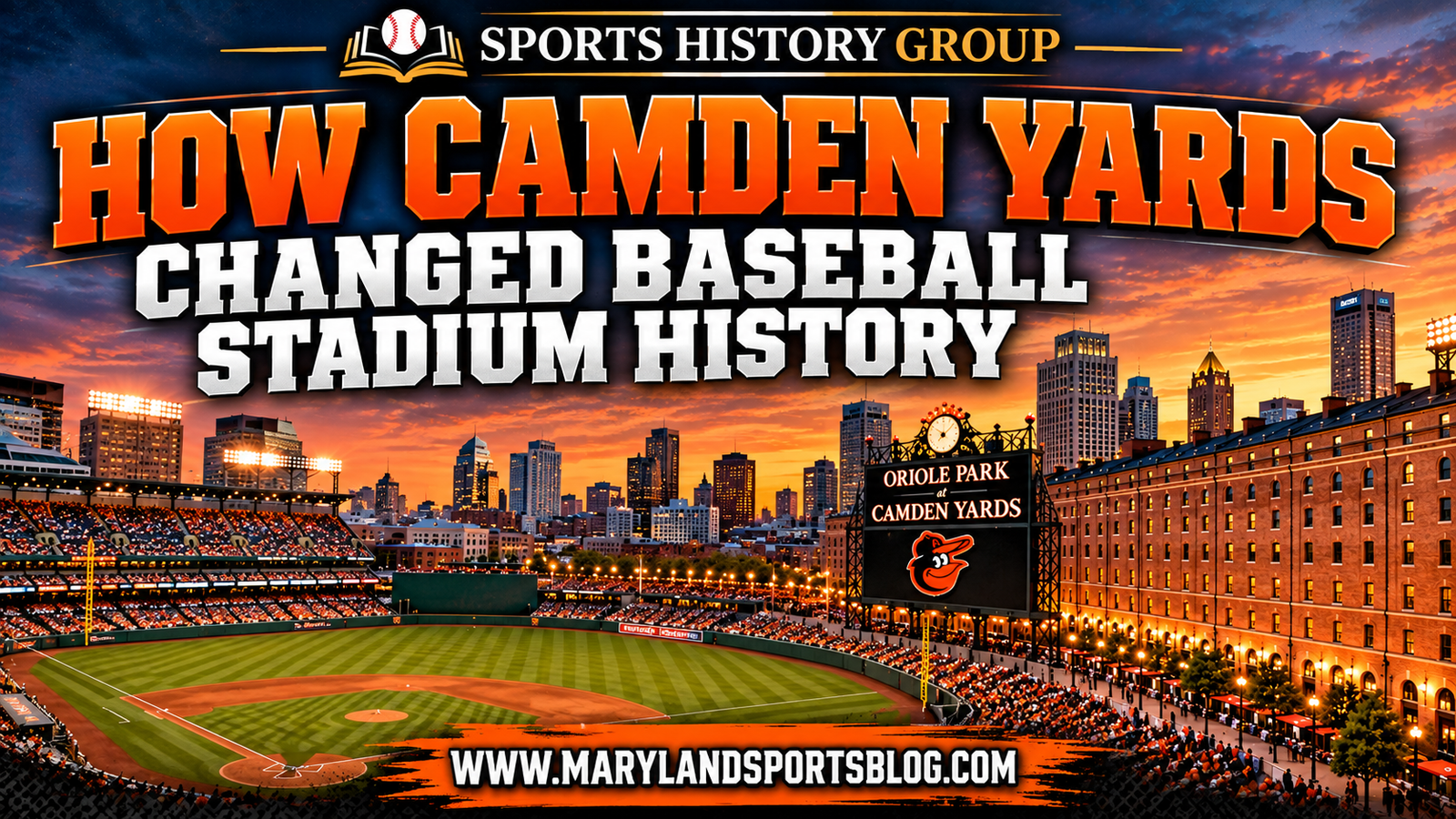
How Camden Yards Changed Baseball Stadium History
By Sports History Group
When Oriole Park at Camden Yards opened on April 6, 1992, it did more than give the Baltimore Orioles a new home. It showed baseball that a modern stadium could belong to its city and still feel like a ballpark. The red brick, irregular outfield and old B&O Warehouse made the place unmistakably Baltimore. Within a decade, other clubs were building around the same idea: leave the multipurpose concrete bowl behind and give baseball a setting with its own streets, skyline and character.
The era Camden Yards interrupted
The Baltimore Orioles history at Memorial Stadium stretched nearly four decades, in a beloved place with a history larger than baseball. It also hosted the Baltimore Colts. Around the major leagues, that kind of shared, all-purpose facility had become familiar. Big circular stadiums could accommodate football and baseball, but their broad footprints often put fans farther from the diamond. Their symmetry made one city’s park look much like another’s.
There were exceptions. Fenway Park and Wrigley Field had survived with their quirky dimensions and neighborhood presence. Yet a new club looking for modern amenities was generally offered a different choice: build large and efficient, then add a baseball field inside. Camden Yards made a compelling case for a third path. The Orioles could have contemporary seating, concessions and operations in a place designed around the game itself.
A ballpark shaped by Baltimore
The setting was central to the design. The Camden rail yards sat near downtown and the Inner Harbor, with an enormous brick Baltimore and Ohio Railroad warehouse along the site. Rather than clear the warehouse for a blank slate, the project kept it. Eutaw Street became a pedestrian corridor between the building and the right-field stands. From inside the park, the warehouse appears over the outfield as an actual piece of the city, not scenery assembled for the game.
That decision was hardly inevitable. The warehouse had been threatened with demolition, and preservation advocates fought to save it. Its survival gave Camden Yards a feature no architect could reproduce elsewhere without turning it into imitation. The building had already stood there for decades. The new park had to respond to it.
Brick and steel evoked older baseball parks, while the asymmetrical field and open views let Baltimore do the rest. Even the name joined two claims on the place: Oriole Park for the team and Camden Yards for the ground beneath it. The result felt established on opening day, though nothing about the fan facilities required spectators to pretend they were living in another century.
Opening day offered proof
On April 6, 1992, Rick Sutcliffe shut out Cleveland as the Orioles won 2–0 in their first regular-season game at the new park. A good game mattered, but the lasting story was the setting. Spectators could walk Eutaw Street, see the warehouse and look out toward the city. The park made arriving, wandering and watching part of one experience. It invited people to recognize where they were.
The Orioles had not invented baseball nostalgia. They had made it work in a newly built venue without simply copying an old one. That distinction mattered to teams and cities contemplating their own stadiums. If a ballpark could be a destination, it could draw interest beyond the nine innings. If it responded to local buildings and streets, it could also make a stronger civic argument than a generic facility surrounded by parking.
The blueprint spread across baseball
Camden Yards helped launch the wave of retro-style major league ballparks that followed in the 1990s and 2000s. Globe Life Park opened in Arlington in 1994, Coors Field in Denver in 1995 and Jacobs Field in Cleveland in 1994. Later parks, including Oracle Park in San Francisco and PNC Park in Pittsburgh, took the relationship between the field and its surroundings in their own directions. Their designs were not identical to Baltimore’s. That is part of Camden Yards’ influence: the most useful lesson was to make a park specific to its city.
The imitation could be superficial. Red brick alone does not give a stadium history, and a deliberately odd outfield fence does not automatically create a neighborhood. Camden Yards succeeded because its details had reasons. The warehouse was there before the Orioles arrived. The street beside it was a real place to walk. The ballpark offered fans an experience tied to the shape of Baltimore, and later designers had to find their own equivalents.
It also changed expectations for baseball-only design. The sport no longer needed to be fitted into a venue conceived for several teams and events. Sightlines, scale, concourses and the view beyond the wall could be considered together. A new park could have modern revenue spaces while still feeling intimate at field level. For owners, architects and fans, Camden Yards became the point of comparison.
The history stayed visible
A strong ballpark accumulates its own memories. Camden Yards hosted the 1993 All-Star Game. During that year’s Home Run Derby, Ken Griffey Jr. hit the warehouse on the fly, a feat that still distinguishes the building from any ordinary right-field backdrop. In September 1995, Cal Ripken Jr. broke Lou Gehrig’s consecutive-games record in the park the Orioles had occupied for only four seasons. A stadium built to recall baseball history was soon making history in its own right.
The park has changed over time, as active ballparks must. Teams adjust walls, amenities and gathering areas. The point is that the original choice still reads clearly: baseball belongs in a setting with a memory and a location. Visitors do not need a plaque to understand that the warehouse was there first. They can see it from the seats and walk beside it on the way to the game.
Camden Yards did not make every subsequent stadium beautiful or every downtown project successful. Its achievement was more precise. It broke the assumption that a new major league venue had to feel anonymous. Baltimore built a modern home for the Orioles around an old railroad building and a city street, then showed the rest of baseball what those choices could make possible.
For more franchise timelines, team identities and the history behind the games, explore Sports History Group.