
Navy’s furious comeback falls short in 38-30 loss at Florida Atlantic
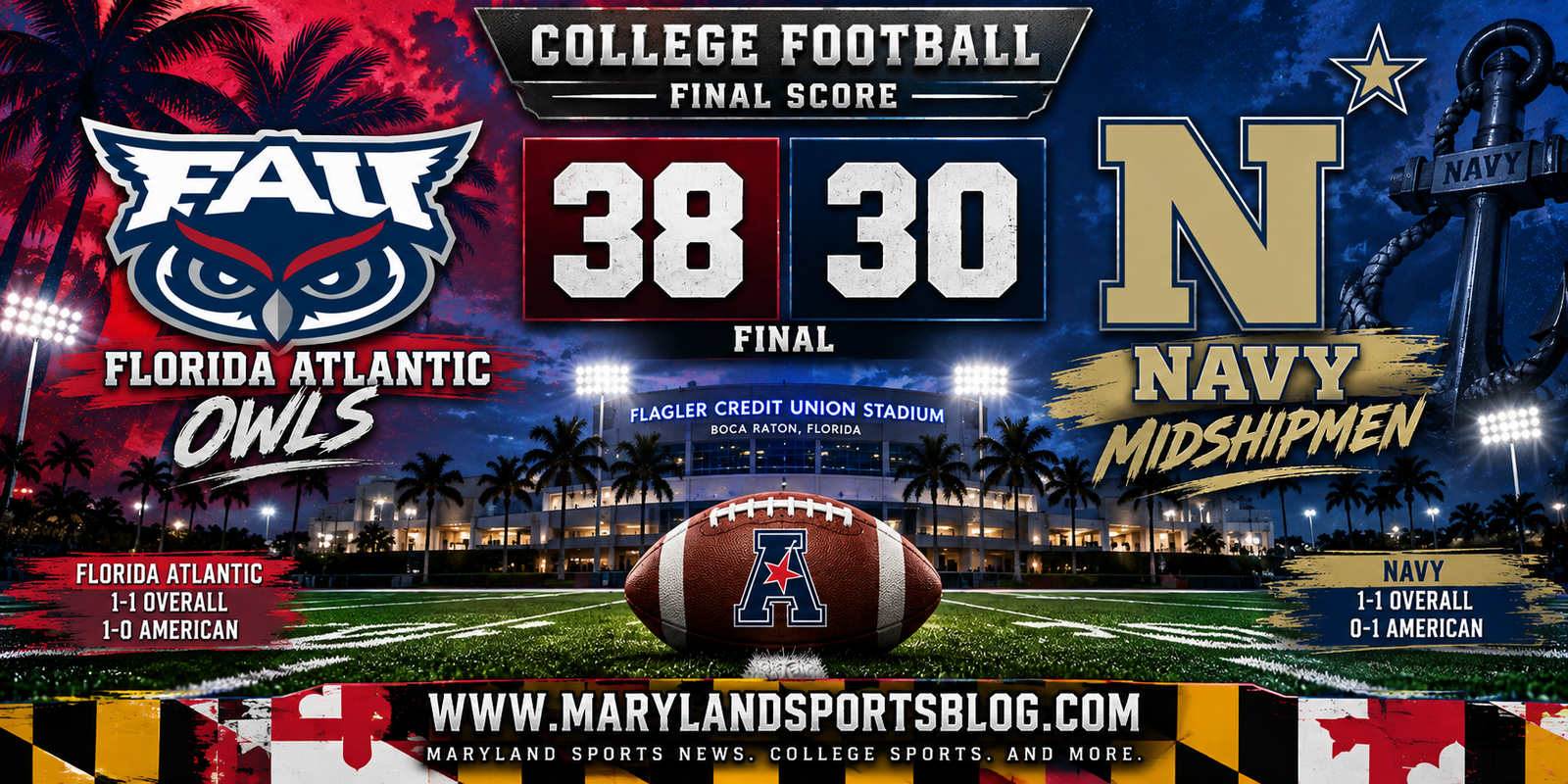
The Navy Midshipmen nearly authored one of the most remarkable comebacks in program history Saturday night, but a disastrous first half ultimately proved too much to overcome as Florida Atlantic defeated Navy 38-30 at Flagler Credit Union Stadium in Boca Raton, Florida.
Navy trailed 31-7 at halftime and fell behind 38-7 late in the third quarter before scoring the final 23 points of the game. Backup quarterback Jackson Gutierrez sparked the comeback after starter Braxton Woodson left with an ankle injury, accounting for three touchdowns while turning what appeared destined to become a lopsided defeat into a one-possession game in the final two minutes. Florida Atlantic recovered Navy’s final onside-kick attempt and converted a fourth down to finally put away the Midshipmen.
The loss dropped Navy to 1-1 overall and 0-1 in American Conference play. Florida Atlantic improved to 1-1 overall and 1-0 in the conference, earning its first victory over a team receiving votes in the Associated Press Top 25 since the Owls defeated SMU in the 2019 Boca Raton Bowl.
It was an unusual game statistically. Navy outrushed Florida Atlantic 246-42 and averaged 6.8 yards per rushing attempt. Florida Atlantic, however, shredded Navy through the air as quarterback Caden Veltkamp completed 27 of 32 passes for 386 yards, five touchdowns and no interceptions. The Owls finished with a 428-393 advantage in total offense despite gaining only 42 net rushing yards.
Florida Atlantic strikes immediately
Navy entered Boca Raton coming off an impressive 42-15 season-opening victory over Towson, but the Midshipmen quickly discovered that Florida Atlantic presented a significantly different challenge.
The Owls needed only two offensive snaps to expose the Navy secondary.
Veltkamp found Easton Messer deep downfield for a 76-yard touchdown, giving Florida Atlantic a 7-0 advantage just 42 seconds into the game. The play immediately established what would become the defining matchup of the night: Florida Atlantic’s passing attack against Navy’s defensive backs.
Navy did not panic.
Michael Barrow opened the Midshipmen’s first possession with a 24-yard run, and Woodson soon broke loose for a 48-yard touchdown. Woodson’s explosive run tied the game at 7-7 with 13:12 remaining in the opening quarter and appeared to settle Navy into the type of offensive rhythm that made its running game so successful one week earlier.
The problem was that Florida Atlantic continued generating explosive plays through the air.
Veltkamp again connected with Messer, this time for a 36-yard touchdown, to put the Owls back ahead 14-7. By the end of the first quarter, Veltkamp had completed 10 of 11 passes for 200 yards. Messer alone already had 151 receiving yards during those opening 15 minutes.
That early production forced Navy into a game script it generally tries to avoid. The Midshipmen are at their best when their option offense controls the football, stays ahead of the chains and forces opponents to play at Navy’s tempo. Florida Atlantic’s explosive passing game instead forced Navy to chase points almost immediately.
Missed opportunities hurt Navy
Despite Florida Atlantic’s explosive start, Navy had several opportunities to keep the game manageable during the first half.
The Midshipmen drove into scoring range but freshman kicker Nolan Bartley missed a 46-yard field-goal attempt. Navy also committed a costly first-quarter fumble, one of two turnovers the Midshipmen would commit in the game. Florida Atlantic did not turn the ball over.
Those mistakes became increasingly damaging because Veltkamp rarely gave Navy’s defense an opportunity to regain control.
Navy’s rushing attack continued producing yards, but the Midshipmen could not sustain enough drives to match Florida Atlantic’s scoring pace. Woodson remained dangerous with the ball in his hands, yet Navy’s passing game struggled badly during the first half.
Woodson eventually finished 3-of-11 passing for 47 yards with one interception. The Midshipmen could run the football, but Florida Atlantic succeeded in forcing Navy into obvious passing situations where its defense held the advantage.
That imbalance became particularly important once Florida Atlantic expanded its lead.
Veltkamp takes control
Florida Atlantic began separating itself during the second quarter.
Veltkamp directed another productive possession and found Kelby Valsin for a 30-yard touchdown with 5:26 remaining before halftime. The score increased Florida Atlantic’s lead to 21-7 and placed significant pressure on Navy to answer before the break.
Instead, the final minute became a nightmare for the Midshipmen.
Veltkamp connected with Dominique Henry for a 13-yard touchdown with 19 seconds remaining. Florida Atlantic suddenly held a 28-7 advantage and appeared ready to head into halftime with complete control of the game.
Things somehow got worse for Navy.
Bo Simpson-Nealy intercepted Woodson with only seconds remaining and returned possession to Florida Atlantic at the Navy 47-yard line. After a short rushing play, Florida Atlantic sent kicker Collin Rogers onto the field for an ambitious 60-yard field-goal attempt.
Rogers drilled it.
The 60-yarder set a Florida Atlantic program record, surpassing the previous mark by six yards. It was also tied for the second-longest field goal in American Conference history. Instead of entering halftime down three touchdowns, Navy went into the locker room trailing 31-7.
That 24-point halftime deficit was Navy’s largest since the Midshipmen trailed Notre Dame 31-7 at halftime during the 2024 season.
The first half could hardly have gone worse. Navy had surrendered four touchdown passes and a record-breaking field goal, committed turnovers, missed a field goal and struggled to generate anything through the air.
Yet the game was not finished.
Woodson leaves with an injury
Navy opened the second half attempting to reestablish its offense and build some momentum.
Woodson helped lead a seven-play possession before leaving the game with an ankle injury with 10:41 remaining in the third quarter. His departure created yet another obstacle for a Navy team already facing a massive deficit.
Woodson finished with 96 rushing yards and one touchdown on 12 carries, averaging eight yards per attempt. His 48-yard scoring run remained one of Navy’s biggest offensive plays of the evening. Through the air, however, he completed only three passes on 11 attempts for 47 yards and threw the late first-half interception that helped set up Florida Atlantic’s 60-yard field goal.
With Woodson unavailable, Navy turned to Gutierrez.
At the time, the situation looked bleak.
Florida Atlantic subsequently produced perhaps its most impressive possession of the night, putting together a 16-play, 80-yard drive that consumed approximately seven minutes. Veltkamp finished it with a 5-yard touchdown pass to AJ Johnson, extending the Owls’ advantage to 38-7 with only 2:39 remaining in the third quarter.
Florida Atlantic had scored 31 consecutive points.
The game appeared over.
Gutierrez had other ideas.
Jackson Gutierrez changes the game
Gutierrez entered Saturday night having attempted only two collegiate passes and without a single career passing yard.
By the end of the night, he had nearly engineered a comeback from 31 points down.
Navy started at its own 25-yard line with 2:39 remaining in the third quarter. After a Christian Cromer run, Gutierrez carried for eight yards and a first down.
Then came the play that changed the entire energy of the game.
Gutierrez dropped back and connected with sophomore tight end Jordan Collins down the middle of the field. Collins broke free for a 64-yard touchdown, cutting Florida Atlantic’s lead to 38-14 with 1:16 left in the third quarter.
It was the first touchdown pass of Gutierrez’s career.
For Collins, it was an equally significant moment. He entered the game with only one collegiate reception. His touchdown was just the second catch of his career, and he finished the night with two receptions for 68 yards.
Florida Atlantic still held a comfortable 24-point advantage entering the fourth quarter, but Navy suddenly had life.
Navy’s defense finally takes control
While Gutierrez provided the offensive spark, Navy’s defense deserves considerable credit for giving the offense repeated opportunities to continue the comeback.
The Midshipmen completely shut down Florida Atlantic during the fourth quarter.
After Veltkamp had dismantled the Navy secondary for much of the first three quarters, the Owls failed to score during the final period. Florida Atlantic actually finished the fourth quarter with minus-27 yards of total offense.
That statistic explains how a game that once stood at 38-7 became increasingly uncomfortable for the Owls.
Christian Johnson led Navy defensively with 11 tackles. Giuseppe Sessi and MarcAnthony Parker each recorded nine tackles, while Parker added two tackles for loss and one sack. Coleman Cauley contributed eight tackles.
Navy’s defense did not erase the damage from the first three quarters, particularly the explosive passing plays, but it responded impressively when the Midshipmen needed stops to have any chance of climbing back into the game.
Gutierrez leads an 85-yard touchdown drive
Navy’s comeback moved from respectable to legitimately threatening when Gutierrez engineered an 11-play, 85-yard fourth-quarter possession.
Instead of relying exclusively on the option, Navy allowed Gutierrez to make plays through the air. He responded with poise that was remarkable considering his lack of previous collegiate passing experience.
Gutierrez ultimately found Charles Robinson for an 8-yard touchdown with 5:41 remaining. The score cut Florida Atlantic’s lead to 38-20.
It was Robinson’s first collegiate touchdown.
Robinson finished with four receptions for 36 yards, while Luke Hutchison contributed a 27-yard reception. Navy’s passing game had been nearly nonexistent for much of the evening, but Gutierrez suddenly gave Florida Atlantic something else to defend.
Navy remained down 18 points, but the comeback continued gaining momentum.
Safety gives Navy another chance
The Midshipmen attempted an onside kick following Robinson’s touchdown, but Florida Atlantic recovered at the Navy 45-yard line.
Normally, that might have ended Navy’s comeback.
Instead, the defense forced Florida Atlantic backward.
The Owls eventually lined up to punt, but a bad snap sailed over the punter and through the end zone for a safety. Navy gained two points and, equally important, received possession following the free kick.
The score was suddenly 38-22 with 3:12 remaining.
A game Florida Atlantic had led by 31 points less than a quarter earlier had become a two-score contest.
Gutierrez breaks loose
Navy still needed something extraordinary.
Gutierrez delivered it.
The Midshipmen took possession and drove 58 yards in six plays. Facing second-and-11 from the Florida Atlantic 49-yard line, Gutierrez found an opening and exploded through the Owls defense.
He raced 49 yards for a touchdown with 1:46 remaining.
Navy then went for two, and Gutierrez completed the conversion pass to Vic Listorti.
Florida Atlantic 38, Navy 30.
A 31-point deficit had been reduced to eight.
Gutierrez had accounted for three touchdowns after taking over for an injured Woodson. He had thrown two scores and rushed for another while transforming the entire complexion of the game.
Navy suddenly needed only an onside-kick recovery and another touchdown to potentially force overtime.
The miracle ended there.
Florida Atlantic recovered Navy’s ensuing onside kick. The Owls then gained enough yardage to convert a fourth-and-1 and exhaust the remaining clock.
Gutierrez emerges despite the loss
Navy obviously would have preferred the victory, but Gutierrez’s performance may become one of the most significant developments to emerge from Saturday night.
The junior completed six passes for 100 yards and two touchdowns while rushing seven times for 75 yards and another score. He averaged 10.7 yards per rushing attempt.
Before Saturday, Gutierrez had two career passing attempts and no passing yards.
Against Florida Atlantic, he entered with his team trailing badly, replaced an injured starting quarterback and nearly led a historic comeback.
His ability to throw the football also forced Florida Atlantic to defend the entire field. The 64-yard touchdown to Collins showed Gutierrez can punish a defense vertically, while the fourth-quarter scoring pass to Robinson demonstrated his ability to finish a sustained drive.
His 49-yard touchdown run then reminded everyone why a mobile Navy quarterback remains so difficult to defend.
Woodson’s health will obviously become one of the biggest questions surrounding the Midshipmen during the upcoming open week, but Navy should feel considerably better about its quarterback depth after what Gutierrez accomplished in Boca Raton.
Florida Atlantic’s passing game was the difference
While Navy’s comeback deserves praise, the Midshipmen cannot ignore what happened defensively during the first three quarters.
Veltkamp was outstanding.
The Florida Atlantic quarterback completed 27 of 32 attempts, an 84-percent completion rate, for 386 yards and five touchdowns. His completion percentage ranked second in Florida Atlantic single-game history, while his 386 passing yards ranked fifth. His five touchdown passes matched his own school record.
Messer was nearly unstoppable.
The veteran receiver caught eight passes for 179 yards and two touchdowns, averaging more than 22 yards per reception. His 76-yard touchdown on Florida Atlantic’s second offensive play immediately put Navy in trouble, and his 36-yard score later in the first quarter restored the Owls’ lead after Woodson had tied the game.
Valsin caught eight passes for more than 100 yards and a touchdown, while Henry finished with six receptions for 63 yards and another score. Florida Atlantic repeatedly created favorable matchups and found receivers in open space.
The Owls did almost nothing on the ground by comparison.
Navy limited Florida Atlantic to only 42 net rushing yards on 44 attempts, an average of one yard per carry. Yet the Midshipmen’s dominance against the run meant little because Veltkamp repeatedly beat them through the air.
That will unquestionably become a major point of emphasis for Navy’s defense before its next game.
Navy’s rushing attack remains dangerous
The Midshipmen still showed why their running game will cause problems throughout the season.
Navy rushed for 246 yards on 36 attempts despite spending much of the game playing from behind. Woodson led Navy with 96 yards, Gutierrez added 75 and Barrow contributed 39 yards. Listorti also finished with 35 rushing yards.
The Midshipmen averaged 6.8 yards per carry.
That is an encouraging number.
The problem was that Navy’s turnovers and early defensive breakdowns prevented the Midshipmen from playing the style of football they prefer. Once Florida Atlantic built a multi-score lead, Navy could no longer afford to methodically drain the clock with long option possessions.
The comeback proved Navy can create explosive plays when forced outside its usual script, but the Midshipmen would much rather avoid needing 23 unanswered points in the final 16 minutes.
Turnovers prove costly
Navy finished with two turnovers while Florida Atlantic committed none.
That difference mattered considerably.
The first-quarter fumble eliminated one Navy possession, while Woodson’s late first-half interception directly contributed to Florida Atlantic’s three additional points before halftime.
The Owls turned the interception into Rogers’ 60-yard field goal.
Navy also missed a 46-yard field goal earlier in the game.
In a contest ultimately decided by eight points, those moments become even more painful.
The Midshipmen were not beaten because they could not move the football. Navy generated 393 total yards, averaged 6.8 yards per play and rushed for nearly 250 yards.
They were beaten because Florida Atlantic made more explosive plays, protected the football and capitalized on Navy’s mistakes.
A tale of two games
The final score does not completely capture just how unusual Saturday night became.
For roughly three quarters, Florida Atlantic dominated the game.
The Owls led 38-7, Veltkamp had thrown five touchdown passes and Navy had lost its starting quarterback. The Midshipmen looked finished.
Then everything changed.
Navy scored the final 23 points.
The Midshipmen outscored Florida Atlantic 16-0 in the fourth quarter.
Florida Atlantic finished that quarter with minus-27 yards.
Gutierrez threw two touchdown passes and rushed for another.
Navy cut a 31-point deficit to eight and forced Florida Atlantic to survive an onside-kick attempt before finally escaping.
There will be frustration in Annapolis because the comeback came too late, but Navy also demonstrated something important about this team.
It did not quit.
Navy now gets an open week
Navy will have time to regroup before returning to action Friday, Sept. 25, at UAB. The open week comes at an important point, particularly because of Woodson’s ankle injury.
The Midshipmen have several issues to address.
The secondary must correct the coverage breakdowns that allowed Veltkamp to throw for 386 yards and five touchdowns. Navy must protect the football better after committing two turnovers. The passing game also needs greater consistency if defenses begin loading the box to slow the option.
At the same time, the Midshipmen discovered another quarterback capable of moving the offense.
That could prove extremely valuable as the season progresses.
MSB Take
This might be one of the strangest Navy losses we see all season.
There is no way to excuse falling behind 38-7. Navy’s secondary was picked apart, the Midshipmen committed two turnovers and Florida Atlantic made nearly every big play during the first 40-plus minutes. Allowing Veltkamp to complete 27 of 32 passes for 386 yards and five touchdowns is simply not good enough for a team with American Conference championship aspirations.
However, Navy deserves tremendous credit for how it responded.
Many teams would have folded after losing their starting quarterback while trailing by 31 points on the road. Navy did the opposite. Gutierrez entered the game with almost no meaningful passing experience and looked completely comfortable. He threw two touchdowns, ran for another and nearly brought the Midshipmen all the way back.
His performance was the biggest positive from the night.
Navy also showed that its rushing attack remains extremely dangerous. The Midshipmen ran for 246 yards and averaged 6.8 yards per attempt against an American Conference opponent. If Woodson returns healthy and Gutierrez can continue providing another dynamic option at quarterback, Navy suddenly has intriguing depth at the most important position in its offense.
But the defensive issues cannot be ignored.
You cannot give up touchdown passes of 76 and 36 yards in the first quarter and expect to consistently beat good football teams. Navy spent almost the entire night trying to recover from those early breakdowns.
The Midshipmen showed tremendous toughness Saturday night.
Now they need to make sure they do not put themselves in a position where toughness alone has to save them.
Navy is 1-1, and the conference opener is a missed opportunity. Still, the season is nowhere close to being defined by one September loss.
If Navy fixes the secondary, gets Woodson healthy and builds on what Gutierrez showed in the second half, the Midshipmen should remain a dangerous team in the American Conference.
The comeback did not produce a win.
It may have revealed something important about Navy anyway.