
Team USA overwhelms Hungary 108-56 to advance to FIBA World Cup semifinals
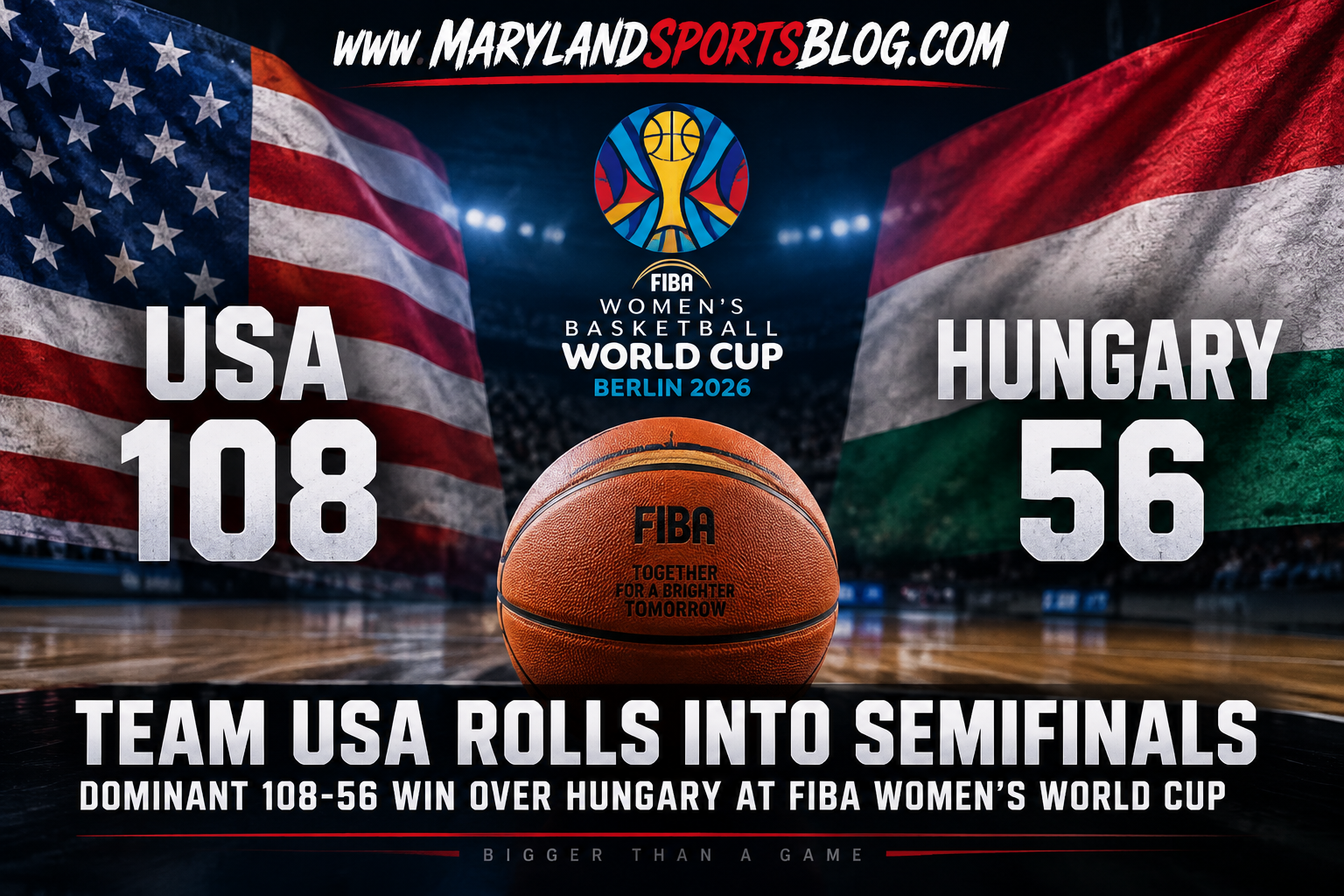
The United States women’s national basketball team left absolutely no doubt in its FIBA Women’s Basketball World Cup quarterfinal Thursday, crushing Hungary 108-56 in Berlin, Germany. Team USA jumped on Hungary immediately, built a 24-point advantage after the opening quarter and never allowed the game to become competitive. The 52-point victory sent the Americans into the World Cup semifinals as they continued their pursuit of a fifth consecutive world championship.
Napheesa Collier led the United States with 19 points and six rebounds despite playing only about 15 minutes. Collier shot 9-for-13 from the field and helped establish the Americans’ dominance around the basket from the opening minutes. With Team USA’s depth allowing head coach Kara Lawson to spread minutes throughout the roster, the Americans did not need any one player to carry a heavy workload.
The United States essentially put the game away during the first quarter. Team USA raced out to a 36-12 advantage, overwhelming Hungary with defensive pressure, transition offense and superior athleticism. Hungary struggled to consistently initiate its offense against an American defense that aggressively pressured the basketball and closed passing lanes.
By halftime, the United States had scored 59 points, the most it had ever scored in a first half at the Women’s World Cup. That was particularly noteworthy after the Americans had scored only 55 points during their narrow 55-52 group-stage victory over Italy earlier in the tournament. Against Hungary, Team USA looked considerably more comfortable offensively and showed the type of overwhelming scoring potential expected from one of the deepest rosters in international basketball.
Caitlin Clark delivered one of her best all-around performances of the tournament. Clark finished with 10 points, nine assists and three rebounds while directing an offense that repeatedly created high-percentage opportunities. Her passing was particularly effective in transition and around the basket, where she developed an impressive connection with Angel Reese.
Reese provided another productive performance off the bench with nine points, six rebounds and three assists. Clark and Reese, longtime opponents throughout college basketball and the WNBA, have shown increasingly strong chemistry while playing together for the national team. Their ability to contribute without needing to dominate the offense has helped make an already talented American roster even deeper.
The numbers illustrated just how complete the performance was. The United States shot 58.8 percent from the field and recorded 31 assists on 40 made field goals, consistently moving the ball rather than relying on isolation offense. Every American player contributed as Team USA produced its highest-scoring game of the tournament.
The defense may have been even more impressive. Team USA forced Hungary into 27 turnovers and converted those mistakes into 44 points, repeatedly turning defensive pressure into easy opportunities at the other end. Hungary shot approximately 34 percent from the field and rarely found enough offensive rhythm to make a sustained run.
Hungary entered the matchup hoping that its size could create problems for the Americans, particularly through Dorka Juhasz. Instead, the United States effectively removed Hungary’s inside game and held Juhasz to just two points despite her playing approximately 31 minutes. Reka Lelik led Hungary with 12 points, but the Americans prevented Hungary from generating enough consistent offense around her.
Rhyne Howard also contributed to Team USA’s dominant defensive performance, while Sonia Citron, Kiki Iriafen and the rest of the American bench continued providing productive minutes. The depth difference became increasingly apparent as the game progressed because the United States could substitute without experiencing a significant drop in scoring, defensive pressure or athleticism. That allowed Lawson to manage playing time while keeping relentless pressure on Hungary.
The victory was especially significant because the United States had shown some vulnerability earlier in the tournament. Italy pushed Team USA to the final possession before the Americans escaped with a 55-52 victory, raising questions about whether the rest of the international field had substantially closed the gap. The Americans answered many of those questions against Hungary by producing their most complete performance of the World Cup.
Team USA has now won 34 consecutive games at the Women’s World Cup and has not lost a World Cup game since falling to Russia in the 2006 semifinals. When Olympic competition is included, the Americans have accumulated 73 consecutive victories across the two biggest international tournaments. The United States won the World Cup in 2010, 2014, 2018 and 2022 and is attempting to claim a fifth consecutive championship in Berlin.
Hungary’s tournament still represented a major accomplishment despite the lopsided ending. The Hungarians reached the World Cup quarterfinals after defeating Japan 84-63 in the qualification round and secured their best finish in the tournament in decades. Against the United States, however, Hungary simply ran into a deeper and more athletic opponent playing its best basketball of the tournament.
The United States now advances to Saturday’s semifinals, where it will face the winner of Spain and Australia. Two more victories would give Team USA another world championship and extend one of the most dominant runs in international team sports. After surviving a serious scare against Italy earlier in the World Cup, the Americans looked much more like the overwhelming championship favorite against Hungary.
MSB Take
This was Team USA at its terrifying best. The Americans did not simply beat Hungary; they overwhelmed them in virtually every phase, using defense to create offense, sharing the basketball and taking advantage of a roster that has elite players throughout the rotation. A 36-12 first quarter against a World Cup quarterfinalist is the type of statement that reminds the rest of the tournament just how high the United States’ ceiling remains.
Clark’s nine assists might be one of the most encouraging numbers from the game. Team USA does not need her to score 25 or 30 points when she can create easy opportunities for Collier, Reese and everyone else on the floor. The growing Clark-Reese combination is also becoming one of the more interesting developments of this tournament because two players who have spent so much time competing against one another are showing how effective they can be together.
The semifinal should provide a much tougher challenge, particularly if Australia advances. However, if the United States moves the basketball like it did Thursday and combines that offense with the same defensive pressure, there may not be another team in Berlin capable of staying with the Americans for 40 minutes. Team USA is now two victories away from another world championship.