
Joe Fagnano Wins Ravens’ Third Quarterback Job as Baltimore Finalizes 53-Man Roster
By Brian Hradsky | Maryland Sports Blog
The Baltimore Ravens had one of the NFL’s deepest rosters entering training camp, which guaranteed that cutdown weekend would produce some difficult decisions.
Few decisions were more interesting than the one Baltimore made at quarterback.
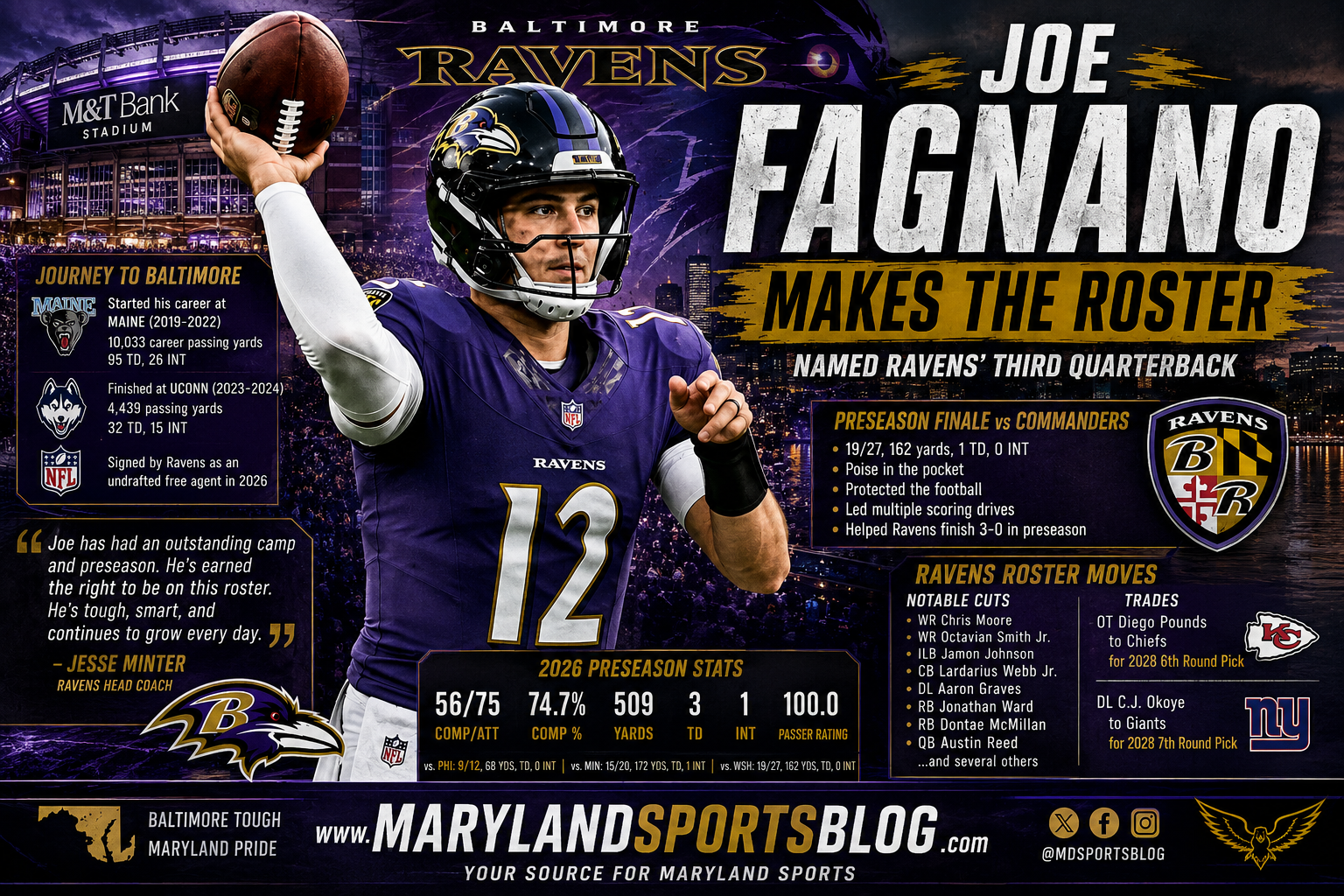
Undrafted rookie Joe Fagnano has made the Ravens’ initial 53-man roster as the third quarterback behind Lamar Jackson and Tyler Huntley, completing one of the best stories of Baltimore’s preseason.
Fagnano was not supposed to force his way onto the roster.
He did anyway.
The former UConn and Maine quarterback played so well throughout the preseason that Baltimore apparently decided the risk of exposing him to waivers was greater than the cost of using a valuable roster spot on a third quarterback.
It is a major development in a Ravens roster that has undergone significant changes over the past two days.
Baltimore has waived numerous players, traded two roster-bubble players for future draft selections and begun shaping the team that will open the first regular season under head coach Jesse Minter.
But Fagnano’s rise might be the most surprising story of them all.
Fagnano refused to give Baltimore an easy decision
Baltimore entered training camp with its top two quarterbacks already established.
Lamar Jackson remains the franchise quarterback, while Tyler Huntley returned to Baltimore as the experienced backup.
The expectation was that the Ravens would probably carry two quarterbacks on the 53-man roster and attempt to place a developmental quarterback on the practice squad.
Fagnano changed that equation.
Baltimore’s own website acknowledged Saturday that keeping three quarterbacks would be something of a luxury. In a projected roster published before the deadline, Ravens staff writer Clifton Brown predicted Baltimore would keep Jackson and Huntley while attempting to get Fagnano through waivers.
Even then, Brown wrote that he was strongly tempted to keep Fagnano because of the rookie’s potential.
The Ravens ultimately decided not to take the chance.
Fagnano earned the roster spot.
Fagnano was excellent throughout preseason
This was not a decision based on one impressive night.
Fagnano consistently performed throughout Baltimore’s three preseason games.
He completed 56 of 75 passes for 509 yards, three touchdowns and one interception, good for a 74.7% completion percentage.
That is outstanding efficiency for an undrafted quarterback learning an NFL offense for the first time.
Fagnano also finished the preseason with a passer rating around 100, while demonstrating the poise and decision-making that coaches look for in developmental quarterbacks.
His final audition came Friday against the Washington Commanders.
Fagnano completed 19 of 27 passes for 162 yards and one touchdown without turning the football over as Baltimore demolished Washington, 41-3, at M&T Bank Stadium.
The Ravens finished the preseason 3-0.
Fagnano was one of the biggest reasons why.
Jesse Minter admitted Fagnano had forced the issue
Before the roster decision became official, Minter essentially acknowledged that Fagnano had made himself impossible to ignore.
Following the Washington game, Minter was asked whether Fagnano had done enough to force Baltimore to consider keeping a third quarterback.
Minter said Fagnano had put enough quality work on film that the Ravens needed to seriously examine the possibility.
That is exactly what happened.
The fascinating part is that Baltimore did not necessarily need Fagnano on the active roster immediately.
Jackson will start.
Huntley is the clear No. 2.
Under normal circumstances, Fagnano could spend most game days inactive.
Yet the Ravens still considered him valuable enough to occupy one of only 53 spots.
That tells us plenty about how Baltimore views his future.
From Maine to UConn to the Ravens
Fagnano took an unconventional road to the NFL.
He began his collegiate career at Maine, where he developed into a multi-year starting quarterback before eventually transferring to UConn.
Fagnano then finished his college career with the Huskies before going undrafted in 2026.
Baltimore signed him as an undrafted free agent and initially viewed him as a developmental prospect behind Jackson and Huntley.
There was nothing guaranteed about his opportunity.
Undrafted quarterbacks often spend training camp competing for practice-squad consideration before disappearing from NFL rosters altogether.
Fagnano instead performed well enough to become part of Baltimore’s 53.
The Ravens’ official roster lists him at 6-foot-3, 230 pounds, giving Baltimore a developmental quarterback with legitimate NFL size.
Austin Reed’s release cleared the path
Baltimore’s quarterback competition also included veteran Austin Reed late in camp.
The Ravens signed Reed after placing Skylar Thompson on injured reserve.
Reed arrived with an impressive UFL résumé. He threw for 1,923 yards and a league-record 21 touchdown passes during the most recent UFL season.
Reed even threw a touchdown pass in Baltimore’s preseason finale.
But the Ravens waived him Saturday.
That left Fagnano as the obvious candidate if Baltimore decided to keep three quarterbacks.
The organization did.
The final quarterback room is therefore:
Lamar Jackson, Tyler Huntley and Joe Fagnano.
It is difficult to imagine many people predicting that combination when training camp began.
Ravens convert depth into draft capital
Fagnano’s story is only part of a busy roster weekend for general manager Eric DeCosta.
Baltimore also made two trades rather than simply releasing players who might not fit on the 53-man roster.
The Ravens traded offensive tackle Diego Pounds to the Kansas City Chiefs for a conditional 2028 sixth-round draft pick.
Pounds entered the NFL as an undrafted free agent from Ole Miss and performed well enough during the preseason to generate interest elsewhere.
That is outstanding asset management.
Baltimore essentially turned an undrafted player who was facing a difficult path to the roster into future draft capital.
The Ravens also traded defensive lineman C.J. Okoye to the New York Giants for a 2028 seventh-round selection.
Okoye played in 13 games for Baltimore last season and had another productive preseason.
But defensive line was one of Baltimore’s deepest position groups.
Instead of releasing Okoye and receiving nothing, DeCosta found a trade partner.
That is exactly how teams with deep rosters should approach cutdown weekend.
Adisa Isaac among notable departures
One of Baltimore’s more surprising defensive decisions involved outside linebacker Adisa Isaac.
The former third-round draft pick was released as Baltimore reshaped its edge-rusher rotation.
The decision became even more interesting because undrafted outside linebacker Ethan Burke reportedly earned a roster spot.
Burke was excellent during the preseason and delivered another impact play against Washington when he forced a fumble on the Commanders’ first offensive snap.
The message is clear.
Draft status only gets players so far.
Performance matters.
Burke played his way onto the roster while Isaac played his way off it.
Lardarius Webb Jr. waived despite strong preseason
Cornerback Lardarius Webb Jr. was also among Baltimore’s cuts.
Webb carried one of the more recognizable names in camp as the son of former Ravens defensive back Lardarius Webb.
The younger Webb played well during the preseason and forced a fumble against Washington, but Baltimore’s depth in the secondary made the numbers difficult.
Webb remains an obvious practice-squad candidate if he clears waivers.
His release is another example of how difficult Baltimore’s roster decisions became.
Several players who performed well simply did not have a clear path onto the 53.
Former Maryland receiver Octavian Smith Jr. waived
The Ravens also waived former Maryland wide receiver Octavian Smith Jr.
Smith dealt with injuries during training camp, costing him important opportunities during one of the most competitive periods of the year.
For an undrafted rookie, missed practice time can be devastating.
Baltimore had numerous receivers competing for limited positions behind its established group, and Smith was unable to create enough separation before the deadline.
He could still become a practice-squad option if he clears waivers.
Chris Moore fails to make roster despite strong finale
Veteran wide receiver Chris Moore also did not make the initial roster.
Moore caught three passes for 54 yards and a touchdown against Washington in the preseason finale.
It was exactly the type of performance a roster-bubble player wants in his final audition.
But Baltimore still went in another direction.
Moore’s veteran experience makes him an intriguing practice-squad possibility under current NFL rules, which allow teams to retain experienced players on the practice squad.
Baltimore could therefore still find a way to keep him in the organization.
Aaron Graves among defensive line cuts
Undrafted defensive lineman Aaron Graves was another player waived during the process.
Graves arrived from Iowa and competed within arguably Baltimore’s deepest position room.
The Ravens simply had too many legitimate defensive linemen for everyone to survive cutdown day.
The Okoye trade demonstrated that point perfectly.
Baltimore had enough depth that another organization was willing to surrender a draft pick for one of the players competing near the bottom of the Ravens’ defensive-line rotation.
Jamon Johnson waived
Inside linebacker Jamon Johnson was also waived.
Baltimore signed Johnson on Aug. 7, but a thumb injury cost him practice time during camp.
Johnson faced a difficult competition at inside linebacker, where Baltimore already had established players and younger developmental options.
His release was another move necessary to get Baltimore down toward the 53-player limit.
Evan Beerntsen is a notable draft-pick casualty
One of Baltimore’s more interesting offensive line decisions was waiving Evan Beerntsen.
The Ravens selected Beerntsen in the seventh round of the 2026 NFL Draft.
Teams obviously prefer to retain draft picks, particularly during their rookie seasons, but Baltimore has historically been willing to expose late-round selections when other players perform better.
Beerntsen could still return through the practice squad if he clears waivers.
Still, losing a player drafted only months ago demonstrates how competitive the bottom of Baltimore’s roster became.
Running back competition produces multiple departures
Baltimore also reduced its crowded running back room.
Jonathan Ward, Dontae McMillan and Elijah Tau-Tolliver were among the players released.
McMillan gave Baltimore one final reminder of his ability with a 63-yard run against Washington, but it was not enough to crack the roster.
That shows how little one preseason highlight can matter when coaches are evaluating weeks of practices, meetings, special teams work and game film.
Baltimore already has Derrick Henry at the top of its backfield and must balance offensive depth against players who can contribute on special teams.
Every roster position has consequences elsewhere.
Fagnano may have taken a roster spot from another position
That is what makes Baltimore’s decision to carry Fagnano particularly fascinating.
Every spot matters.
Keeping a third quarterback means Baltimore cannot use that position on another running back, linebacker, defensive back, offensive lineman or special-teams contributor.
Before the deadline, roster projections consistently questioned whether Baltimore could justify carrying three quarterbacks.
The Ravens decided Fagnano was worth it.
That suggests Baltimore believes another team might have claimed him if the Ravens tried to sneak him onto the practice squad.
Given his preseason numbers, that was a legitimate concern.
NFL teams are constantly searching for quarterbacks.
A 25-year-old rookie who completed nearly 75% of his preseason passes while displaying NFL size and composure would certainly have attracted attention.
Baltimore removed that possibility entirely.
The Ravens might have found another undrafted quarterback
There is some organizational history worth remembering here.
Tyler Huntley himself entered the NFL as an undrafted quarterback.
Baltimore developed him into a legitimate NFL backup who has started meaningful games.
Now the Ravens have another undrafted quarterback worth developing.
Nobody should suggest Fagnano is ready to challenge Jackson or Huntley.
That is not the point.
The value comes from finding and developing a quarterback without spending a draft pick.
If Fagnano continues improving, Baltimore could eventually have an inexpensive backup quarterback under team control.
In a salary-cap league, that matters.
Quarterbacks are too valuable to throw away when you believe you may have found one.
Baltimore’s 41-3 win made roster decisions harder
The Ravens could hardly have ended the preseason more impressively.
Baltimore overwhelmed Washington, 41-3, completing a perfect 3-0 preseason.
Minter had challenged players to make roster decisions difficult.
They listened.
Fagnano threw another touchdown.
Moore caught one.
McMillan broke a 63-yard run.
Burke forced a fumble.
Webb forced another.
Okoye recovered a fumble.
Several of those players still did not make Baltimore’s roster.
That is what roster depth looks like.
For Baltimore, the challenge was no longer finding 53 NFL-caliber players.
It was deciding which NFL-caliber players the Ravens could afford to lose.
Initial 53 is never really final
The phrase “final 53” is somewhat misleading.
Baltimore’s initial roster could change almost immediately.
The waiver process will give the Ravens an opportunity to claim players released elsewhere.
Baltimore has the 14th waiver priority, a relatively advantageous position for an organization accustomed to picking much later following successful seasons.
A successful waiver claim would require Baltimore to create another roster spot.
The Ravens will also begin constructing their practice squad after waived players clear.
That means some of the names released this weekend could be back in Owings Mills quickly.
But Fagnano does not have to worry about that process.
Baltimore made sure of it.
MSB Take
Joe Fagnano earned this.
The Ravens probably entered camp hoping to keep two quarterbacks and stash a developmental passer on the practice squad.
Fagnano ruined that plan by being too good.
Completing 74.7% of his passes for 509 yards with three touchdowns and only one interception was not a fluke performance from one game. He consistently looked comfortable, decisive and in control throughout the preseason.
Baltimore could have rolled the dice.
The Ravens could have released him and hoped 31 other teams passed.
Instead, Eric DeCosta protected an asset.
That is the right move.
Baltimore knows exactly how important quarterback depth can become during a 17-game season. Huntley provides the immediate veteran insurance behind Jackson. Fagnano provides something different: a developmental quarterback with upside.
The Ravens found him without using a draft pick.
Now they get the opportunity to develop him without worrying that another organization will do it instead.
There were bigger names on Baltimore’s roster bubble.
There were drafted players who did not survive.
There were veterans who played well and still got cut.
There were players traded because Baltimore simply did not have room for them.
But one undrafted quarterback showed up in Owings Mills this spring without a guaranteed job and played himself onto one of the deepest rosters in football.
Joe Fagnano is a Baltimore Raven.
And after the preseason he just put together, he absolutely deserves to be one.