
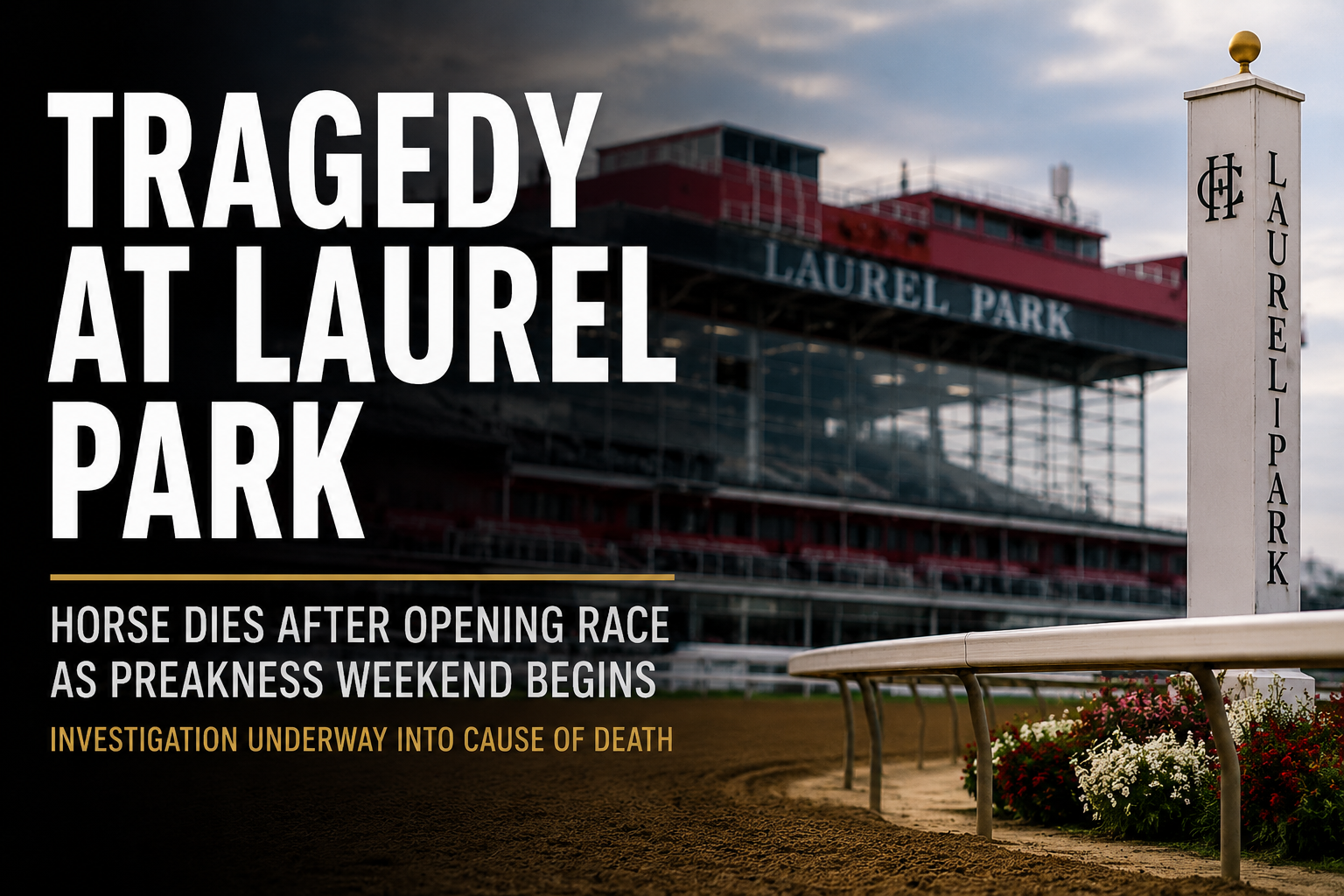
Tragedy at Laurel Park Casts Shadow Over Preakness Weekend After Death of Hit Zero
The excitement and celebration surrounding Preakness weekend in Maryland took a devastating turn Friday afternoon when a 3-year-old colt named Hit Zero collapsed and died following the opening race at Laurel Park.
The incident occurred shortly after Race 1 on Black-Eyed Susan Day, one of the signature lead-in events to the Preakness Stakes festivities. According to Maryland racing officials, veterinary staff responded immediately after the horse collapsed, but despite emergency efforts, Hit Zero could not be saved.
Hit Zero was trained by Brittany Russell and owned by ItsTheJHo LLC and Evan Trommer. The colt was ridden by veteran jockey Sheldon Russell, Brittany Russell’s husband and one of the more respected riders on the Maryland circuit.
The Maryland Racing Commission later stated that the horse appeared to suffer a cardiac event following the race, though officials emphasized that the exact cause of death will not be officially determined until a full necropsy is completed.
For many in attendance, the scene was heartbreaking and impossible to ignore. Fans arriving for one of Maryland horse racing’s biggest weekends instead witnessed a grim reminder of the risks that continue to surround the sport.
What Happened During the Race
Hit Zero was making the first start of his career Friday at Laurel Park. The colt entered the six-furlong race with considerable attention, even going off as the betting favorite despite his lack of racing experience.
Early in the race, nothing appeared dramatically unusual. But toward the stretch run, Hit Zero began to fade badly and was eased near the finish line after falling far behind the field. Moments after the race concluded, witnesses reported the horse began coughing before collapsing near the track.
According to reports from WBAL Radio and racing officials, the colt dropped to his knees and quickly became unresponsive. Emergency veterinary personnel rushed to the scene within seconds, and screens were brought onto the track in an attempt to shield the situation from spectators as medical efforts continued.
The horse was ultimately pronounced dead on the track.
Even in a sport where injuries and tragedy unfortunately remain part of the landscape, the timing and visibility of the incident magnified its impact. Black-Eyed Susan Day traditionally serves as a celebratory kickoff to Maryland’s premier racing weekend. Instead, Friday’s opener created an emotional and somber atmosphere over the facility.
A Difficult Moment for Brittany Russell
The tragedy also placed an emotional spotlight on Brittany Russell, one of the most successful trainers in Maryland racing and one of the sport’s rising national figures.
Russell has built an elite reputation in Mid-Atlantic racing over the last several years, dominating standings at Maryland tracks and developing a stable known for consistency and professionalism. Her operation has become one of the most respected in the region.
Friday’s events were especially painful because Hit Zero was not simply another horse in a large national stable. This was a young colt making his career debut under the care of one of Maryland’s most prominent racing families.
To make matters even more emotional, Sheldon Russell was aboard the horse during the race. The husband-and-wife trainer and jockey combination has long been one of the faces of Maryland racing, especially at Laurel and Pimlico.
Compounding the situation further, Brittany Russell also entered Preakness weekend with major aspirations in Saturday’s marquee race. Her horse Taj Mahal is among the notable entries for the Preakness Stakes itself.
Instead of spending Friday focused entirely on preparation and celebration, Russell and her team were left mourning the loss of a horse only hours before one of the sport’s biggest moments.
The Maryland Racing Commission Responds
The Maryland Racing Commission released a statement Friday confirming the death and outlining the review process that will now follow.
According to officials, the Equine Medical Director immediately initiated a full post-incident review consistent with Horseracing Integrity and Safety Authority protocols, commonly known as HISA.
The Commission stated:
“The Commission has initiated all required review and investigation protocols.”
Officials also confirmed that a necropsy would be conducted to determine the exact cause of death.
In modern Thoroughbred racing, fatalities are reviewed extensively because of increased public scrutiny and growing national concern over equine safety. Every major incident now becomes part of a broader conversation regarding the future of horse racing itself.
The Shadow Over Preakness Weekend
The timing of the tragedy immediately intensified national attention because the 2026 Preakness Stakes is being held at Laurel Park rather than its traditional home of Pimlico Race Course.
This year’s race was temporarily relocated due to ongoing renovations at Pimlico.
That change already made this year’s event historically significant. Laurel Park suddenly became the centerpiece of Triple Crown weekend in Maryland, placing even more attention on every aspect of the facility and racing operations.
Instead of the headlines focusing entirely on contenders, betting odds, and the future of the Triple Crown, much of Friday became centered around the death of Hit Zero and renewed questions regarding horse safety.
Animal rights groups and critics of horse racing were quick to point toward the incident as another example of the dangers facing Thoroughbred racing. Some activist organizations had already planned demonstrations surrounding Preakness weekend prior to Friday’s events.
The tragedy now adds even more scrutiny to a sport that has spent years attempting to improve safety standards and rebuild public trust.
Horse Racing’s Ongoing Safety Debate
Horse fatalities remain one of the most controversial aspects of professional racing.
Supporters of the sport argue that modern veterinary medicine, track maintenance, medication regulation, and safety reforms have significantly improved conditions over the last decade. Organizations like HISA were specifically created to establish national standards and increase accountability across the industry.
Critics, however, believe the sport remains fundamentally dangerous because of the physical demands placed on young Thoroughbreds racing at high speeds.
Incidents like Friday’s death inevitably reignite those debates.
According to reporting from CBS Baltimore, advocacy group Horseracing Wrongs claims that hundreds of horses have died at Maryland tracks since 2014.
Maryland racing has already faced significant scrutiny in recent years. In 2023, racing at Laurel Park was temporarily suspended after concerns involving multiple horse fatalities during the season.
Those events led to deeper evaluations of track conditions, veterinary procedures, and racing protocols.
The sport nationally has also endured several high-profile controversies over the last decade, including clusters of breakdowns at major tracks like Santa Anita Park and Churchill Downs.
Every new incident now immediately becomes part of a much larger conversation about whether horse racing can sustainably move forward while protecting animal welfare.
Cardiac Events in Horse Racing
What makes the Hit Zero incident especially notable is the early indication that the horse may have suffered a cardiac event rather than a catastrophic leg injury.
While breakdowns receive the most public attention in racing, sudden cardiovascular collapse is another risk that occasionally occurs in equine athletics.
Veterinary experts often describe these incidents as difficult to predict because horses may show no obvious warning signs beforehand. In many cases, the exact cause cannot be definitively determined until post-mortem examinations are completed.
Reports Friday indicated Hit Zero began coughing shortly after the race before collapsing.
That sequence led officials to suspect a cardiovascular issue, though racing authorities have emphasized that the necropsy remains ongoing.
Cardiac-related fatalities are less common than musculoskeletal injuries but can still occur during periods of intense exertion, particularly in young racehorses making competitive debuts.
A Reminder of the Human Side of Racing
One of the difficult realities of horse racing is that the sport involves deep emotional bonds between trainers, jockeys, grooms, exercise riders, veterinarians, and horses.
Public reaction often focuses on betting or controversy, but within the barns and stable areas, horses are daily companions and athletes cared for by entire teams.
For trainers like Brittany Russell, the loss of a horse is deeply personal.
Racing insiders frequently describe stable life as emotionally exhausting because of the attachment formed with animals that are simultaneously competitors and companions. When tragedy occurs publicly during major race weekends, the emotional impact becomes magnified.
Friday’s events visibly affected many individuals throughout Laurel Park. Television broadcasts, track coverage, and reports from journalists on-site all described a subdued atmosphere afterward as fans and racing personnel attempted to process what had happened only moments into the day’s card.
Laurel Park’s Historic Role
Friday’s tragedy also unfolded at one of Maryland racing’s most historic venues.
Laurel Park has operated since 1911 and has long served as one of the central homes of Mid-Atlantic horse racing.
The track has hosted numerous graded stakes races and traditionally serves as an important companion venue to Pimlico. In recent years, however, Laurel has taken on an even larger role amid restructuring plans involving Maryland racing facilities.
The 2026 Preakness Stakes being held there represents a temporary but historic shift during Pimlico’s redevelopment process.
Unfortunately for Maryland racing officials, one of the first major national storylines attached to Laurel’s hosting duties became the death of Hit Zero.
The Challenge Facing Modern Horse Racing
The broader challenge for racing is that incidents like Friday’s death resonate far beyond a single track or single weekend.
Every tragedy now unfolds in an era of instant social media reaction, viral video clips, and intense public debate over animal welfare. Even a single fatality during a nationally visible racing weekend can overshadow an entire event.
At the same time, racing remains deeply important culturally and economically in states like Maryland and Kentucky. Thousands of jobs depend on the industry, including trainers, breeders, jockeys, veterinarians, stable workers, and track employees.
The sport therefore exists in a difficult balancing act:
- Maintaining historic traditions
- Protecting horses more effectively
- Preserving economic viability
- Rebuilding public confidence
That balancing act becomes harder each time a fatal incident occurs.
What Happens Next
The immediate next step in the Hit Zero case will be the necropsy and official veterinary review.
Officials are expected to examine:
- Cardiac function
- Pulmonary health
- Pre-race veterinary evaluations
- Track conditions
- Training history
- Medication records
- Any additional contributing factors
Those findings may take days or weeks to become public.
In the meantime, the Preakness Stakes weekend will continue at Laurel Park under an emotional cloud.
Saturday’s Preakness remains one of horse racing’s crown jewel events, but Friday’s tragedy ensured that conversations surrounding the sport this weekend will involve far more than just odds, favorites, and Triple Crown aspirations.
For many racing fans, the death of Hit Zero served as a painful reminder of both the beauty and fragility that exist within Thoroughbred racing.
And for Maryland racing, it became a sobering moment during what was supposed to be one of the state’s biggest celebrations of the sport.