
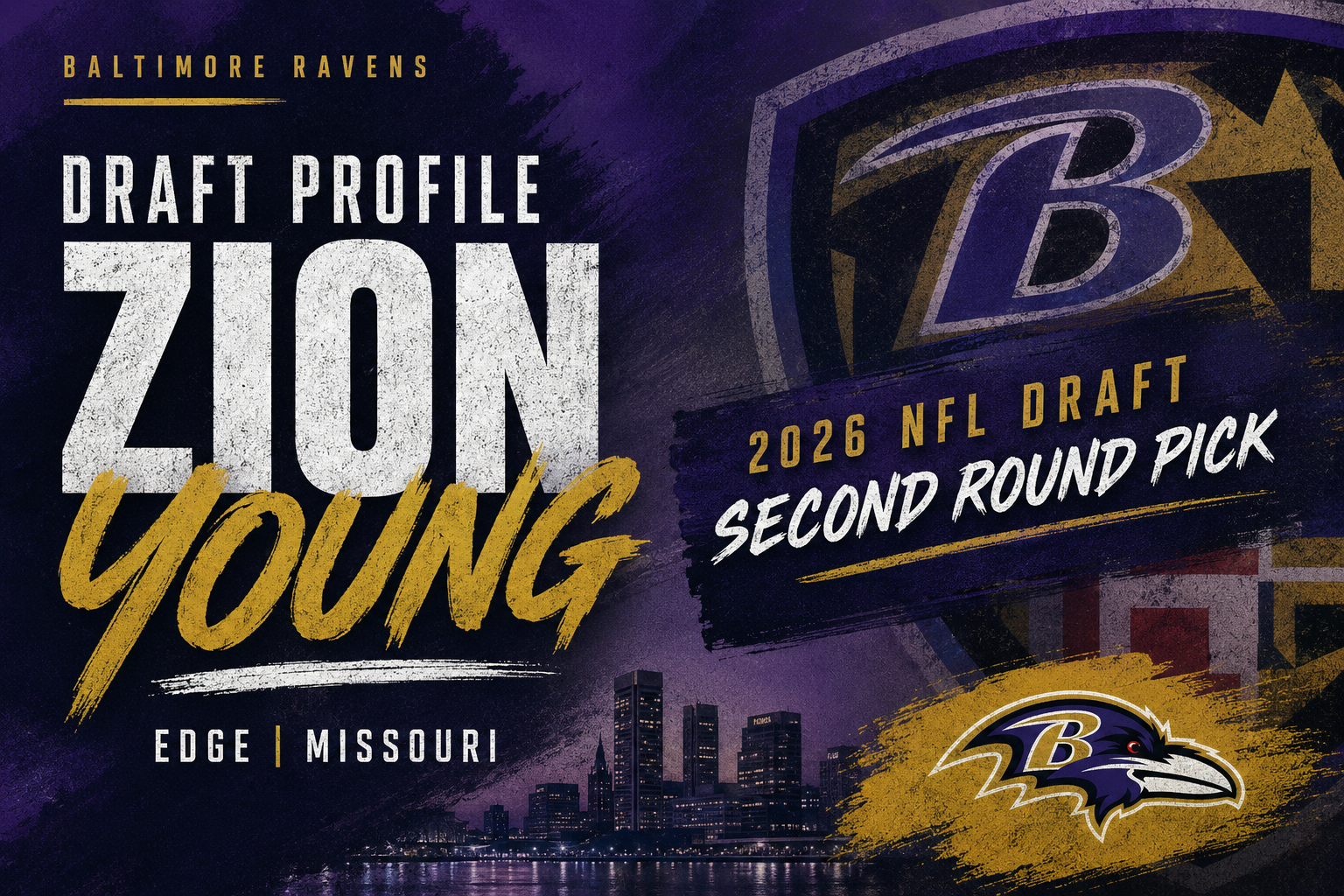
Ravens Draft Profile: Zion Young Brings Violence, Versatility and Baltimore Football Back to the Edge
The Baltimore Ravens entered the 2026 NFL Draft searching for more toughness on the edge of the defense. General manager Eric DeCosta and head coach Jesse Minter wanted another defender capable of setting the tone against the run while still collapsing the pocket on passing downs. Baltimore found that answer when the organization selected Zion Young with the 45th overall pick in the second round of the 2026 NFL Draft.
Baltimore did not simply draft a developmental pass rusher. Baltimore drafted a football player who fits the identity of Ravens defense from the Ray Lewis era through the Terrell Suggs years and now into the next phase under Minter. Violence at the point of attack, relentless effort, physical hands and positional flexibility define Young’s game. Scouts repeatedly highlighted those traits throughout the pre-draft process.
At 6-foot-6 and 262 pounds, Young arrives in Baltimore with the frame to play multiple spots across the front seven. Missouri coaches lined Young up wide, reduced inside on passing downs and occasionally dropped the edge defender into space. Baltimore likely plans to use that versatility immediately. Defensive coordinator Jesse Minter values hybrid defenders who create chaos before quarterbacks can settle into rhythm. Young fits that philosophy perfectly.
The Ravens needed another tone-setter after inconsistent edge production surfaced throughout stretches of the 2025 season. Baltimore’s defense generated pressure, but opposing offenses still found too much room in the running game. Young changes that equation because offensive linemen rarely move Young off the line of scrimmage once leverage arrives. Strong hands and elite play strength allow the rookie to lock out blockers and force runners back inside.
Missouri coaches watched that dominance develop over two seasons in Columbia. Before starring in the SEC, Young spent two years at Michigan State Spartans. The transfer ultimately unlocked the edge defender’s full potential. Missouri’s aggressive defensive scheme placed Young in attacking situations rather than reactive roles. Confidence exploded after the move.
A First-Team All-SEC selection followed during the 2025 season after Young recorded 42 tackles, 6.5 sacks, 14 quarterback hurries and multiple forced fumbles for the Missouri Tigers.
Production alone never tells the full story with defensive linemen. Film explains why NFL evaluators viewed Young as one of the safest edge defenders in the draft class. Offensive tackles struggled with Young’s combination of length and power. Bull rushes regularly collapsed pockets backward into quarterbacks. Interior linemen rarely anchored against Young once momentum built through the hips and hands. Missouri often asked Young to attack gaps rather than simply hold contain responsibilities.
That style should look familiar to longtime Ravens fans.
Baltimore defenses traditionally feature edge defenders who punish offensive linemen physically over four quarters. Suggs mastered that role for years. Jadeveon Clowney delivered a similar impact during his stint in Baltimore. Young now enters a system built to maximize that same mentality.
Several draft analysts considered Young one of the best value selections on Day 2. Some evaluators projected the Missouri defender as a late first-round talent. Baltimore Beatdown called the pick “outstanding” after Young surprisingly remained available at No. 45 overall.
The fit makes even more sense when examining Baltimore’s current defensive roster construction.
Veteran leadership remains in place, but youth now drives the future. Kyle Van Noy continues producing. Odafe Oweh still flashes elite athleticism. Mike Green brings speed off the edge. Young complements that group differently because physicality defines every snap. Offensive coordinators hate defenders who consistently force second-and-long situations by destroying outside run concepts. Young creates exactly that type of disruption.
Ravens officials repeatedly praised Young’s motor after the draft concluded. Minter described collisions involving Young as “train wrecks” because blockers fly backward upon contact.
That description perfectly captures the rookie’s style.
Violence appears throughout every aspect of Young’s tape. Offensive tackles absorb punishment immediately after the snap. Tight ends struggle to survive against the edge defender in blocking situations. Pulling guards often bounce backward after first contact. Few college defenders played with more controlled aggression during the 2025 season.
That mentality should energize Baltimore’s defense immediately.
Young also brings maturity developed through adversity and transition. Early years at Michigan State provided valuable experience but inconsistent production. The transfer portal move to Missouri demanded another adjustment period. Rather than fading under pressure, Young elevated every season.
NFL teams value players who continue improving rather than plateauing early.
Baltimore especially prioritizes competitors who embrace coaching and development. The Ravens historically turn high-motor defenders into productive NFL starters because organizational culture rewards preparation and toughness. Young enters one of the league’s best environments for defensive front development.
Size and strength obviously stand out first, but hand usage separates Young from many college edge rushers. Violent swipes consistently knock offensive linemen off balance. Long-arm techniques generate immediate pocket collapse. Strong lower-body power prevents blockers from resetting once Young gains leverage.
Raw athleticism alone never guarantees NFL success. Technical refinement matters more at the professional level. Young already possesses advanced fundamentals compared to many incoming rookies.
Pass-rush counters still need development.
Elite NFL tackles eventually neutralize pure power rushers unless secondary moves emerge consistently. Young must continue refining inside counters, cross-chops and bend around the edge. Baltimore’s coaching staff likely views that improvement as achievable because the foundational tools already exist.
Effort never becomes a concern.
Young chases plays across the field with relentless energy. Missouri’s coaching staff trusted the defender in every situation because stamina remained strong deep into games. Conditioning and motor frequently determine whether talented college defenders survive NFL rotations. Young already plays with professional-level urgency.
Run defense might provide the quickest path toward immediate playing time.
Baltimore needed another edge defender capable of setting strong edges against physical AFC rushing attacks. Teams like the Pittsburgh Steelers and Cleveland Browns continue emphasizing downhill rushing attacks during divisional matchups. Young’s size and leverage create problems for those schemes immediately.
Few rookies enter the league ready for NFL run responsibilities. Young already looks prepared.
Missouri frequently aligned Young against top SEC competition. Offensive linemen from programs like Georgia Bulldogs, Alabama Crimson Tide and Texas Longhorns provided NFL-level competition weekly. SEC trench battles forced Young to sharpen technique quickly.
Baltimore values battle-tested defenders for exactly that reason.
Pressure statistics also reveal why scouts loved Young’s projection. Over the final two collegiate seasons, Young generated 78 pressures while maintaining strong run-stop percentages.
Quarterbacks rarely escaped comfortably once Young collapsed one side of the pocket.
Baltimore’s defense thrives when pressure arrives without excessive blitzing. Minter prefers disguising coverages rather than constantly exposing defensive backs through all-out pressure packages. Young’s ability to generate disruption with four-man fronts could dramatically improve defensive flexibility.
That impact may not always appear in sack totals.
Pocket collapse often creates opportunities for teammates. Interior pressure flushes quarterbacks sideways into edge rushers. Strong edge contain eliminates escape lanes. Young consistently affected offensive structure even when official statistics failed to reward the effort.
Ravens fans appreciate defenders who handle dirty work.
Baltimore’s defensive history celebrates physical football players more than flashy personalities. Young fits that tradition naturally. Social media clips and scouting breakdowns repeatedly describe the rookie as relentless, physical and violent.
Those descriptions sound exactly like Ravens football.
The selection also reflects Baltimore’s continuing commitment to trench dominance. While many franchises chase speed and finesse, the Ravens still prioritize physical control at the line of scrimmage. Young strengthens that identity immediately.
Another important factor centers around positional versatility.
Modern NFL defenses demand flexibility because offenses constantly create mismatches through motion and personnel packages. Young can align as a traditional outside linebacker, defensive end or interior rusher during passing situations. Baltimore loves defenders capable of multiple assignments because disguise and unpredictability define successful defensive systems.
Young’s frame especially intrigues coaches.
At 262 pounds with long arms, additional functional strength could allow even more interior usage during obvious passing downs. Offensive guards often struggle against edge defenders possessing outside quickness and power simultaneously. Baltimore may eventually create specialized pass-rush packages featuring Young attacking interior gaps.
That possibility should excite Ravens fans immediately.
Development alongside veterans could accelerate growth quickly. Baltimore historically builds strong defensive cultures where younger players absorb preparation habits from established veterans. Young now joins a locker room filled with playoff expectations and championship standards.
Those environments often maximize talent.
Missouri coaches consistently praised Young’s competitiveness and toughness throughout the draft process. NFL evaluators also highlighted the defender’s willingness to embrace physical assignments rather than chasing statistics selfishly.
That mentality matters tremendously inside winning organizations.
Baltimore’s defense occasionally lacked consistency setting the edge during the 2025 season. Opposing offenses attacked outside contain aggressively in several key games. Young directly addresses that weakness.
Expect immediate rotational snaps early in the rookie season.
Baltimore rarely overloads rookie defenders immediately, but Young’s skill set translates naturally toward early downs and rotational pass-rush situations. Strong training camp performances could expand that role rapidly.
The AFC North also demands physical edge defenders capable of surviving brutal late-season football.
December football in Baltimore, Pittsburgh and Cleveland rarely resembles warm-weather passing showcases. Cold weather and playoff intensity create trench battles. Young’s playing style fits those environments perfectly.
Few draft selections feel more “Ravens” than this one.
Baltimore fans should also appreciate Young’s football journey because resilience defines the story. The transfer from Michigan State to Missouri represented a major career gamble. Many players disappear after changing programs. Young elevated every aspect of the game instead.
That progression impressed NFL scouts throughout the pre-draft process.
Strong Senior Bowl practices further boosted draft stock. Young consistently won reps through power and hand usage against talented offensive linemen during all-star evaluations. Baltimore clearly valued those performances heavily.
Draft analysts often debate ceilings versus floors when evaluating edge defenders. Young arguably offers both. High-level run defense already exists. Pass-rush refinement could unlock significantly higher production.
Baltimore likely believes coaching can elevate sack numbers dramatically.
The Ravens also value players who embrace physical special teams roles early in careers. Young’s size, effort and aggression should translate well onto several units if necessary. Rookies often earn roster security through those contributions before larger defensive roles develop.
Another underrated aspect of Young’s profile involves durability.
SEC trench warfare punishes defensive linemen physically over long seasons. Young handled heavy workloads while maintaining strong effort and physicality. Availability always matters in the NFL, especially across long playoff-contending seasons.
Baltimore’s championship aspirations require rotational depth capable of surviving injuries and fatigue. Young strengthens that area significantly.
Several outside evaluators compared Young stylistically to former NFL stars like Jason Pierre-Paul and Clowney because of the size-power combination.
Those comparisons obviously create lofty expectations.
Baltimore does not need Young to become a superstar immediately. Baltimore needs consistency, toughness and disruptive energy across the defensive front. Everything from Young’s collegiate tape suggests those qualities already exist.
The organization also understands how difficult AFC quarterback situations continue becoming. Facing elite quarterbacks demands pass rush depth across four quarters. Young adds another disruptive body capable of wearing down offensive lines physically.
That strategy historically works in Baltimore.
The Ravens rarely chase splashy headlines during drafts. Baltimore typically prioritizes football character, scheme fit and physical upside. Young checks every box within that formula.
Draft grades reflected that belief almost universally.
National analysts praised Baltimore for landing one of the draft’s most physical edge defenders outside the first round. Several reports suggested other franchises considered trading ahead of Baltimore specifically to target Young.
Baltimore stayed patient and still secured the defender.
Smart franchises consistently maximize draft value through discipline and preparation. This selection looked like another example.
Young’s background also adds another layer to the story. Growing up as the youngest among 11 siblings helped shape the aggressive personality visible on the field. Ravens.com highlighted that upbringing after the draft announcement.
Competition often creates toughness.
That edge clearly carried onto the football field.
Missouri fans watched Young evolve into one of the SEC’s most feared defensive linemen because effort remained relentless snap after snap. Baltimore fans will likely embrace that same mentality quickly.
Sacks create headlines, but edge setting wins playoff games.
Young already excels at the difficult, physical responsibilities many defenders avoid. Baltimore values that type of football player tremendously.
Ravens defenses historically build around intimidation and physical control. Young’s arrival strengthens both areas immediately.
Expect offensive coordinators to notice the rookie quickly once preseason action begins.
Strong hands, violent leverage and nonstop effort translate regardless of competition level. Young may never become the flashiest player on Baltimore’s defense, but championship defenses always need tone-setting enforcers across the front seven.
Hopefully Baltimore just drafted another one.