
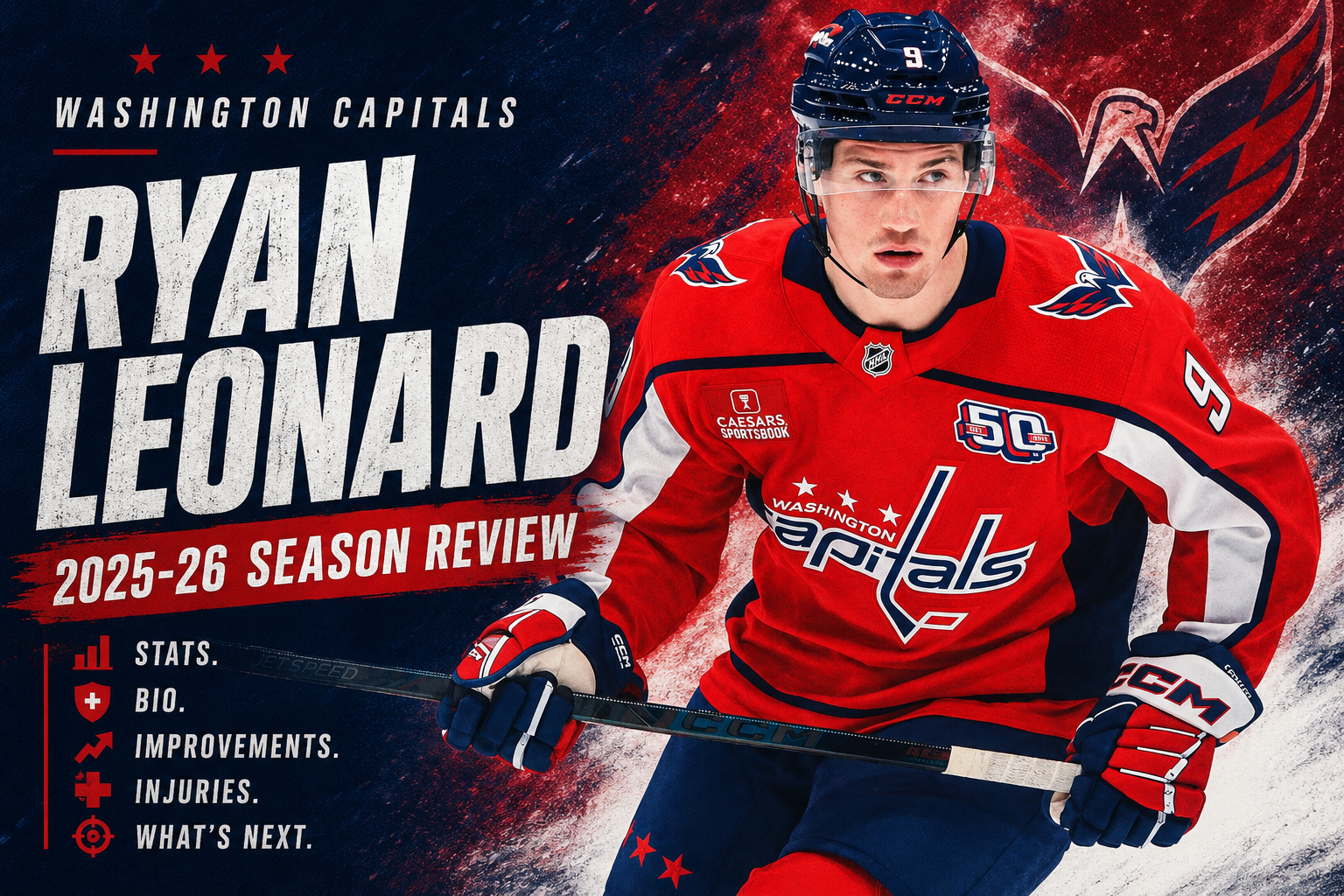
Ryan Leonard’s Rookie Rise Gave the Capitals a New Foundation
The Washington Capitals entered the 2025-26 season searching for a new identity behind the aging core that carried the franchise for nearly two decades. Veterans still drove the locker room, but the organization needed explosive young talent to push the next era forward. Ryan Leonard answered that challenge almost immediately.
Leonard arrived in Washington carrying massive expectations after the Capitals selected him eighth overall in the 2023 NHL Draft. The rookie winger brought elite scoring instincts, relentless physicality, emotional energy, and a reputation as one of the fiercest competitors in amateur hockey. By the end of the 2025-26 campaign, Leonard had transformed from elite prospect into one of the NHL’s most important young forwards.
The rookie season did not follow a perfectly smooth path. Leonard battled inconsistency, endured a notable shoulder injury, handled the grind of an 82-game schedule, and faced the pressure that comes with wearing a Capitals sweater during a transition period. Still, the final numbers painted the picture of a future star.
Leonard finished the season with 20 goals, 25 assists, and 45 points in 75 games while adding 153 shots on goal, 47 penalty minutes, and meaningful power-play production. Among NHL rookies, Leonard ranked near the top in goals, physical play, and offensive impact throughout the year.
More important than the statistics, Leonard changed the emotional tone of the Capitals lineup. Energy shifted every time the rookie stepped onto the ice. Big hits ignited the bench. Aggressive forechecks forced turnovers. Timely goals revived playoff hopes during the final months of the season. Coaches trusted Leonard in difficult situations because the rookie never backed away from pressure.
Washington did not simply develop a talented scorer during the 2025-26 season. The franchise discovered a future centerpiece.
Leonard’s Hockey Roots Built the Perfect Capitals Prospect
Ryan Leonard’s hockey journey started long before the NHL spotlight arrived in Washington. Born on Jan. 21, 2005, in Amherst, Massachusetts, Leonard grew up inside a deeply competitive hockey environment.
The Massachusetts native developed a reputation early as a physically dominant power forward with elite scoring touch. Leonard never played a finesse-only game. Every shift carried edge, aggression, and pace. Opponents hated matching up against him because Leonard attacked every puck battle like the final play of the season.
USA Hockey quickly identified Leonard as a premier talent. Time with the U.S. National Team Development Program elevated his profile nationally. Scouts loved the combination of offensive skill and relentless compete level. Leonard scored goals, delivered punishing hits, and embraced leadership responsibilities against top international competition.
The Capitals valued those intangibles heavily during the 2023 NHL Draft process. Washington needed more speed and nastiness in its forward group. Leonard offered both.
Boston College then became the next major stop in Leonard’s development. College hockey sharpened every part of his game. Leonard exploded offensively while competing against older, stronger opponents every night.
During his collegiate career, Leonard established himself as one of the best forwards in NCAA hockey. Boston College relied on him in every situation — even strength, power play, late-game pressure moments, and emotional momentum swings. Leonard scored 31 goals and 60 points during one dominant collegiate season while earning national recognition.
That production confirmed what Capitals scouts already believed.
Leonard possessed NHL-ready tools long before his professional debut.
Washington’s Expectations Reached Another Level
The Capitals organization entered the season balancing two timelines simultaneously.
Veterans such as Alex Ovechkin still pursued championships, while younger players attempted to establish the next competitive core. Leonard quickly became central to both missions.
Washington fans immediately embraced Leonard’s style because it mirrored the physical identity many associated with classic Capitals hockey. Leonard attacked defenders. Leonard crashed the crease. Leonard played through contact. Leonard never floated through shifts.
The coaching staff gradually expanded Leonard’s responsibilities as the season progressed.
Early in the year, Leonard operated primarily in middle-six roles while adjusting to NHL speed and defensive structure. That transition challenged him at times. NHL defenders closed space faster than college opponents. Goaltenders punished missed opportunities. Defensive mistakes created immediate consequences.
Still, flashes of brilliance appeared almost every night.
Leonard generated scoring chances with raw determination. Powerful skating helped him drive wide around defenders. Heavy wrist shots created rebound chaos. Physicality opened space for linemates.
The rookie also brought emotional swagger to a team that occasionally looked stale offensively during stretches of the season.
By December, Leonard no longer looked like a player merely surviving NHL competition.
Leonard started taking over games.
Offensive Growth Defined Leonard’s Season
Leonard’s final offensive totals reflected both consistency and growth throughout the year.
The rookie finished with:
- 20 goals
- 25 assists
- 45 points
- 153 shots on goal
- 14 power-play points
- 75 games played
- 47 penalty minutes
Those numbers only told part of the story.
Leonard’s improvement curve became the most impressive aspect of the season. Production increased dramatically during the second half of the year. Confidence with the puck grew noticeably. Decision-making improved. Defensive reads sharpened. Offensive timing accelerated.
March especially showcased Leonard’s evolution.
Several reports highlighted Leonard’s importance during Washington’s playoff push. Russian Machine Never Breaks noted that no Capitals player produced more points during crucial March games.
That stretch represented a turning point.
Instead of merely contributing secondary offense, Leonard started driving results against playoff-caliber opponents. Coaches trusted him late in games. Teammates searched for him in transition. Opposing defenders treated him like a primary threat.
Leonard’s shot generation also became a major weapon.
The rookie averaged more than two shots per game while consistently attacking dangerous scoring areas. Many young players settle for perimeter attempts during their first NHL season. Leonard preferred chaos near the crease.
That mentality translated directly into goals.
Several of Leonard’s biggest goals arrived through relentless net-front pressure, second-effort rebounds, and hard drives through contact. The rookie demonstrated the willingness to absorb punishment in order to create offense.
Washington desperately needed that style.
Physicality Separated Leonard From Most Rookies
Many rookie forwards arrive with scoring ability.
Few arrive with Leonard’s level of controlled violence.
The Capitals rookie delivered nearly 90 hits during stretches of the season and regularly changed momentum through physical play.
Leonard’s hits rarely looked reckless. Instead, they reflected calculated aggression.
Forecheck pressure forced hurried breakouts. Open-ice contact disrupted opposing transition attacks. Board battles became exhausting for defenders forced to handle Leonard’s strength shift after shift.
That physical edge earned enormous respect inside Washington’s locker room.
Veterans consistently praised Leonard’s willingness to compete in difficult areas. Coaches trusted him because effort never fluctuated. Even during scoring droughts, Leonard impacted games physically.
That consistency matters tremendously for young NHL players.
Scoring slumps happen. Defensive mistakes happen. Confidence dips happen.
Physical engagement often determines whether a rookie survives those difficult stretches mentally.
Leonard never disappeared.
The Shoulder Injury Tested Leonard’s Maturity
Every NHL rookie faces adversity eventually.
Leonard encountered his biggest obstacle through a shoulder injury that sidelined him for several weeks during the season. Reports indicated the rookie suffered the injury during a game against the Anaheim Ducks and missed significant time afterward.
At the time of the injury, Leonard ranked among the top rookie scorers in the NHL.
The absence created multiple challenges.
First, Leonard lost developmental momentum. Young players benefit tremendously from uninterrupted repetitions, especially during their first professional season.
Second, Washington lost one of its most energetic forwards during an important portion of the schedule.
Third, Leonard faced the mental frustration that accompanies injuries for aggressive players. Physical competitors often struggle emotionally when forced away from the lineup.
Leonard handled the situation impressively.
The rookie returned with noticeable determination and quickly re-established himself within the lineup. Physicality remained intact after the injury. Offensive confidence returned steadily. Most importantly, Leonard showed no hesitation engaging in difficult puck battles.
That resilience revealed another reason Washington views Leonard as a future cornerstone.
The rookie responds to adversity the right way.
Leonard’s Power-Play Development Changed the Capitals Offense
Washington’s power play evolved throughout the season, and Leonard gradually became an increasingly important piece of that evolution.
The rookie finished with 14 power-play points, including several critical goals during the second half.
Leonard’s presence added dimensions the Capitals previously lacked.
Quick-release shooting threatened penalty killers from the circles. Net-front pressure created rebound opportunities. Physicality helped Washington recover loose pucks after blocked shots.
Leonard also displayed improving chemistry with veteran playmakers.
Young scorers often struggle adjusting to NHL puck movement speed on power plays. Leonard adapted quickly. Timing improved dramatically as the season progressed. Passing reads sharpened. One-touch finishes became more common.
The rookie’s ability to contribute offensively without needing constant puck possession especially impressed coaches.
Leonard thrived through movement, effort, and anticipation.
Those traits translate extremely well in playoff hockey.
Defensive Improvements Elevated Leonard’s Overall Value
Offense drove most headlines surrounding Leonard, but defensive improvement became equally important during the season.
Early games occasionally exposed typical rookie mistakes.
Leonard sometimes overcommitted offensively. Defensive zone positioning drifted. NHL opponents exploited small timing errors during transitions.
Those issues gradually diminished.
By the final months of the season, Leonard looked far more composed away from the puck. Backchecking effort remained strong throughout the year, but positional awareness improved significantly.
Coaches rewarded that growth with additional ice time.
Leonard started earning tougher defensive assignments while maintaining offensive production. The rookie became more reliable protecting leads late in games. Washington trusted him against stronger competition.
That development matters enormously for projecting Leonard’s long-term ceiling.
Elite NHL forwards must impact games in all three zones.
Leonard started demonstrating that capability consistently.
Leonard’s Chemistry With Veterans Accelerated His Growth
Young players rarely succeed alone.
Leonard benefited tremendously from Washington’s veteran leadership structure.
Players such as Tom Wilson and Ovechkin helped establish expectations immediately. Practice intensity, physical preparation, professionalism, and emotional consistency all became daily lessons for Leonard.
Wilson especially represented a stylistic blueprint.
Both players thrive through physicality, emotional edge, and offensive aggression. Leonard’s willingness to engage physically fit naturally alongside Washington’s veteran identity.
Reports throughout the season also highlighted Leonard’s strong locker-room relationships. Teammates praised the rookie’s personality, confidence, and competitiveness.
That chemistry matters.
Organizations transition more smoothly when younger players integrate comfortably into established locker rooms. Leonard never appeared overwhelmed by the spotlight or intimidated by veteran personalities.
Instead, Leonard became part of the emotional heartbeat of the team surprisingly quickly.
Leonard’s Biggest Games Showed Star Potential
Several moments during the season hinted strongly at Leonard’s future ceiling.
A four-point explosion against the San Jose Sharks became one of the season’s signature performances. NHL.com noted Leonard became the first Capitals rookie with a four-point game since Alex Semin accomplished the feat years earlier.
Other stretches proved equally impressive.
Leonard became the first Capitals rookie since Ovechkin to reach major goal-scoring milestones during a rookie season.
The timing of many goals stood out most.
Leonard consistently produced during high-pressure situations late in the year when Washington fought desperately for playoff positioning. Big moments never appeared too large for the rookie.
That trait separates good young players from future stars.
Some prospects accumulate points quietly during low-pressure games. Leonard influenced emotionally charged games against desperate opponents.
Washington noticed.
Fans noticed.
Opponents noticed.
Areas Leonard Still Must Improve
Despite the outstanding rookie campaign, Leonard’s game still contains clear growth areas.
Consistency remains the biggest objective.
Leonard occasionally disappeared offensively for stretches before erupting with huge performances. More stable night-to-night production would elevate Leonard toward true first-line status.
Puck management also requires refinement.
Aggressive offensive instincts sometimes created turnovers through the neutral zone. Young power forwards often need time learning when to attack aggressively versus when to simplify plays.
Discipline represents another area for improvement.
Leonard’s emotional style fuels his effectiveness, but maintaining control matters against veteran opponents who attempt to provoke reactions. Some penalties stemmed from overaggression rather than necessary physical play.
Faceoff and defensive-zone responsibilities could also expand if Washington eventually experiments with more positional flexibility.
Still, these concerns feel relatively minor considering Leonard’s age and production level.
Most importantly, none of Leonard’s weaknesses involve effort.
That gives coaches a tremendous foundation to build upon.
Leonard’s Mentality Fits Washington Perfectly
Statistics explain part of Leonard’s value.
Mentality explains the rest.
The rookie plays with an unmistakable emotional edge that resonates strongly within hockey culture. Leonard celebrates goals passionately. Leonard attacks physical battles relentlessly. Leonard embraces pressure situations instead of avoiding them.
Several teammates and analysts repeatedly referenced Leonard’s competitiveness throughout the season.
That mindset becomes contagious inside locker rooms.
Washington occasionally struggled with offensive urgency during portions of the season. Leonard frequently helped reverse that energy through effort alone.
Every organization needs players capable of emotionally lifting teammates during difficult stretches.
Leonard already looks capable of filling that role at age 21.
International Hockey Expanded Leonard’s Profile
Leonard’s development extended beyond NHL competition.
Selection to represent the United States at the 2026 IIHF World Championship further validated Leonard’s growing reputation within American hockey circles.
International experience provides enormous value for young stars.
Tournament hockey demands rapid adjustment, emotional resilience, and chemistry-building with unfamiliar teammates. Leonard’s aggressive style also tends to translate effectively in shorter tournament formats where momentum swings matter heavily.
Washington likely views those opportunities as critical developmental steps.
The Capitals do not simply want Leonard becoming a productive scorer.
The organization wants Leonard developing into a franchise-level leader.
Why Leonard Could Become the Face of Washington’s Next Era
The Capitals understand their organizational timeline has changed.
Ovechkin’s era transformed the franchise forever, but Washington now faces the challenge every aging contender eventually encounters: building the next core before the previous one fully disappears.
Leonard appears central to that plan.
The rookie combines several traits franchises crave:
- Goal-scoring instincts
- Physical intimidation
- Emotional leadership
- Competitive fire
- High-end skating
- Power-play value
- Marketable personality
- Big-game confidence
Very few young forwards offer all those qualities simultaneously.
Leonard’s ceiling now looks substantially higher than many initially projected during draft evaluations. Instead of merely becoming a productive top-six winger, Leonard increasingly resembles a future franchise centerpiece capable of driving playoff-caliber hockey.
Washington likely envisions Leonard eventually anchoring scoring lines while carrying emotional leadership responsibilities once veteran stars move on.
That transition will not happen overnight.
Still, the foundation clearly exists.
Final Evaluation of Leonard’s Rookie Season
Ryan Leonard delivered one of the most encouraging rookie campaigns the Capitals have seen in years.
The statistics impressed. The physicality energized the roster. The maturity through injury adversity stood out. The late-season offensive surge revealed star potential.
Leonard finished the year with 20 goals and 45 points while proving capable of handling NHL physicality, playoff pressure, and major organizational expectations.
More importantly, Leonard established a clear identity.
Every great young player eventually forces opponents to prepare differently. Leonard already started creating that effect during his rookie year. Defenders braced for contact. Coaches adjusted matchups. Opponents tracked Leonard’s forecheck pressure carefully.
That respect must be earned.
Leonard earned it quickly.
The Capitals still need additional roster development before returning to true Stanley Cup contention, but Leonard’s emergence dramatically accelerated optimism surrounding Washington’s future.
A franchise searching for its next emotional leader may have already found one.
And if Leonard’s rookie season represented only the beginning, the rest of the NHL may soon face a major problem.