
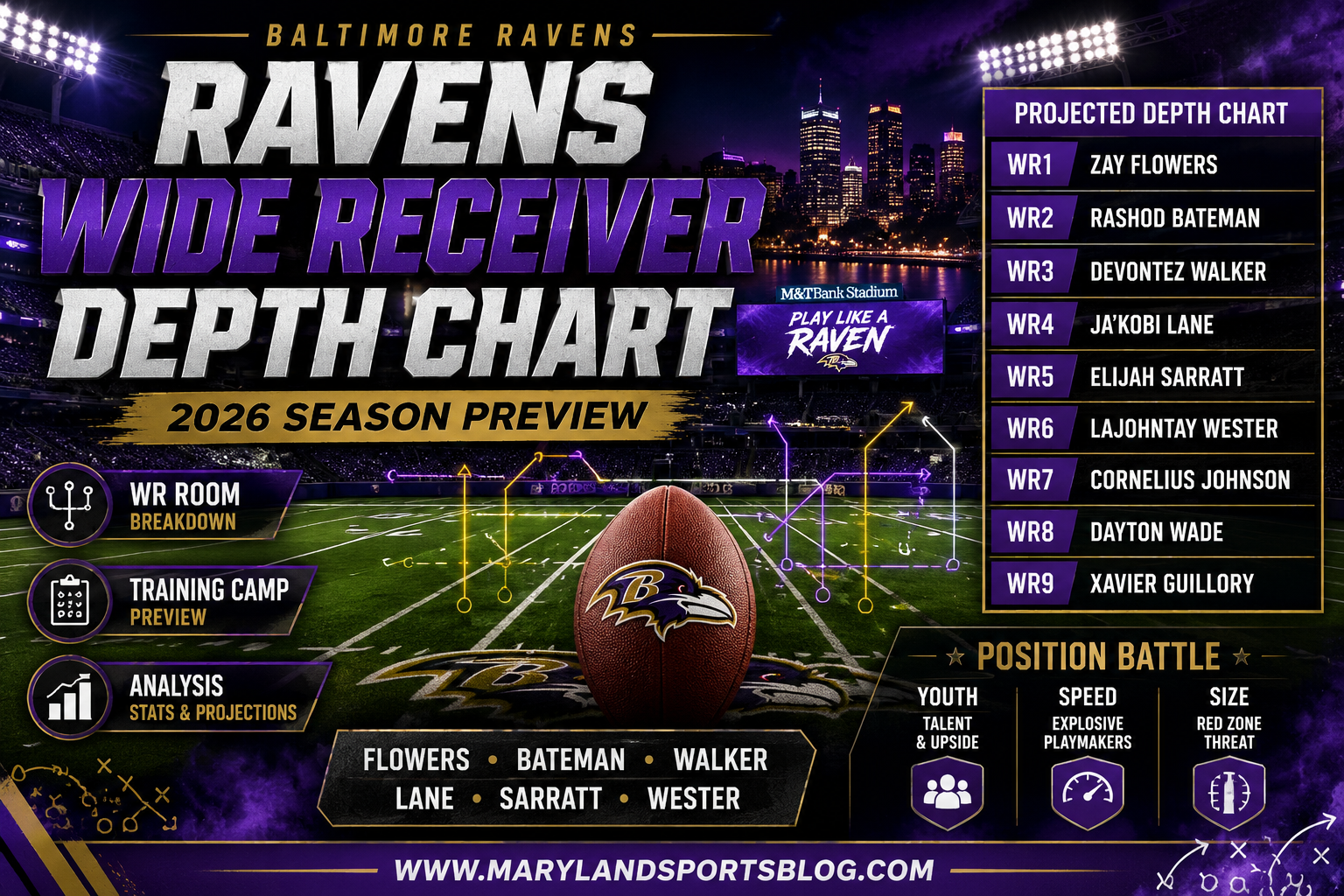
Baltimore Ravens Wide Receiver Depth Chart: Can Zay Flowers and a Young Receiving Corps Elevate Baltimore’s Passing Game in 2026?
The Baltimore Ravens enter the 2026 season with one of the youngest and most intriguing wide receiver rooms in the NFL.
For years, Baltimore built its offense around Lamar Jackson’s dynamic running ability, dominant rushing attacks, and elite tight end play. Wide receiver often felt like an afterthought. That narrative began to change when the Ravens drafted Zay Flowers in the first round, and now Baltimore is betting heavily on a homegrown group of receivers to take the next step.
According to the Ravens’ post-draft depth chart, Zay Flowers and Rashod Bateman remain the projected starters entering training camp, while Devontez Walker, Ja’Kobi Lane, Elijah Sarratt, LaJohntay Wester, Cornelius Johnson, Dayton Wade, and Xavier Guillory compete for roster spots and playing time.
The group lacks a proven superstar outside of Flowers, but it features speed, size, versatility, and upside. The Ravens believe the combination of Flowers’ emergence, Walker’s development, Bateman’s rebound potential, and the addition of rookies Ja’Kobi Lane and Elijah Sarratt can create the deepest receiver room Baltimore has fielded in years.
Several questions will determine how successful this unit becomes.
Can Flowers make the jump from Pro Bowl-caliber receiver to legitimate All-Pro candidate?
Can Bateman recapture the form that earned him a contract extension?
Can Walker finally turn flashes of brilliance into consistent production?
Will either Lane or Sarratt force their way into a major role as rookies?
The answers to those questions could determine whether Baltimore merely wins the AFC North or finally reaches the Super Bowl.
For more Ravens coverage, check out our previous MarylandSportsBlog depth chart breakdowns:
- Ravens Running Back Depth Chart
- Ravens Tight End Depth Chart
- Ravens Offensive Tackle Depth Chart
- Ravens Guard Depth Chart
Additional resources:
- Baltimore Ravens Official Depth Chart
- ESPN Ravens Depth Chart
- NFL.com Ravens Roster
Projected 2026 Wide Receiver Depth Chart
- Zay Flowers
- Rashod Bateman
- Devontez Walker
- Ja’Kobi Lane
- Elijah Sarratt
- LaJohntay Wester
- Cornelius Johnson
- Dayton Wade
- Xavier Guillory
The battle behind Flowers is one of the most competitive position groups on the entire roster. Baltimore could keep six or seven receivers, meaning every preseason snap will matter.
WR1: Zay Flowers
There is no debate about who leads this room.
Flowers has become the centerpiece of Baltimore’s passing attack.
After establishing himself as a reliable target during his first two NFL seasons, Flowers exploded in 2025 and produced the most productive season by a Ravens wide receiver in recent memory. Flowers finished with 86 receptions for 1,211 yards while averaging 14.1 yards per catch. He added five touchdowns and 48 receiving first downs while playing nearly 87 percent of Baltimore’s offensive snaps.
Through his first three NFL seasons, Flowers has accumulated more than 230 receptions and over 3,100 receiving yards. Few receivers in franchise history have started their careers more productively.
What makes Flowers special isn’t simply the statistics.
It is how he produces them.
Few receivers in the NFL possess his combination of short-area quickness, acceleration, and route-running precision. Defensive backs struggle to stay in phase with him through breaks, allowing Lamar Jackson to trust him in critical situations.
Flowers is equally dangerous after the catch. Screens, slants, drag routes, and crossing patterns routinely turn into explosive gains because of his ability to make defenders miss in space.
The Ravens frequently move him around the formation. Offensive coordinators can line him up outside, in the slot, motion him across the formation, or use him on jet sweeps.
There are weaknesses.
At 5-foot-9, Flowers will never be the type of receiver who dominates jump-ball situations. Physical corners occasionally disrupt him at the line of scrimmage. The heavy workload also raises durability concerns.
Still, Flowers has rapidly become one of the NFL’s better young receivers.
Strengths
- Elite route running
- Explosive acceleration
- Dynamic after the catch
- Versatility
- Proven production
Weaknesses
- Smaller catch radius
- Not a dominant contested-catch receiver
- Heavy workload concerns
2026 Projection
95 receptions 1,300 yards 8 touchdowns
Position Grade: A
WR2: Rashod Bateman
No Ravens receiver faces more pressure entering 2026 than Rashod Bateman.
The former first-round pick has experienced one of the more unusual careers in franchise history. Injuries slowed his development early, but the talent has never been questioned.
Bateman’s breakout season produced 45 receptions, 756 yards, and nine touchdowns. That performance earned him a lucrative contract extension and appeared to establish him as Baltimore’s long-term No. 2 receiver.
Then came 2025.
Bateman’s production dropped to just 19 catches for 224 yards and two touchdowns. Availability again became a concern, and Flowers emerged as the unquestioned focal point of the passing attack.
The Ravens still believe Bateman can contribute because his route-running remains among the best on the roster.
Competition is coming, however.
Ja’Kobi Lane and Elijah Sarratt were drafted because Baltimore wanted more depth and more competition.
Strengths
- Route running
- Football IQ
- Reliable hands
- Versatility
Weaknesses
- Durability
- Inconsistent production
- Limited physicality
2026 Projection
52 receptions 705 yards 6 touchdowns
Position Grade: B-
WR3: Devontez Walker
Walker may be the biggest boom-or-bust player on the roster.
At 6-foot-2 with elite speed, Walker brings something Baltimore’s offense desperately needs: a true vertical threat.
Every time Walker steps onto the field, defenses must account for his speed. Safeties cannot cheat toward Flowers or Mark Andrews because Walker can beat coverage over the top.
The challenge is turning flashes into consistency.
Walker has not yet proven he can handle a full-time workload. Route refinement remains a work in progress, and he must become more dependable on intermediate routes.
Still, the upside is enormous.
Many Ravens observers believe Walker could be Baltimore’s breakout player this season.
Strengths
- Elite deep speed
- Size
- Explosiveness
- Big-play ability
Weaknesses
- Route consistency
- Limited NFL production
- Needs expanded route tree
2026 Projection
44 receptions 789 yards 7 touchdowns
Position Grade: B+
WR4: Ja’Kobi Lane
The Ravens drafted Lane because they needed something different.
At 6-foot-4, Lane instantly becomes the biggest receiver in the room.
Flowers wins with quickness.
Walker wins with speed.
Lane wins with size.
That combination could make him an immediate red-zone weapon.
Lane routinely dominated contested catches during his college career. Baltimore has lacked that type of receiver for years.
The rookie still faces a learning curve. NFL cornerbacks are significantly more physical, and Lane must continue refining his route-running.
Strengths
- Size
- Catch radius
- Red-zone ability
- Physicality
Weaknesses
- Raw route runner
- Rookie adjustment period
- Separation consistency
2026 Projection
31 receptions 418 yards 5 touchdowns
Position Grade: B
WR5: Elijah Sarratt
Sarratt may be the most underrated receiver in Baltimore’s receiver room.
While Lane receives attention because of his size, Sarratt offers perhaps the most complete all-around skill set among Baltimore’s young receivers.
The former Indiana standout produced consistently against high-level competition and demonstrated an ability to win at every level of the field.
Sarratt runs polished routes, catches the football naturally, and understands defensive coverages.
Those traits often translate well to the NFL.
Strengths
- Route running
- Hands
- Football IQ
- Versatility
Weaknesses
- Average top-end speed
- Limited special teams value
- Needs NFL strength development
2026 Projection
23 receptions 296 yards 2 touchdowns
Position Grade: B
WR6: LaJohntay Wester
Wester brings a different skill set than anyone else in the room.
Quickness and agility define his game.
Many scouts viewed him as one of the better slot receivers available coming out of college. His ability to create separation underneath makes him intriguing.
Flowers already occupies many of the same areas of the field, however, meaning Wester’s best path to the roster could be through special teams.
Strengths
- Quickness
- Return ability
- Slot versatility
Weaknesses
- Size
- Catch radius
- Crowded depth chart
Position Grade: C+
WR7: Cornelius Johnson
Johnson enters camp as one of the roster bubble players.
The former Michigan receiver possesses NFL size and experience.
His biggest asset is reliability. Coaches know exactly what they will get from Johnson.
Unfortunately, the athletic upside is lower than some younger receivers.
Strengths
- Size
- Blocking
- Experience
Weaknesses
- Limited explosiveness
- Lower upside
Position Grade: C
WR8: Dayton Wade
Wade remains an intriguing developmental prospect.
His speed and athleticism give him a chance to stick around on the practice squad.
Baltimore likes his competitiveness and work ethic.
Unfortunately, roster numbers are working against him.
Position Grade: C-
WR9: Xavier Guillory
Guillory enters training camp as a long shot to make the active roster.
The talent is present, but the numbers game works against him.
His most realistic path appears to be earning a practice squad spot.
Position Grade: C-
Final 53-Man Roster Projection
Wide Receivers Kept:
- Zay Flowers
- Rashod Bateman
- Devontez Walker
- Ja’Kobi Lane
- Elijah Sarratt
- LaJohntay Wester
Practice Squad:
- Cornelius Johnson
- Dayton Wade
- Xavier Guillory
Overall Position Outlook
For the first time in years, Baltimore’s receiver room has legitimate depth.
Flowers is a star.
Bateman remains a capable starter.
Walker possesses breakout potential.
Lane and Sarratt bring exciting rookie upside.
Wester offers special teams value.
The group lacks a proven elite No. 2 receiver, but the overall talent level is stronger than many Ravens fans realize.
If Walker develops and Bateman rebounds, this could become the deepest wide receiver room Lamar Jackson has ever played with.
Final Grade: B+
The Ravens may not have the NFL’s best receiving corps, but they have enough talent to support a championship offense. Flowers gives Baltimore a legitimate No. 1 target, and the combination of Walker, Bateman, Lane, and Sarratt provides upside that could make this group one of the AFC’s biggest surprises in 2026.
Baltimore’s success in 2026 may ultimately depend on whether one of those young receivers takes the next step. If that happens, Lamar Jackson could be working with the deepest and most versatile wide receiver room of his career.