
Baltimore Ravens Tight End Depth Chart Breakdown: Can Mark Andrews Lead a Rebuilt Position Group?
The Baltimore Ravens have long been considered the gold standard when it comes to developing tight ends. From Todd Heap to Dennis Pitta to Mark Andrews, Baltimore has consistently found ways to make the position one of the focal points of its offense.
However, the 2026 season brings significant change.
For the first time in several years, the Ravens enter training camp without Isaiah Likely and Charlie Kolar. Both departed during free agency, leaving Mark Andrews as the lone returning contributor from what had been one of the deepest tight end rooms in football. Baltimore responded by signing veteran Durham Smythe and drafting SMU standout Matt Hibner, creating one of the more intriguing position battles on the roster.
The result is a position group filled with questions, upside, and opportunities.
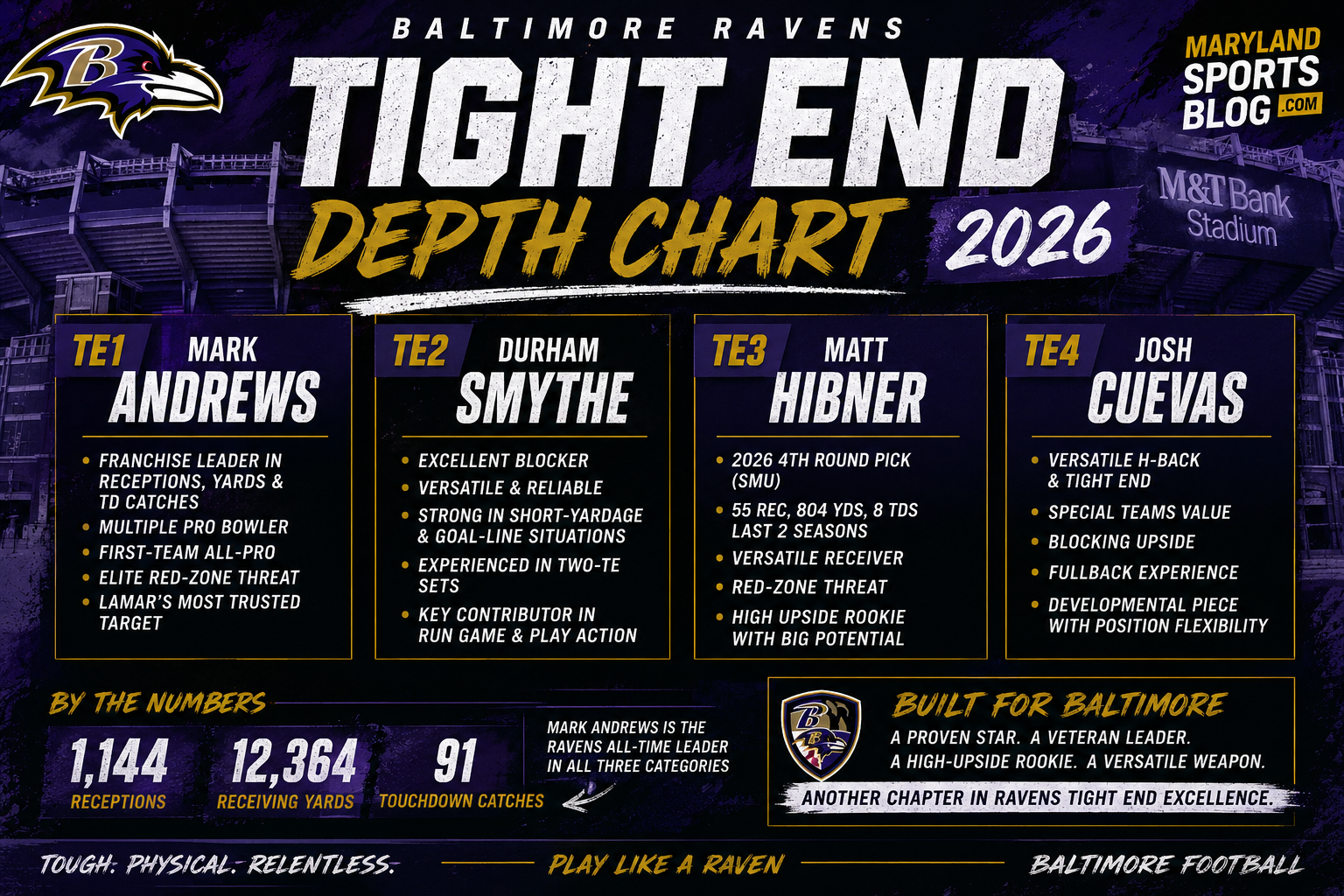
Projected Ravens Tight End Depth Chart
TE1 – Mark Andrews
The Ravens made their intentions clear when they signed Andrews to a three-year contract extension worth $39.3 million. Baltimore remains committed to its franchise tight end despite speculation that the team could transition toward a younger option.
At age 31, Andrews remains one of the most productive players in franchise history.
Career accomplishments include:
- Ravens all-time leader in receptions
- Ravens all-time leader in receiving yards
- Ravens all-time leader in touchdown catches
- Multiple Pro Bowl selections
- First-Team All-Pro honors
The Ravens believe Andrews still has elite football left in him. The departures of Likely and Kolar create a path for Andrews to return to being one of Lamar Jackson’s primary targets. Andrews himself has stated he expects “a lot of opportunities” in the offense following those departures.
Why Andrews Is Still TE1
Several factors work in Andrews’ favor:
- Exceptional chemistry with Lamar Jackson
- Elite route running
- Strong red-zone production
- Leadership in the locker room
- Extensive experience in Baltimore’s offense
The Ravens’ new-look tight end room will likely revolve around Andrews, particularly in key third-down and red-zone situations.
Concerns
The biggest concern is age and workload.
Andrews has battled injuries over the past few seasons and has seen some statistical decline compared to his peak All-Pro years. Baltimore will need to manage his snap count carefully to keep him healthy throughout a 17-game season.
Still, Andrews enters camp as one of the safest starters on the entire roster.
TE2 – Durham Smythe
The most overlooked addition of the offseason may end up being one of the most important.
Baltimore signed veteran Durham Smythe after losing both Likely and Kolar. The former Dolphins tight end brings years of NFL experience and is viewed as a natural fit for the Ravens’ offense.
Strengths
Smythe’s value comes from the things that do not show up in fantasy football box scores.
He is:
- An excellent blocker
- Effective in short-yardage situations
- Capable of lining up at multiple spots
- Experienced in heavy personnel packages
- Reliable as a pass protector
Baltimore’s offense has traditionally relied heavily on tight ends to create running lanes for Lamar Jackson and Derrick Henry. Smythe fits that mold perfectly.
Expected Role
Expect Smythe to see significant snaps in:
- Two-tight-end formations
- Goal-line packages
- Running situations
- Play-action concepts
While he may never replicate the receiving production of Likely, his versatility should make him a key contributor immediately.
TE3 – Matt Hibner
The future of the position may be fourth-round pick Matt Hibner.
Baltimore traded up during the 2026 NFL Draft to acquire the former SMU star, signaling just how highly the organization views his potential.
Why Ravens Fans Should Be Excited
Hibner profiles similarly to Isaiah Likely in several ways.
At SMU, he demonstrated:
- Strong receiving ability
- Route-running versatility
- Red-zone effectiveness
- Ability to line up all over the formation
- Improving blocking skills
Over his final two college seasons, Hibner totaled 55 receptions, 804 receiving yards, and eight touchdowns.
Development Path
The Ravens are unlikely to rush him.
Instead, expect Baltimore to:
- Allow Andrews to handle TE1 duties.
- Use Smythe in blocking situations.
- Slowly increase Hibner’s offensive role.
By the second half of the season, Hibner could become one of the most exciting young weapons in the offense.
Several scouts viewed him as one of the most underrated receiving tight ends in the draft class.
TE4 – Josh Cuevas
The Ravens doubled down on the position by adding Josh Cuevas after selecting Hibner.
Cuevas projects as a versatile H-back and developmental tight end capable of contributing on special teams immediately.
Why He Could Stick
Baltimore loves versatile football players.
Cuevas offers:
- Special teams value
- Fullback versatility
- H-back experience
- Blocking upside
- Positional flexibility
The departure of Patrick Ricard has opened opportunities for players capable of filling multiple roles. Cuevas could become a valuable depth piece because of that versatility.
Position Group Outlook
The Ravens lost significant talent when Isaiah Likely signed elsewhere and Charlie Kolar departed in free agency. Both players developed into valuable contributors during their time in Baltimore.
However, the front office moved aggressively to rebuild the room.
Baltimore now has:
- A proven star in Andrews
- A veteran blocker in Smythe
- A high-upside rookie in Hibner
- A versatile developmental option in Cuevas
While this group lacks the depth and proven production of previous Ravens tight end rooms, it may possess more long-term upside than many observers realize.
The biggest key will be Andrews.
If Andrews returns to Pro Bowl form, Baltimore’s tight ends could once again rank among the best units in the AFC. If injuries strike or age begins to show, the development of Hibner becomes critically important.
Final Thoughts
The Ravens enter 2026 with one of the more fascinating tight end groups in football.
Mark Andrews remains the centerpiece. Durham Smythe provides veteran stability. Matt Hibner offers tremendous upside. Josh Cuevas gives Baltimore another versatile chess piece.
The room may not be as deep as it was a year ago, but the potential is there for another successful chapter in Baltimore’s long tradition of elite tight end play.
Projected 53-Man Tight End Depth Chart
- Mark Andrews
- Durham Smythe
- Matt Hibner
- Josh Cuevas
Position Grade: B+
The star power remains. The depth has changed. The future now depends on how quickly Matt Hibner develops into the next weapon in Baltimore’s offense.