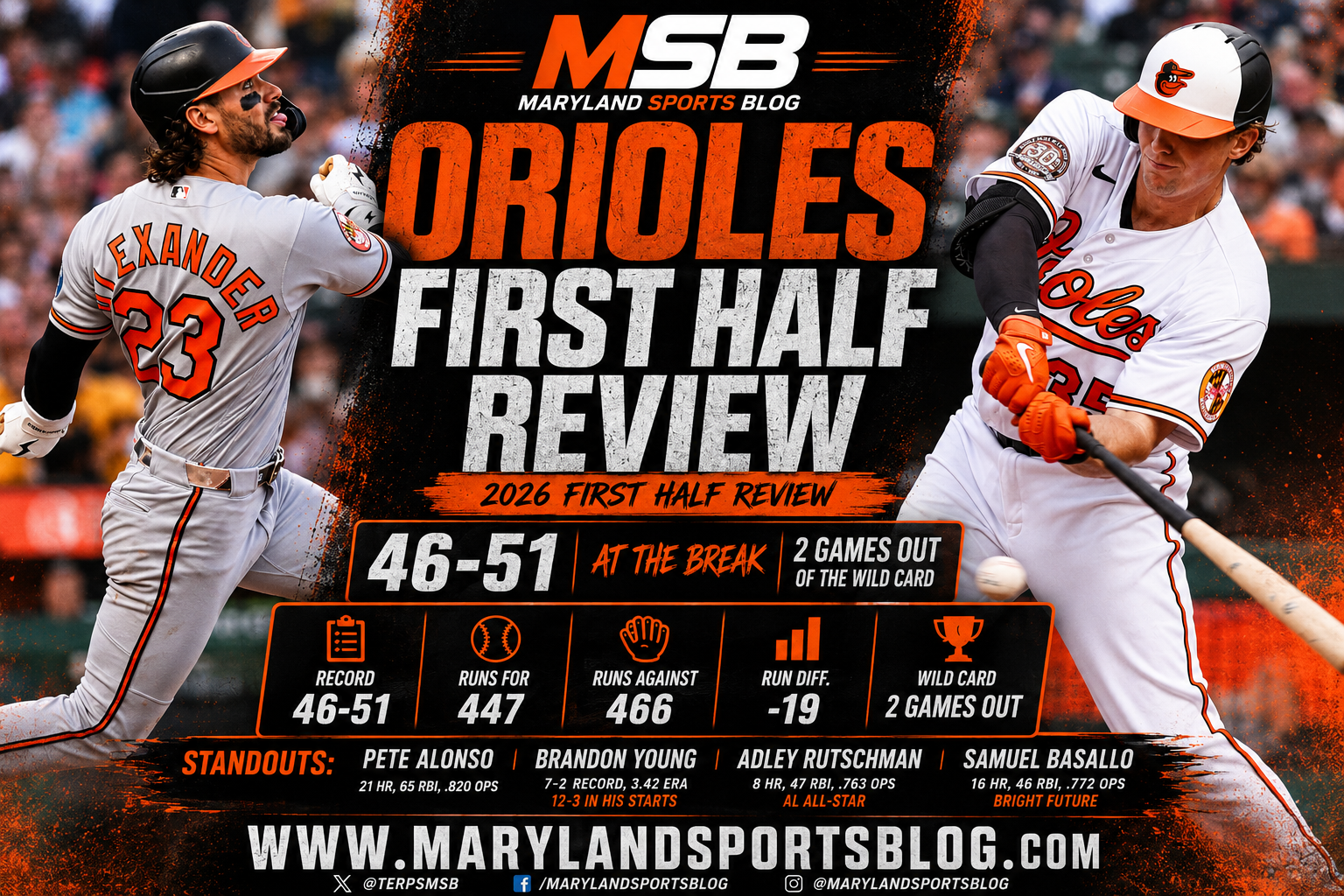
A Deeper Look at How the Orioles Reached 46-51
Baltimore’s four-game winning streak entering the All-Star break created a more optimistic feeling around the club, but it should not obscure the inconsistency that defined the first 97 games.
The Orioles reached the break at 46-51, five games below .500 and in fourth place in the American League East. Baltimore remained only two games outside the final Wild Card position, which kept the season alive despite a record that ordinarily would place a team closer to selling than buying. The Orioles finished the first half by sweeping Kansas City and winning their fourth consecutive game for the first time all season.
That final surge mattered. It gave Baltimore a chance to enter the break discussing a possible postseason run rather than the beginning of a roster selloff.
The larger first-half picture remains concerning.
A team does not reach 51 losses because of one injured player, one weak position group or one unreliable pitcher. Baltimore’s losing record resulted from several problems overlapping at the same time.
The Orioles rarely received peak production from their best hitters. The rotation frequently struggled to work deep into games. Injuries forced Craig Albernaz to constantly alter his batting order and defensive alignment. Established veterans underperformed, while several young players failed to immediately take advantage of expanded opportunities.
Baltimore was talented enough to remain competitive. It was not consistent enough to establish itself as a legitimate contender.
Baltimore Has Not Played Like the Sum of Its Parts
One of the most frustrating aspects of the first half was the gap between the roster’s individual talent and the team’s overall performance.
The Orioles have a legitimate power hitter in Pete Alonso. They have one of baseball’s most talented young shortstops in Gunnar Henderson. Adley Rutschman remains an All-Star catcher. Samuel Basallo has emerged as a dangerous middle-of-the-order bat. Taylor Ward consistently reaches base, while Kyle Bradish possesses the ability to pitch like a front-line starter.
That collection of talent should produce more than 46 wins in 97 games.
The problem has been timing.
When the offense produced, the pitching staff often surrendered too many runs. When the rotation delivered a strong start, Baltimore sometimes failed to provide run support. When the Orioles appeared ready to build momentum, another injury or extended losing stretch followed.
The first four-game winning streak did not arrive until the final four games before the break. That statistic summarizes the season as well as any individual batting or pitching number.
Good teams create sustained stretches of winning baseball. The Orioles spent the first half alternating between promising performances and immediate setbacks.
The Westburg Injury Created a Chain Reaction
Jordan Westburg’s absence deserves more than a brief mention because it changed nearly every aspect of Baltimore’s infield construction.
Westburg did not appear in a regular-season game. He underwent Tommy John surgery on his right elbow on May 13 after an attempted rehabilitation program failed to resolve the problem. The recovery period for a position player generally ranges from nine to 12 months, and the Orioles hope Westburg can return during the early portion of the 2027 season.
Losing Westburg removed more than one hitter.
The Orioles lost a player capable of handling second base or third base, providing above-average defense and producing extra-base power. His versatility would have allowed Baltimore to move Jackson Holliday, Gunnar Henderson and Coby Mayo around the diamond based on matchups and injuries.
Without Westburg, every other infield issue became more significant.
Mayo’s struggles became harder to hide because Baltimore needed him to play. Holliday’s delayed start created another hole. Blaze Alexander’s eventual emergence became essential rather than simply encouraging. Jeremiah Jackson received more responsibility, and Henderson faced even greater pressure to carry the group.
Westburg’s loss did not cause every problem, but it eliminated much of Baltimore’s margin for error.
The Orioles’ Offense Has Been Too Dependent on Power
Baltimore has enough power to erase deficits quickly.
Alonso, Henderson and Basallo have supplied the heart of that production. The Orioles can score several runs in one inning when the middle of the order begins driving the ball.
The offense becomes much easier to contain when the home runs disappear.
Baltimore has not consistently manufactured runs through sustained rallies. The Orioles have experienced too many games where they put runners on base but failed to convert those opportunities into runs.
This roster should be capable of applying pressure in several ways.
Ward gets on base. Alexander supplied contact and speed before his injury. Taveras can run. Rutschman does not strike out excessively. Holliday has demonstrated patience even while struggling to raise his batting average.
The Orioles have not consistently connected those skills.
An offense cannot rely solely on three-run home runs. Baltimore needs more productive outs, more two-out hitting and better execution with runners in scoring position.
The best version of this lineup does not abandon power. It combines power with patience and situational execution.
Gunnar Henderson Holds the Key to the Second Half
No Orioles player has a greater opportunity to change the direction of the season than Henderson.
A .224 batting average and .697 OPS would represent respectable production for a defense-first middle infielder. Those numbers are not enough for a player with Henderson’s talent and importance.
Baltimore needs Henderson to become the centerpiece of the offense again.
His 17 home runs demonstrate that his power has not disappeared. Henderson has still produced extra-base damage and remains capable of changing games with his legs and defense.
The inconsistent contact and on-base production have prevented him from becoming a true MVP-level force.
Henderson does not need to chase home runs. He needs to control the strike zone, use the entire field and avoid allowing difficult stretches to alter his approach.
A strong Henderson second half would create a ripple effect throughout the lineup.
Alonso would receive better pitches to hit. Basallo would face fewer situations where opposing pitchers could work around him. Rutschman would have more RBI opportunities. Ward’s ability to reach base would become significantly more valuable.
Baltimore can add players at the trade deadline, but it cannot acquire anyone with a higher ceiling than the shortstop already on its roster.
Samuel Basallo Has Become More Than a Prospect
Basallo entered the season as one of Baltimore’s most exciting young players.
He enters the second half as an essential part of the major league lineup.
The distinction matters.
Basallo’s 16 first-half home runs ranked second on the club, and his power helped compensate for the struggles of Cowser, O’Neill and Mayo. He homered again in the final game before the break as Baltimore defeated Kansas City, 8-2.
The Orioles should no longer treat Basallo’s playing time primarily as a developmental exercise.
He needs to play regularly.
Baltimore can rotate him between catcher, first base and designated hitter to protect his workload while keeping his bat in the lineup. Rutschman remains the superior defensive catcher and staff leader, but Basallo’s offensive value has become too significant for a part-time role.
His next developmental step involves plate discipline.
Basallo can punish mistakes. Major league pitchers will increasingly attempt to expand the strike zone with breaking balls and elevated fastballs. His ability to identify those patterns will determine whether he becomes a productive power hitter or a complete middle-of-the-order star.
The first half proved that Basallo belongs.
The second half will show how quickly he can adjust once the league develops a more detailed plan against him.
Adley Rutschman Remains the Center of the Club
Rutschman’s importance extends beyond his traditional offensive numbers.
He was Baltimore’s only representative in the 2026 All-Star Game and made his third career appearance. Rutschman entered defensively in the seventh inning and caught three scoreless frames during the American League’s 4-0 victory.
That selection reflected both his first-half production and his standing around the league.
Rutschman continues to provide a quality combination of contact, patience, power and leadership. His 47 RBIs in 65 games showed how effective he was with runners on base.
Baltimore must resist the temptation to judge Rutschman solely against the enormous expectations created during his arrival.
He does not need to be the best catcher in baseball every month to remain one of the Orioles’ most valuable players.
The second half should focus on keeping him healthy and maximizing his offensive impact. Basallo’s presence allows Baltimore to provide Rutschman with more designated-hitter days without removing his bat from the lineup.
A rested Rutschman could become especially important during the final six weeks.
Coby Mayo Faces a Defining Second Half
Few Orioles players have more at stake than Mayo.
Westburg’s injury created a clear opportunity at third base. Mountcastle’s absence also opened at-bats at first base and designated hitter.
Mayo has shown that his power can translate to the major leagues. His 12 home runs are significant, especially considering his limited number of games.
The rest of the offensive profile remains troubling.
A .193 average and 80 strikeouts in 223 at-bats demonstrate that major league pitching has consistently exposed weaknesses in his swing decisions and contact ability.
Mayo does not need to become a high-average hitter to succeed.
He does need to reduce the empty at-bats.
A power hitter can survive a batting average around .230 when he draws walks and consistently produces extra-base hits. A sub-.200 average with a low on-base percentage places enormous pressure on every home run.
Baltimore must decide whether regular major league playing time remains the best developmental path.
The Orioles are trying to win. They cannot indefinitely carry a struggling hitter solely because of his prospect status.
Mayo’s talent still justifies patience. The second half will determine how much patience the club can afford.
Colton Cowser Must Reestablish His Offensive Identity
Cowser’s defense continues to give him value even when he struggles at the plate.
That does not make his offensive regression acceptable.
The Orioles need Cowser to become more than an athletic defensive outfielder. They need the power, patience and extra-base production that made him such an important part of their long-term plans.
His first-half slash line did not reflect that potential.
Cowser’s problems appear to begin with contact quality and consistency. He can work walks and punish certain pitches, but too many plate appearances end without meaningful contact.
The lack of doubles has been particularly noticeable. A hitter with Cowser’s strength and speed should consistently produce damage into the gaps.
Baltimore does not need Cowser to become the primary offensive star. It needs him to become a reliable contributor who can lengthen the batting order and punish right-handed pitching.
A productive Cowser would also reduce the urgency to acquire an everyday outfielder.
Tyler O’Neill Has Run Out of Excuses
O’Neill’s situation differs from Mayo’s and Cowser’s because he is an established veteran.
Baltimore did not add him to develop slowly. The Orioles expected immediate right-handed power and run production.
A .195 average, .642 OPS, six home runs and 12 RBIs do not meet that standard.
Injuries have affected O’Neill throughout his career, but availability alone does not explain his 2026 performance. When healthy enough to play, he has not consistently controlled the strike zone or driven the baseball.
The Orioles must evaluate O’Neill based on production rather than reputation.
If he begins the second half slowly, Baltimore should reduce his role. Beavers, Cowser, Taveras and any potential deadline addition could absorb those at-bats.
Roster decisions become more difficult when they involve veterans with guaranteed money or established track records.
Contending teams cannot allow those considerations to outweigh current performance.
The Rotation Needs Length as Much as Talent
Baltimore’s starting rotation has not been disastrous.
Its greatest weakness has been the inability to consistently deliver seven strong innings.
Bradish, Young, Baz and Rogers have each produced quality starts. All four have also experienced outings where high pitch counts or traffic on the bases forced Albernaz to reach the bullpen earlier than desired.
That cumulative effect matters.
A bullpen might survive one short start. It struggles when asked to cover four or five innings several times in the same week.
The Orioles need their starters to attack the strike zone earlier in counts. Bradish and Baz possess enough swing-and-miss ability that they should not need to pitch around average hitters.
Walks extend innings, increase pitch counts and create opportunities for one extra-base hit to become a crooked inning.
Baltimore’s deadline priority should not simply be finding the most recognizable available starter.
The Orioles need durability.
A dependable starter who consistently provides six innings could improve both the rotation and bullpen.
Kyle Bradish Still Has Another Level
Bradish’s 3.61 ERA and 106 strikeouts made him Baltimore’s best first-half starter.
Those numbers are strong. His overall performance can still improve.
The 50 walks are the primary concern.
Bradish has the pitch quality to dominate without issuing that many free passes. His breaking pitches can generate swings and misses, while his fastball plays effectively when he commands it.
The difference between a good starter and a true ace often comes down to efficiency.
Bradish can strike out eight hitters and still leave after five innings if he needs 100 pitches to get there. Baltimore needs him pitching into the seventh.
Reducing the walks would lower his WHIP, protect the bullpen and give the Orioles a legitimate stopper.
That development would be more valuable than almost any realistic trade-deadline acquisition.
Brandon Young Has Earned Trust
Young began the year as a pitcher trying to establish himself.
He ended the first half with a 7-2 record and 3.42 ERA, including a victory over Kansas City during Baltimore’s final series before the break. MLB’s official lineup page listed Young at 7-2 with 67 strikeouts after that start.
Young does not overwhelm hitters in the same way Bradish or Baz can.
He succeeds through competitiveness, command and the ability to limit damage.
Those traits are valuable on a team that has experienced significant rotation instability.
Young should not lose his spot merely because a more experienced pitcher returns from the injured list. He has earned the opportunity to remain in the rotation until his performance says otherwise.
The next challenge involves handling the increased workload of a full major league season.
Baltimore must monitor his fatigue without becoming overly cautious during a playoff race.
Shane Baz Remains an Important Second-Half Wild Card
Baz’s record and ERA do not fully capture his potential.
His high-velocity arsenal and strikeout ability give him one of the highest ceilings in the rotation. His inconsistency prevents Baltimore from knowing which version it will receive.
Baz can dominate for several innings and then lose command. He can generate strikeouts but also allow extended rallies because he struggles to finish innings efficiently.
The Orioles do not need Baz to become an ace immediately.
They need him to become predictable.
A reliable six-inning starter with an ERA around 4.00 would carry significant value. If his command improves enough to unlock his full arsenal, he could become much more than that.
The second half represents an opportunity for Baz to move from intriguing talent to dependable rotation fixture.
The Bullpen Needs Clearly Defined Roles
Garcia, Cano and Wells provided Baltimore with a solid late-inning foundation.
The uncertainty around the ninth inning prevented the bullpen from becoming a true strength.
Helsley recorded eight saves but also posted a 4.11 ERA and 1.43 WHIP. Those numbers do not inspire complete confidence in close games.
Albernaz does not necessarily need to appoint one permanent closer.
He needs to identify which relievers can handle the highest-leverage situations.
The most important plate appearance might occur with two runners on base in the seventh inning rather than with the bases empty in the ninth. Garcia’s strikeout ability and low WHIP make him an obvious candidate for those situations.
Wells can work multiple innings. Cano can generate ground balls and weak contact. Helsley can overpower hitters when his command is sharp.
Baltimore should organize bullpen usage around matchups and leverage rather than rigid inning labels.
Félix Bautista Cannot Be Treated as the Entire Solution
A healthy Bautista would change the bullpen.
The Orioles cannot assume he will immediately return as the same dominant closer he was before his injuries.
Pitchers returning from lengthy absences frequently need time to regain command, velocity and confidence. Even when their pure stuff returns, back-to-back appearances and high-stress innings can present another challenge.
Baltimore should view anything Bautista provides as an addition rather than the foundation of its bullpen plan.
The front office still needs to explore relief help.
Depending entirely on Bautista would place too much pressure on both the pitcher and the rest of the bullpen.
Defense and Baserunning Must Become Advantages
The Orioles’ athleticism should create value beyond hitting.
Henderson, Cowser, Taveras, Alexander and Holliday all possess the ability to influence games defensively or on the bases.
Baltimore has not consistently converted that athleticism into clean baseball.
Defensive mistakes become especially damaging for a pitching staff that already allows too many baserunners. An extra out can turn a scoreless inning into a multi-run rally.
The same principle applies offensively.
Baltimore cannot give away outs through poor baserunning, especially when the lineup is struggling to produce consecutive hits.
The Orioles do not need to lead baseball in stolen bases. They need to choose aggressive opportunities intelligently and avoid preventable mistakes.
Cleaner defense and smarter baserunning represent two improvements that do not require a trade.
The First Six Games After the Break Could Shape the Deadline
Baltimore returns from the break with a six-game road trip through Houston and Boston. That stretch carries enormous importance because the July 31 trade deadline will follow soon afterward.
A strong road trip could push Baltimore back toward .500 and strengthen the argument for adding immediate help.
A poor trip could leave the Orioles several games behind multiple Wild Card competitors and force Elias to consider a more conservative approach.
The front office should not allow six games to erase everything learned over the first 97.
Those games can still provide important information.
Does the four-game winning streak represent the beginning of a real turnaround? Can Henderson and Cowser begin the second half with improved approaches? Can the rotation continue providing competitive starts away from Camden Yards?
Baltimore’s position is neither clearly buying nor clearly selling.
The next two weeks may determine which direction becomes responsible.
What Would Qualify as a Successful Deadline?
A successful deadline does not require acquiring the biggest available name.
The Orioles should seek players who improve the roster in 2026 without sacrificing prospects who could become part of the next competitive team.
A controllable starting pitcher would be ideal. So would a reliever who remains under contract beyond the current season.
Short-term rentals should carry lower acquisition costs.
Baltimore must avoid trading premium prospects merely to increase its playoff odds from modest to slightly less modest.
At the same time, doing nothing would send the wrong message to the clubhouse and fan base. The Orioles remain two games outside a postseason position.
The right strategy falls between recklessness and inactivity.
Add a dependable starter. Strengthen the bullpen. Find a hitter who can help the outfield or infield.
Do not dismantle the farm system.
Realistic Second-Half Benchmarks
The Orioles have 65 games remaining.
Playing .500 baseball would leave Baltimore at 78-84, which would not be enough.
A 35-30 second half would produce an 81-81 record. That would represent improvement but would probably leave the Orioles outside the postseason.
Going 38-27 would move Baltimore to 84-78.
A 40-25 finish would produce an 86-76 record and give the Orioles a far more credible Wild Card chance.
Baltimore therefore needs to win approximately 58 to 62 percent of its remaining games.
That is a demanding standard for a team that won only 47 percent of its first-half games.
The Orioles do not need perfection. They need to stop following every productive week with a damaging losing streak.
Five Players Who Will Decide the Season
Gunnar Henderson
Henderson must return to being an elite offensive player. No internal improvement would influence the team more.
Kyle Bradish
Bradish must give Baltimore consistent top-of-the-rotation performances and work deeper into games.
Colton Cowser
Cowser must become a productive everyday outfielder instead of relying primarily on his defense.
Jackson Holliday
Holliday must translate his patience and talent into more consistent contact and extra-base production.
Ryan Helsley or Félix Bautista
One of Baltimore’s power relievers must establish himself as a dependable ninth-inning option.
Final Second-Half Prediction
The Orioles are likely to play better than they did during the first half.
Henderson should improve. Holliday should become more comfortable as he moves further beyond his hand injury. Basallo appears ready to continue producing power, while Rutschman and Alonso provide stability in the middle of the order.
The rotation also has enough capable arms to remain competitive.
The larger question is whether improvement will arrive quickly enough.
Baltimore created its five-game deficit over 97 games. It must erase that deficit while also passing several other American League teams over only 65 games.
The Orioles should remain in the Wild Card conversation into September.
Their margin for error is too small to confidently predict a postseason berth.
MSB prediction: Baltimore finishes 84-78 and remains in the Wild Card race until the final week.
That would represent a strong recovery but might leave the Orioles just outside the postseason field.
The outcome can change if Henderson catches fire, Bradish becomes a true ace and Elias adds two meaningful pitchers before the deadline.
The first half proved Baltimore is flawed.
The final four games proved the Orioles are not finished.