
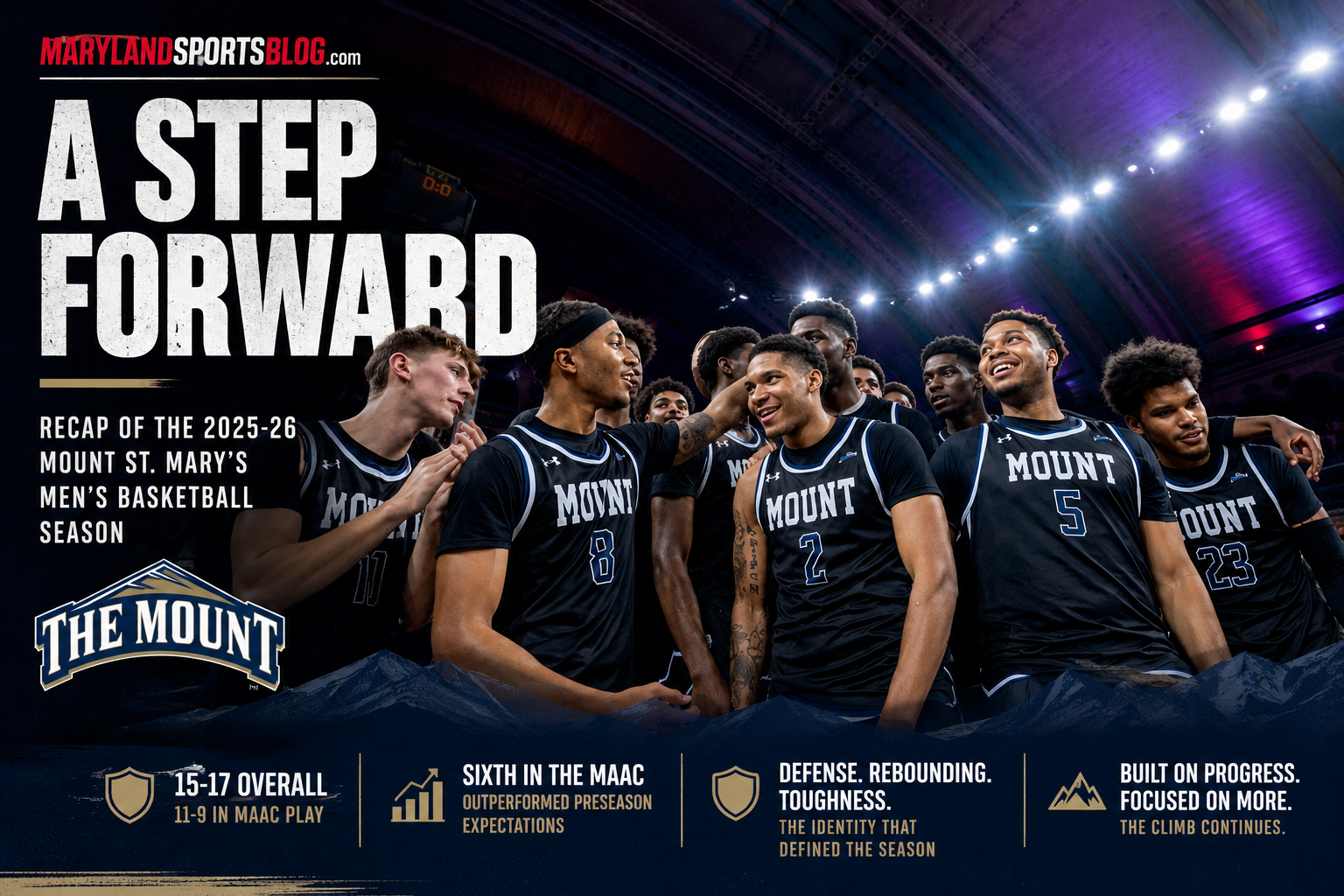
Mountaineers Take a Step Forward Under Donny Lind
The 2025-26 season for the Mount St. Mary’s Mountaineers men’s basketball did not end with another NCAA Tournament appearance, but the year still showed progress for a program trying to build long-term consistency in the Metro Atlantic Athletic Conference.
Second-year head coach Donny Lind guided the Mountaineers to a 15-17 overall record and an 11-9 mark in MAAC play after the program entered the season picked ninth in the conference preseason poll.
That finish mattered.
Mount St. Mary’s lost several key contributors from the 2024-25 team that captured the MAAC Tournament title and reached the NCAA Tournament First Four. Expectations dropped around the league. Instead of folding, the Mountaineers stayed competitive all winter, earned a first-round bye in the conference tournament, and developed one of the better defensive rebounding teams in the MAAC.
The season ended in a narrow MAAC quarterfinal loss to Siena, but the Mountaineers established a foundation that could help the program stay relevant in the league over the next several years.
A Season Full of Adjustments
Replacing a championship roster never comes easy at a mid-major program.
Mount St. Mary’s entered the year with a younger rotation, new offensive roles, and pressure to prove that the previous season’s NCAA Tournament berth was not a one-year spike. The team struggled at times during nonconference play, but conference action helped the roster settle into defined roles.
The Mountaineers finished sixth in the MAAC standings with 11 conference wins.
Several stretches during January and February showed the team’s growth:
- A 78-68 win over Canisius
- A road win over Rider
- A strong victory against Iona
- A dominant 69-47 regular-season finale against Fairfield
Those games highlighted the identity Lind wanted from the roster — physical rebounding, defensive effort, ball movement, and balanced scoring.
Defense and Rebounding Carried the Team
Mount St. Mary’s did not overwhelm opponents offensively. The Mountaineers averaged 68.1 points per game, which ranked near the bottom of the MAAC.
The team instead leaned on rebounding and half-court defense.
The Mountaineers held opponents to 39.6 percent shooting from the field, the best defensive field-goal percentage in the conference.
That defensive discipline kept the Mount competitive in games even when shots stopped falling.
The rebounding numbers also stood out:
- 37.1 rebounds per game
- +3.7 rebounding margin
- Conference leader in defensive rebounds per game
Those numbers reflected effort and toughness more than star power. The Mount rarely backed down physically despite lacking the overall size and depth of some MAAC contenders.
Xavier Lipscomb Led the Backcourt
Graduate guard Xavier Lipscomb entered the season as one of the program’s most experienced players and handled major responsibility throughout conference play.
Lipscomb provided scoring, perimeter defense, and leadership. The veteran guard consistently controlled tempo during close games and delivered several strong performances against MAAC competition. Preseason coaches selected him to the All-MAAC Third Team before the season began.
The Mount needed that veteran presence because the offense often struggled to create easy baskets in transition.
Luke McEldon Emerged
Luke McEldon gave the roster another important scoring option.
McEldon produced several key performances during conference play, including standout games against Iona and Manhattan.
The sophomore showed improvement as the season moved forward. Shot creation became more consistent late in the year, and the offense looked far more dangerous whenever McEldon attacked downhill instead of settling for perimeter jumpers.
Development from younger players like McEldon may become the biggest long-term takeaway from the season.
Abdou Khadre Kebe Anchored the Defense
Abdou Khadre Kebe emerged as one of the team’s best defenders and rebounders.
Kebe earned All-Defensive Team honors in the MAAC after consistently protecting the rim and cleaning the glass.
The Mountaineers rarely dominated offensively, but Kebe’s physicality allowed the roster to survive difficult scoring nights.
That style reflected Lind’s approach. The Mount did not try to outgun opponents every night. The coaching staff emphasized toughness, positioning, rebounding, and defensive rotations.
Three-Point Shooting Remained Inconsistent
The biggest weakness came at the free-throw line and from deep during pressure moments.
Mount St. Mary’s shot only 67.1 percent from the free-throw line, one of the lowest percentages in the MAAC.
The team also shot 32.5 percent from three-point range.
Those numbers hurt during close games.
Several losses followed a similar pattern:
- strong defensive effort
- solid rebounding
- long offensive droughts late in games
That inconsistency showed up again in the MAAC Tournament quarterfinal against Siena.
MAAC Tournament Exit Hurt
The Mount earned a first-round bye and entered Atlantic City hoping to defend the conference title from the previous season.
Instead, Siena eliminated the Mountaineers in the quarterfinals, 63-58.
The Mount fought back late after trailing by double digits, but the comeback fell short.
That loss stung because the bracket appeared open. A repeat title run never materialized, and the Mount could not generate enough offense in the final minutes.
Still, reaching the quarterfinal round while outperforming preseason expectations showed growth for the program.
Donny Lind Changed the Culture
The most important storyline may not appear in the standings.
Lind inherited a program that needed stability and identity. Two seasons later, Mount St. Mary’s looks tougher defensively, more organized offensively, and more competitive nightly inside the MAAC.
The 2024-25 season delivered the NCAA Tournament appearance.
The 2025-26 season tested whether the program could sustain success after roster turnover.
The answer looked encouraging.
The Mount did not collapse after losing championship pieces. Instead, the roster stayed competitive and established a blueprint built around rebounding and defense.
That matters for a mid-major program trying to compete every season despite constant roster movement.
What Comes Next
The next step involves offensive growth.
Mount St. Mary’s needs:
- more perimeter shooting
- improved free-throw consistency
- additional scoring depth
- better transition offense
The defensive structure already exists.
If Lind and the coaching staff add more shot creation through recruiting and development, the Mount could push back toward the top tier of the MAAC next season.
The conference remains wide open behind programs like Siena, Quinnipiac, and Marist. Mount St. Mary’s already proved it can win in March once. The challenge now centers on building yearly consistency instead of occasional breakthroughs.
For a program picked ninth in the preseason, a sixth-place finish and competitive conference season represented a respectable step forward.