
Washington Nationals Go Bat-Heavy on Day One of the 2026 MLB Draft: A Deep Dive Into the First Four Picks
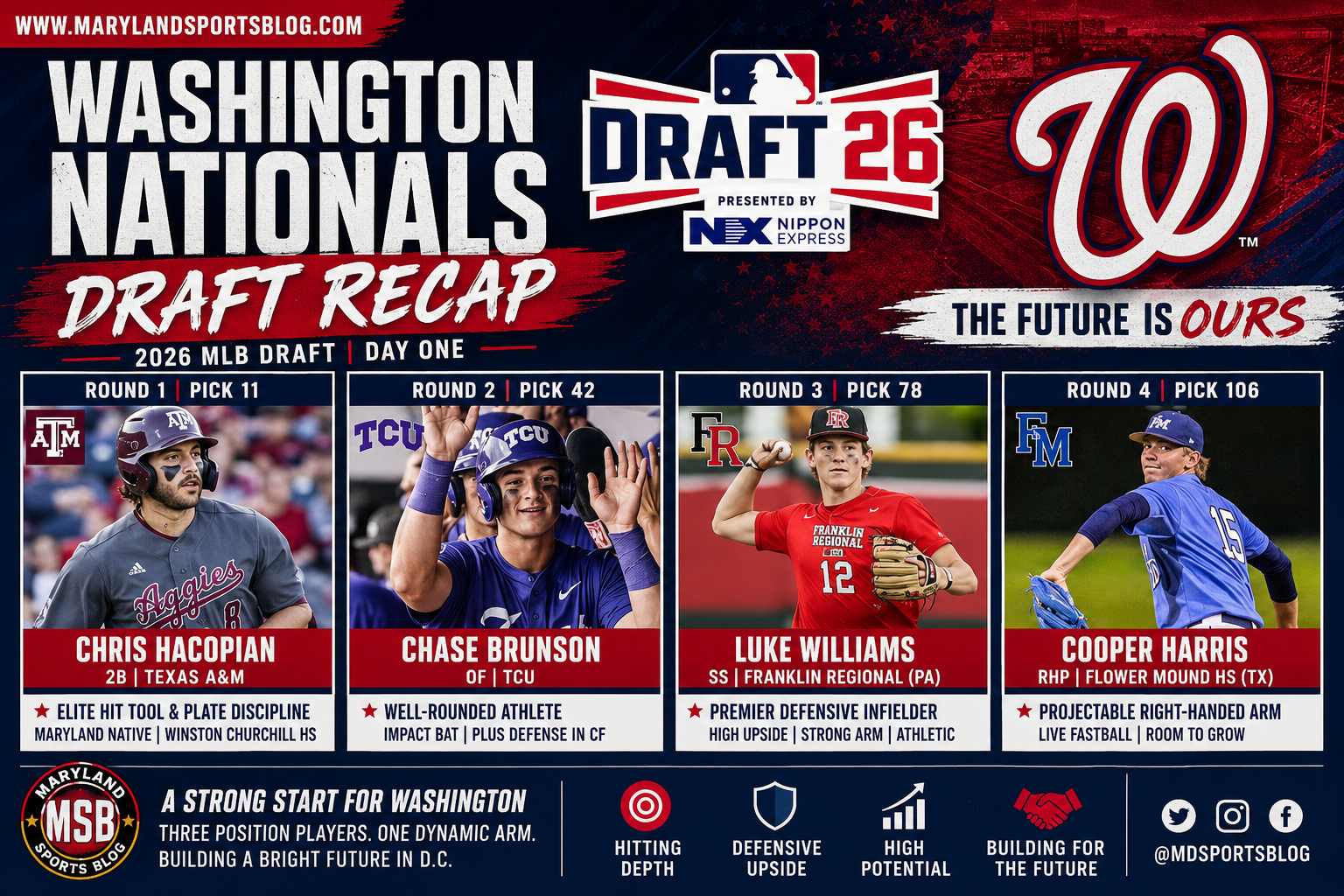
The Washington Nationals made a clear statement on Day One of the 2026 MLB Draft: they’re betting on hitters with advanced offensive profiles while adding one intriguing high-school arm to close out the evening.
With new President of Baseball Operations Paul Toboni and General Manager Anirudh Kilambi leading their first draft, Washington selected four players through the first four rounds:
- Round 1 (No. 11): Chris Hacopian, 2B, Texas A&M
- Round 2 (No. 42): Chase Brunson, OF, TCU
- Round 3 (No. 78): Luke Williams, SS, Franklin Regional (PA)
- Round 4 (No. 106): Cooper Harris, RHP, Flower Mound High School (TX)
The class features three position players with polished offensive tools and one projectable prep pitcher, continuing the organization’s effort to build long-term depth around a young major league core that already includes CJ Abrams, James Wood, Brady House and Dylan Crews.
Chris Hacopian Headlines the Class
The Nationals couldn’t have scripted a better first-round selection.
With the 11th overall pick, Washington selected Chris Hacopian, one of the best pure hitters available and a player with deep Maryland roots.
Hacopian starred at Winston Churchill High School before beginning his college career at Maryland, where he became one of the Big Ten’s best hitters. After transferring to Texas A&M for his junior season, he continued to produce against SEC competition, hitting .319 with a .405 on-base percentage while displaying elite strike-zone discipline.
Why Scouts Love Him
Hacopian isn’t viewed as a flashy athlete.
Instead, evaluators rave about:
- Elite bat-to-ball skills
- Outstanding strike-zone awareness
- Mature offensive approach
- Gap power with growing home-run potential
- Consistent hard contact
Perhaps the most impressive statistic from his college career is his remarkable plate discipline. Throughout more than 1,000 collegiate plate appearances, Hacopian walked more often than he struck out—a rare accomplishment in modern baseball.
Defensive Outlook
Questions remain regarding his long-term defensive home.
He has primarily played second base but could eventually move to first base depending on his development.
Washington clearly believes his bat will carry him through the system.
For a franchise seeking impact offensive talent, Hacopian may have been the safest hitter still on the board.
Chase Brunson Gives Washington Another Advanced College Bat
The Nationals doubled down on polished hitters in Round Two.
They selected TCU center fielder Chase Brunson with the 42nd overall selection.
Brunson emerged as one of college baseball’s biggest risers during the spring after producing:
- .304 batting average
- OPS above 1.000
- Double-digit home runs
- Strong defensive play in center field
Scouts view Brunson as one of the draft’s most balanced prospects.
While he may not possess one elite tool, he does almost everything well.
His profile includes:
- Above-average hit tool
- Emerging power
- Quality center-field defense
- Strong baseball instincts
- Athleticism
Several scouting services ranked Brunson among the top 50 prospects entering the draft.
Fit With Washington
The Nationals have built one of baseball’s better collections of young outfielders.
Adding Brunson gives the organization another player capable of reaching the majors relatively quickly because of his polished college background.
Luke Williams Could Become One of the Draft’s Biggest Steals
Washington shifted toward upside in Round Three.
The Nationals selected Pennsylvania prep shortstop Luke Williams.
Williams is regarded as one of the better defensive infielders in the high school class.
His strengths include:
- Athletic frame
- Quick first step
- Soft hands
- Strong throwing arm
- Room to add offensive strength
Many evaluators believe his defense gives him an excellent chance to remain at shortstop as he climbs the minor leagues.
Because of his age, Williams will likely require patience, but his ceiling could make him one of the best value selections Washington made on Day One.
Cooper Harris Adds Pitching Upside
Washington finally addressed pitching in Round Four.
The Nationals selected Texas high school right-hander Cooper Harris.
Harris brings projection more than polish.
His profile includes:
- Athletic delivery
- Live fastball
- Developing secondary pitches
- Projectable frame
- Significant room for physical growth
Like many prep pitchers, Harris represents a longer-term investment.
If Washington’s player development system can maximize his stuff, Harris could become an important piece of the organization’s pitching pipeline.
Draft Philosophy Becomes Clear
One theme emerged quickly Saturday night.
Washington prioritized hitters who control the strike zone.
Rather than chasing pure athleticism, the Nationals selected players known for:
- Plate discipline
- Contact ability
- Baseball IQ
- Offensive consistency
That philosophy aligns with many successful modern player-development models.
The organization appears intent on building an offense capable of producing high on-base percentages while limiting strikeouts.
How This Fits the Nationals’ Rebuild
Washington already possesses several cornerstone young players at the major league level.
Adding Hacopian and Brunson gives the organization two advanced hitters who could move through the system relatively quickly.
Williams provides long-term middle-infield upside.
Harris strengthens a pitching pipeline that can never have enough high-ceiling arms.
It’s a balanced first day that combines immediate offensive help with long-range potential.
Maryland Sports Blog Take
The Nationals deserve high marks for Day One.
Landing Chris Hacopian was one of the biggest stories of the first round—not only because of his talent, but because a Maryland native is staying in the region with an organization that can market him immediately to local fans.
Brunson may ultimately prove to be one of the best value selections of the second round, while Williams and Harris add legitimate developmental upside.
Rather than chasing raw tools, Washington drafted baseball players—hitters who know the strike zone, compete every at-bat, and have strong track records of production.
If even two of these four selections become everyday major leaguers, Day One of the 2026 MLB Draft could be remembered as the beginning of another important chapter in the Nationals’ rebuild.