
Ravens Add Versatility and Toughness With SMU Tight End Matthew Hibner
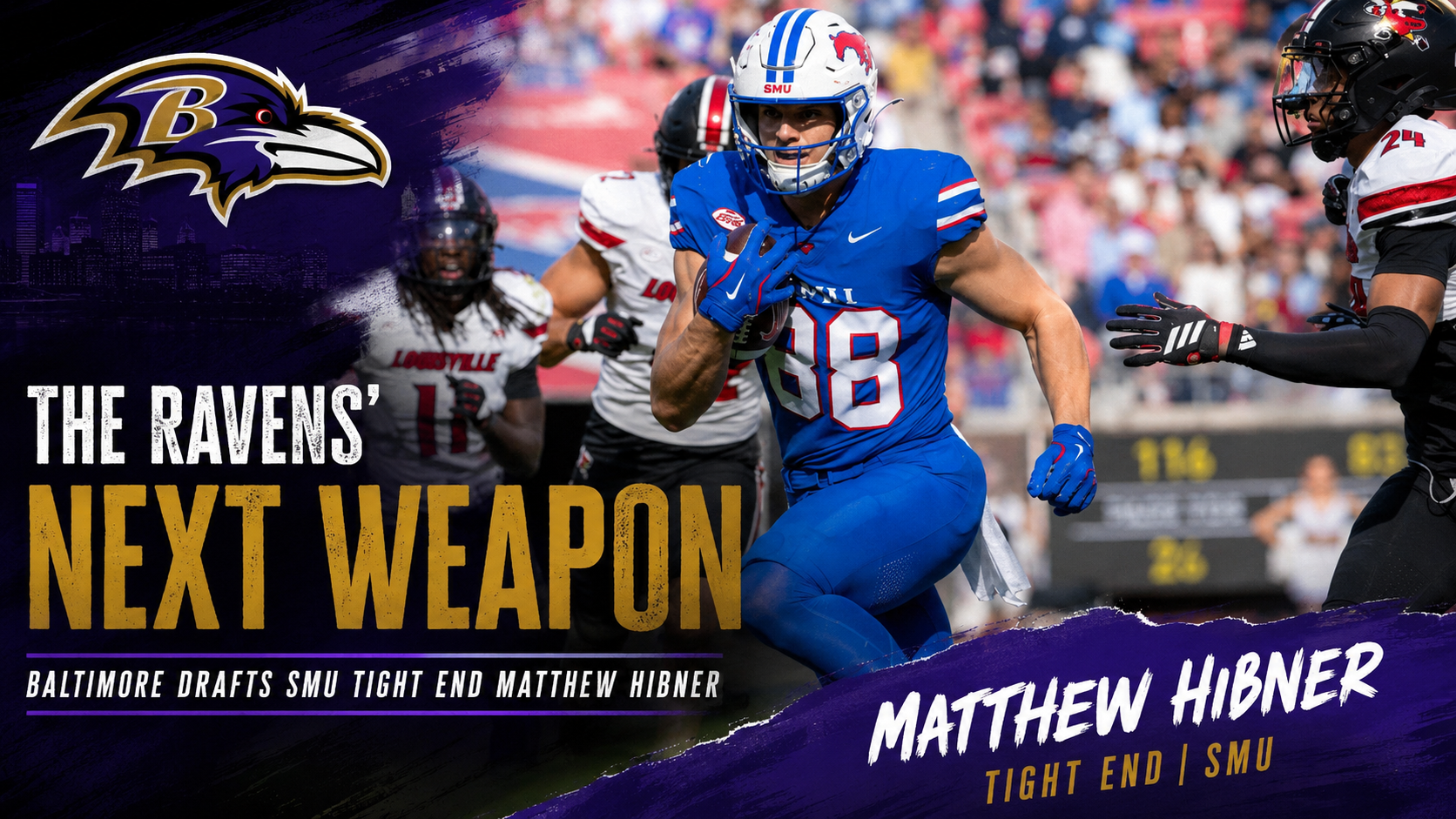
The Baltimore Ravens once again trusted their scouting department at the tight end position during the 2026 NFL Draft. General manager Eric DeCosta traded up in the fourth round to select SMU tight end Matthew Hibner with the No. 133 overall pick, adding another versatile chess piece to one of the NFL’s most creative offenses.
Baltimore rarely spends draft capital without a plan. The organization built a reputation for developing tight ends into impact NFL players, and Hibner arrives with many of the same traits that made previous Ravens tight ends successful. Size, toughness, reliable hands, athletic testing numbers and positional versatility all jumped off the scouting reports during the pre-draft process.
The selection also addressed a real roster need. Offseason departures created uncertainty behind veteran tight end Mark Andrews, and the Ravens wanted another physical option capable of contributing immediately as both a blocker and receiver. Hibner fits the identity Baltimore wants offensively under Lamar Jackson.
Coverage of the Ravens’ offseason at already highlighted Baltimore’s focus on physical offensive weapons throughout the draft. Recent features on the rookie class, including breakdowns of and , showcased the organization’s renewed emphasis on size and toughness at the skill positions.
Another recent feature at discussed Baltimore’s changing offensive philosophy entering 2026. Hibner fits that transition perfectly because the former SMU standout can line up almost anywhere on the field.
From Virginia Football To National Contender
Matthew Hibner’s football journey started long before the bright lights of the NFL Draft. Born in Burke, Virginia, Hibner developed into a multi-sport athlete while attending Robinson Secondary School. Football coaches quickly noticed the combination of size, athleticism and toughness that later became his calling card as a tight end prospect.
High school production painted the picture of a player capable of impacting games in multiple ways. Hibner contributed as a pass catcher, blocker and special teams contributor during his prep career. Recruiting services viewed him as a developmental tight end prospect with substantial upside because of his frame and movement skills.
Several Power Five programs pursued Hibner during the recruiting process before the talented tight end eventually landed at the University of Michigan. The decision placed Hibner inside one of college football’s premier developmental programs for tight ends and offensive linemen.
Michigan molded Hibner into a more complete player. Early years in Ann Arbor focused heavily on blocking fundamentals, route precision and strength development. Playing time came sparingly at first because of the Wolverines’ loaded depth chart, but coaches consistently praised Hibner’s work ethic and willingness to handle physical assignments.
That developmental period proved critical later in his career.
Michigan Helped Build the Foundation
The Wolverines asked tight ends to block defensive ends, pull across formations and operate in pro-style concepts that mirrored NFL offenses. Hibner embraced those responsibilities instead of chasing statistics.
Physicality became one of the defining characteristics of his game.
Michigan’s coaching staff routinely trusted Hibner in heavy packages and run-heavy formations. The experience sharpened leverage technique, hand placement and situational awareness. NFL scouts often value tight ends who already understand those details because the transition to professional offenses becomes much smoother.
The Wolverines also exposed Hibner to high-pressure football environments. Big Ten competition forced him to battle future NFL defenders nearly every week. Practice repetitions against elite talent accelerated his development.
Although receiving numbers at Michigan never exploded, evaluators saw encouraging flashes whenever opportunities arrived. Reliable hands, body control near the sideline and strong effort after the catch hinted at untapped offensive upside.
After spending time inside Michigan’s demanding system, Hibner eventually transferred to Southern Methodist University looking for a larger offensive role.
The move changed everything.
SMU Unlocked Hibner’s Offensive Potential
SMU’s aggressive offensive system allowed Hibner to showcase skills that previously remained hidden inside Michigan’s run-oriented approach. Coaches quickly recognized the matchup problems created by a 6-foot-4, 250-pound tight end with soft hands and surprising athleticism.
Production immediately improved.
Hibner became an important piece of SMU’s offense during the Mustangs’ rise inside the ACC landscape. Injuries higher on the depth chart eventually pushed Hibner into an even larger role, and the veteran tight end responded with the best football of his collegiate career.
Over his final two collegiate seasons, Hibner recorded 48 receptions, 650 receiving yards and seven touchdowns while consistently contributing as a blocker.
SMU coaches moved Hibner around the formation constantly. Some snaps came attached to the offensive line. Others placed him in the slot, in the backfield or detached outside against smaller defensive backs. That versatility eventually became one of the biggest reasons the Ravens targeted him.
The Mustangs trusted Hibner in critical situations because of his dependable hands and toughness in traffic. Quarterbacks frequently looked his direction on third downs and near the goal line.
NFL evaluators noticed.
Senior Bowl Performance Raised His Draft Stock
The pre-draft process transformed Hibner from an under-the-radar prospect into a legitimate NFL target.
Strong Senior Bowl practices created momentum first. Scouts watching in Mobile saw a tight end capable of handling blocking drills while also stretching the field vertically. Hibner competed aggressively during one-on-one periods and consistently displayed strong hands through contact.
Then came the NFL Combine.
Hibner tested like one of the most athletic tight ends in the draft class. The SMU standout posted a 4.57-second forty-yard dash at roughly 251 pounds while adding a 37-inch vertical jump and 28 bench press repetitions.
Those numbers confirmed what scouts already suspected.
Explosiveness, functional strength and long-speed all translated onto paper. Athletic testing also dramatically increased Hibner’s value because modern NFL offenses demand tight ends capable of threatening defenses vertically while still holding up as blockers.
Baltimore clearly believed the athletic traits justified an aggressive move up the draft board.
Why the Ravens Loved Matthew Hibner
The Ravens value versatility more than almost any organization in football.
Offensive coordinators constantly shift personnel, formations and alignments to create confusion for defenses. Hibner’s ability to function in multiple roles made him an ideal fit.
Blocking stands out immediately on film.
Hibner attacks defenders with physical intent and solid leverage technique. Run plays often flowed behind his edge seals at SMU. Screen designs also showcased his ability to reach smaller defenders in space and eliminate pursuit angles.
Pass protection added another layer of value. Scouts charted a low pressure rate allowed during pass-blocking assignments, which matters significantly inside Baltimore’s offensive structure.
Reliable hands also separated Hibner from many Day 3 tight end prospects.
Drops rarely appeared on film. Contested catches became another strength. Hibner routinely extended outside his frame and absorbed contact without losing focus at the catch point.
The Ravens covet players who handle dirty work assignments without sacrificing receiving value. Hibner checks both boxes.
Comparing Hibner To Previous Ravens Tight Ends
Baltimore’s history with tight ends shaped much of the reaction to the selection.
The franchise consistently develops productive NFL contributors at the position. Andrews became an All-Pro. Isaiah Likely developed into a dangerous secondary receiving threat. Hayden Hurst, Charlie Kolar and others all carved out roles inside Baltimore’s offense.
Hibner shares traits with several former Ravens tight ends.
Blocking mentality resembles Charlie Kolar in many ways. Athletic testing and alignment flexibility create some similarities to Likely. Red-zone usage at SMU also mirrors concepts Baltimore often uses with Andrews.
Scouts projected Hibner as a long-term TE1 candidate because of the well-rounded skill set.
That projection explains why the Ravens traded up instead of waiting.
Organizations rarely sacrifice draft assets for developmental players unless conviction exists internally. Baltimore clearly viewed Hibner as more than just depth.
Statistical Breakdown
Hibner’s statistical profile may not overwhelm casual observers, but context matters heavily when evaluating tight ends.
Michigan’s offensive structure limited opportunities early in his career. SMU then utilized multiple receiving options inside a balanced offense.
Efficiency numbers tell a stronger story.
Reliable catch rates and low drop percentages consistently appeared throughout the pre-draft process. Scouts also valued his touchdown production and red-zone effectiveness.
Career receiving totals included:
- 48 receptions over his final two seasons
- 650 receiving yards
- Seven touchdowns
- Strong yards-per-catch averages
- Reliable third-down conversion ability
Blocking grades from scouting reports often ranked among the best in the middle rounds of the draft.
Athletic testing metrics included:
- 4.57-second forty-yard dash
- 37-inch vertical jump
- 28 bench press reps
- Excellent Relative Athletic Score
Those numbers helped separate Hibner from many similarly productive collegiate tight ends.
High School Background and Early Development
Recruiting analysts initially viewed Hibner as a high-upside developmental athlete because of his frame and willingness to play physically.
Robinson Secondary School coaches frequently praised leadership qualities and toughness. Hibner contributed in multiple phases of the game while helping elevate the program’s competitiveness in Virginia football circles.
Basketball experience also helped shape body control and movement skills. Many NFL tight ends possess basketball backgrounds because rebounding and route positioning translate naturally to contested catches and leverage battles.
Hibner’s early athletic profile hinted at NFL potential long before recruiting rankings caught up.
Michigan recognized those traits first.
SMU later helped maximize them.
Now Baltimore hopes the developmental arc continues at the professional level.
Scheme Fit With Lamar Jackson
Few offenses utilize tight ends as creatively as Baltimore.
Defenses already struggle accounting for Lamar Jackson’s mobility. Adding another versatile tight end increases the stress placed on linebackers and safeties.
Hibner should immediately contribute inside multiple personnel packages.
Expect Baltimore to deploy him:
- Attached to the offensive line in heavy formations
- Motioning across formations before the snap
- Aligned in the slot against linebackers
- Operating inside red-zone concepts
- Serving as a lead blocker in power-run looks
Jackson historically thrives throwing seam routes and play-action concepts to tight ends. Hibner excelled attacking intermediate zones at SMU, making the pairing particularly intriguing.
The Ravens also value tight ends willing to block on the perimeter during option concepts and designed quarterback runs. Hibner’s physicality fits perfectly there.
Areas That Need Improvement
No draft prospect enters the NFL without weaknesses.
Hibner still needs refinement as a route runner. Suddenness at the top of breaks occasionally disappears against quicker defenders. Elite separation ability may never become a major part of his game.
Initial contact strength during blocking assignments also requires continued development. Stronger NFL edge defenders could occasionally drive Hibner backward early in reps before technique recovers positioning.
Consistency remains another key developmental area.
Baltimore’s coaching staff traditionally maximizes tight end talent exceptionally well, however, which makes the fit particularly interesting. Position coaches can focus on refining details instead of teaching basic physicality or effort.
That matters significantly for rookie tight ends because the transition into NFL offenses often proves difficult.
Ravens Tight End Room Outlook
Mark Andrews still anchors Baltimore’s tight end room entering 2026, but the long-term future at the position carries more uncertainty than previous seasons.
Hibner arrives at an important time.
Baltimore lost several depth pieces during the offseason and needed younger contributors capable of developing into larger roles. The Ravens clearly envision Hibner as part of that succession plan.
Training camp battles should become fascinating.
Veterans will likely handle most early-season snaps, but Hibner’s versatility gives coaches flexibility when building weekly game plans. Contributions on special teams could also accelerate playing time.
The Ravens traditionally trust rookies who block aggressively and avoid mental mistakes.
Hibner checks both categories.
NFL Draft Analysts Reacted Strongly
Reaction to the pick varied across NFL media circles.
Some analysts questioned Baltimore’s decision to trade up for a player many projected later in the draft. Others trusted the Ravens’ exceptional track record evaluating tight ends.
Consensus themes emerged quickly:
- Strong athletic profile
- Reliable hands
- Physical blocking style
- Positional versatility
- Significant developmental upside
Several scouting reports also compared Hibner favorably to long-term NFL starters because of the complete skill set rather than elite specialization.
That distinction matters.
Many college tight ends enter the league as oversized receivers or pure blockers. Hibner projects closer to a balanced every-down player.
Baltimore values those players heavily.
Special Teams Could Define Early Success
Rookie tight ends rarely dominate offensively immediately.
Special teams often determine active game-day status during the first season. Hibner’s physicality and athleticism should help tremendously there.
Coverage units need players willing to embrace contact and execute assignments consistently. Hibner’s background suggests those responsibilities will not intimidate him.
The Ravens historically demand complete roster contributions from developmental players.
Special teams coordinator meetings likely helped influence the draft evaluation process as well.
The Brian Hradsky Projection
The Ravens did not trade up for Matthew Hibner just to stash another developmental player on the depth chart.
Baltimore saw traits that fit the organization’s offensive identity perfectly.
Physicality. Versatility. Toughness. Reliability.
Those characteristics define Ravens football.
Hibner may never post superstar receiving numbers, but the complete package gives Baltimore another weapon capable of impacting games in multiple ways. Blocking on first down, converting third-and-medium, sealing red-zone edges and catching play-action passes over the middle all fit inside his skill set.
Andrews still headlines the room for now, but Hibner carries legitimate long-term starting upside.
Baltimore’s track record with tight ends deserves respect.
Whenever the Ravens aggressively target a player at that position, opposing defenses should probably pay attention.
Final Thoughts
Matthew Hibner enters the NFL in an ideal situation.
Few franchises develop tight ends better than the Baltimore Ravens. Strong coaching, a creative offensive system and an established veteran mentor in Mark Andrews all create an excellent developmental environment.
SMU helped unlock Hibner’s offensive potential after Michigan built the foundation physically and technically. Now Baltimore hopes the final stage of development produces another impact NFL tight end.
The Ravens clearly believe the ceiling extends much higher than outside analysts initially projected.
Considering Baltimore’s history at the position, betting against that evaluation feels dangerous.