No Evidence of Secret Sabotage, but Mike Elias Has Squandered the Orioles’ Championship Window
By Brian Hradsky | Maryland Sports Blog
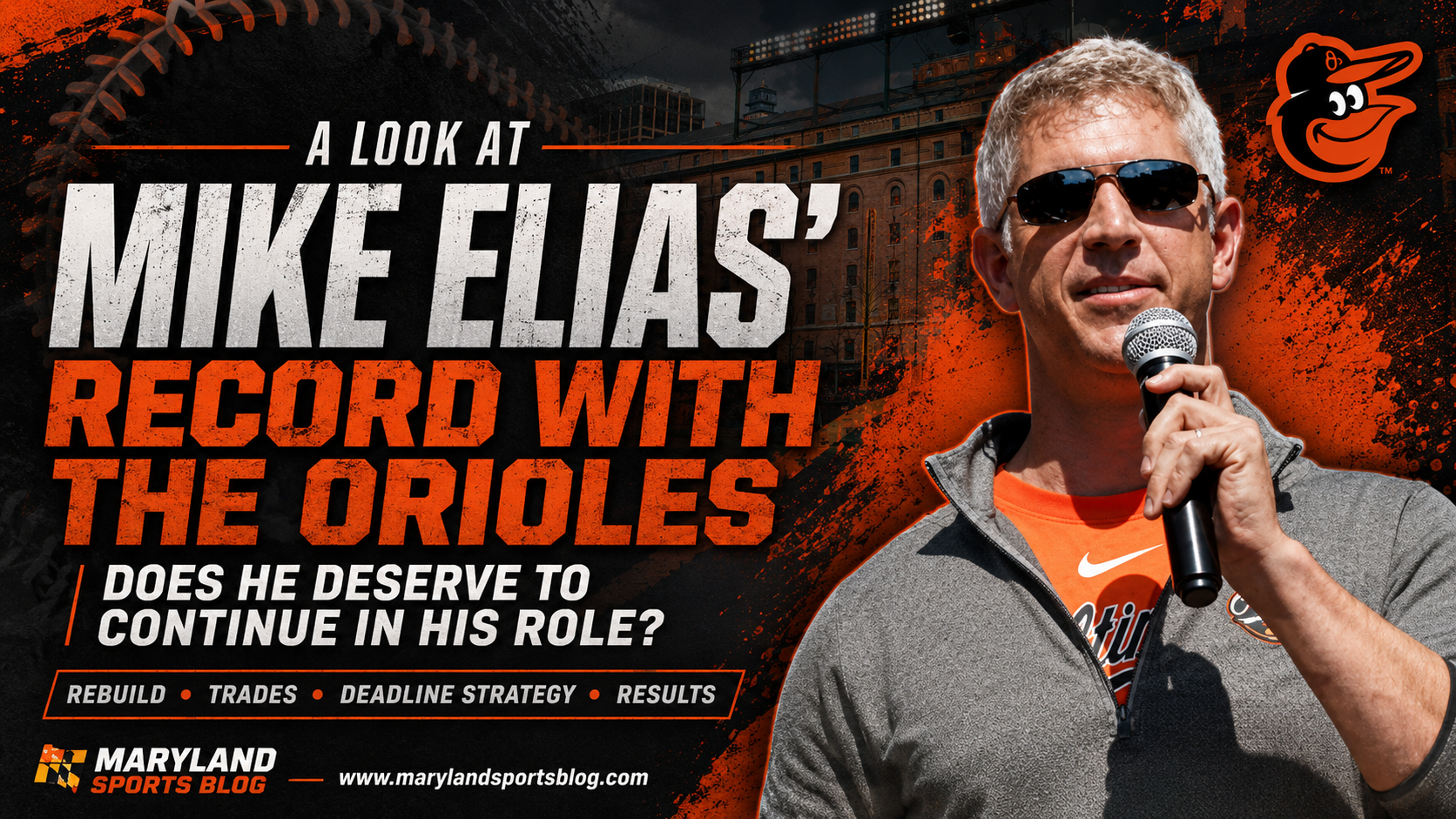
Has Mike Elias secretly been sabotaging the Baltimore Orioles?
There is no evidence that Elias has intentionally attempted to damage the franchise. Accusing a baseball executive of deliberate sabotage would require proof that does not currently exist.
Orioles fans do not need a conspiracy theory, however, to question Elias’ leadership. His documented record provides more than enough evidence for a harsh conclusion: Elias successfully rebuilt Baltimore’s farm system, assembled one of baseball’s most talented young rosters and then repeatedly failed to give that roster the support necessary to win a championship.
Now Elias has started dismantling the core he constructed without winning a single postseason game.
The trade of Adley Rutschman to the Boston Red Sox represents the most painful example. Rutschman was not simply another player. He was the first overall selection in Elias’ first draft with Baltimore, the face of the rebuild and the player whose arrival helped transform the Orioles from a historically bad team into an American League contender.
Elias drafted Rutschman to begin the Orioles’ new era. Seven years later, he traded him within the American League East while Rutschman remained under team control through 2027.
That does not prove sabotage. It does raise a more realistic and equally troubling question: Did Elias become so focused on maintaining future organizational value that he forgot the purpose of building a baseball team is to win?
The Elias Record
The Orioles hired Elias on Nov. 16, 2018, following a disastrous 47-115 season. He inherited a depleted organization, an outdated international scouting operation and a farm system that required significant modernization.
Baltimore’s regular-season records under Elias through 2025 were:
2019: 54-108
2020: 25-35
2021: 52-110
2022: 83-79
2023: 101-61
2024: 91-71
2025: 75-87
That produces a combined record of 481-551 through seven completed seasons. Baltimore entered Aug. 5, 2026, at 55-58, bringing the overall Elias-era record to approximately 536-609. The shortened 2020 season affects the raw totals, but the broader pattern remains clear.
The Orioles endured four consecutive losing seasons while Elias accumulated high draft selections and overhauled the player-development system. Baltimore finally broke through with 83 victories in 2022 before winning 101 games and the American League East in 2023.
The Orioles returned to the postseason in 2024 with 91 victories.
Those accomplishments matter. Elias deserves credit for helping create a sustainable talent pipeline, developing players such as Gunnar Henderson and assembling the first Orioles team to win 100 games since 1980.
The postseason results are also part of his record.
Baltimore was swept by the Texas Rangers in the 2023 American League Division Series. The Kansas City Royals then swept the Orioles in the 2024 Wild Card Series.
Two postseason appearances. Five postseason games. Five losses.
The Orioles did not merely fail to win a championship during the peak of the rebuild. They did not win one playoff game.
Six Selling Deadlines in Eight Years
The most revealing statistic from Elias’ tenure may not involve wins and losses.
It is that the Orioles have operated as sellers at six of his eight trade deadlines.
Selling during the early rebuilding seasons was understandable. The 2019, 2020 and 2021 Orioles were not legitimate contenders. Trading veterans for younger players was a necessary part of reconstructing the organization.
The pattern became harder to justify in 2022.
Baltimore entered that deadline above .500 and only 1½ games out of the final American League Wild Card position. Instead of rewarding the roster, Elias traded Trey Mancini to the Houston Astros and All-Star closer Jorge López to the Minnesota Twins.
Elias argued that he had to manage the organization’s long-term future rather than sacrifice resources for a team with relatively low postseason odds. He described the moves as possible short-term steps backward that would benefit Baltimore’s broader plan.
The López trade ultimately produced meaningful value, including Yennier Cano and Cade Povich. The Mancini trade also made sense from a contract-control perspective.
Still, the message to the players was unmistakable. Even after the Orioles unexpectedly fought their way into contention, management remained unwilling to treat them like contenders.
Baltimore finally acted as a buyer in 2023 and 2024, but the level of aggression remained debatable.
The Conservative 2023 Deadline
The 2023 Orioles won 101 games despite entering the season without a proven top-of-the-rotation starter.
At the deadline, Elias acquired Jack Flaherty from the St. Louis Cardinals. Flaherty struggled after arriving in Baltimore and was eventually removed from the rotation.
The Orioles did not obtain the type of dominant starter who could lead a postseason rotation. They entered October relying heavily on young pitchers and a roster with almost no playoff experience.
Baltimore’s season ended in three games.
A front office cannot guarantee that an aggressive trade will result in a championship. Elias also had legitimate reasons to protect prospects who could contribute for several seasons.
But a 101-win team represents a rare opportunity. Elias treated that opportunity as though another one was guaranteed.
It was not.
The 2024 Deadline
Elias was more active in 2024.
The Orioles acquired Zach Eflin, Trevor Rogers, Seranthony Domínguez, Gregory Soto, Eloy Jiménez, Austin Slater and Cristian Pache while sending away players and prospects including Austin Hays, Connor Norby and Kyle Stowers.
Eflin became an important rotation addition. Domínguez helped stabilize the bullpen. Other acquisitions produced mixed or disappointing results.
The Rogers trade became particularly controversial because Baltimore surrendered Norby and Stowers, two major-league-ready position players, for a starter who initially struggled badly after joining the Orioles.
The deadline was not an outright failure, but it again showed Elias attempting to thread the needle. He wanted to improve the major-league roster without surrendering the organization’s most valuable prospects.
Baltimore was swept in the Wild Card Series.
The 2025 Fire Sale
The championship window did not remain open automatically.
The Orioles collapsed to 75-87 in 2025. Injuries, pitching failures, roster-construction problems and underperformance pushed Baltimore out of contention.
Elias responded with a major sell-off.
The Orioles traded:
- Cedric Mullins to the New York Mets.
- Ryan O’Hearn and Ramón Laureano to the San Diego Padres.
- Ramón Urías to the Houston Astros.
- Andrew Kittredge to the Chicago Cubs.
Baltimore received a large collection of prospects, but the deadline removed several productive and popular players from the organization.
Selling veterans on expiring contracts during a losing season is common. The larger problem was how the Orioles reached that position only two years after winning 101 games.
The farm system was supposed to create a long competitive runway. Instead, Baltimore moved from division champion to first-round elimination, another first-round elimination and then a losing season.
That regression happened before the team won a postseason game.
The Adley Rutschman Trade Changes Everything
The 2026 deadline cannot be dismissed as a routine sale.
Baltimore traded Rutschman and catcher Jake Rogers to Boston for catcher Carlos Narváez, pitching prospects Anthony Eyanson and Kyson Witherspoon, outfielder Enddy Azocar and a player to be named later or cash considerations.
Eyanson and Witherspoon are highly regarded. Boston surrendered three of its top five prospects, giving Baltimore a substantial package. Rutschman had also battled wrist inflammation, a concussion and ankle trouble during the season.
Those facts explain the baseball logic behind the return.
They do not erase the symbolism or competitive consequences.
Rutschman was a three-time All-Star and remained under team control through 2027. He was traded to a division rival that was strengthening itself for a postseason run. Boston did not view Rutschman as a fading asset to unload. It viewed him as a potential difference-maker.
Only weeks earlier, Elias publicly described the Orioles as potential buyers and said Baltimore was “going for it.” At that point, he maintained that the 2026 Orioles were a postseason-caliber club.
By the deadline, Elias had traded Rutschman, Taylor Ward, Dean Kremer and Tyler Wells.
Baltimore was not buried in the standings. The Orioles were still within reach of an American League Wild Card position when the front office stripped four major contributors from the roster. Wells had recorded a 2.67 ERA over 54 innings before being traded to the Tampa Bay Rays.
The Orioles sent Ward to Seattle for Alex Hoppe, Brock Moore and Harrison Kreiling. Ward had originally arrived from the Los Angeles Angels in the trade that sent former top pitching prospect Grayson Rodriguez out of Baltimore. Elias therefore converted Rodriguez into one season of Ward and then converted Ward into another package of pitchers.
That is the Elias cycle in its clearest form:
Develop talent.
Trade talent for another asset.
Repackage that asset for younger talent.
Continue talking about the future.
At some point, the future is supposed to become the present.
The Talented Players Elias Traded Away
Not every player traded by Elias became a star, and several deals worked in Baltimore’s favor. Any fair evaluation must recognize both sides.
The Dylan Bundy trade brought Kyle Bradish into the organization. The Jorge López deal produced Cano and Povich. Trading veterans such as Andrew Cashner, José Iglesias and Freddy Galvis during the rebuild was reasonable.
However, Elias also surrendered substantial talent.
Mike Yastrzemski
One of Elias’ first major mistakes was trading Mike Yastrzemski to the San Francisco Giants in March 2019 for pitcher Tyler Herb.
Yastrzemski became a productive major-league outfielder and received National League Most Valuable Player votes in two seasons. Herb never appeared in the majors for Baltimore.
The Orioles had spent years developing Yastrzemski, only to move him immediately before his breakthrough.
Tanner Scott
Baltimore traded Tanner Scott and Cole Sulser to the Miami Marlins before the 2022 season.
Scott eventually developed into one of baseball’s premier left-handed relievers and an All-Star. Baltimore’s return failed to match the value Scott later provided.
Pitching development is not perfectly predictable, but trading away a left-hander with elite velocity and swing-and-miss ability became another example of the Orioles failing to capitalize on talent already inside the organization.
Trey Mancini and Jorge López
The Orioles traded Mancini and López during the surprising 2022 playoff chase.
The López return became one of Elias’ better deals. The Mancini trade was defensible because of his contract situation.
The damage was less about the players’ future production and more about the organizational message. The first competitive Orioles team under Elias received no meaningful deadline reinforcement.
Austin Hays, Connor Norby and Kyle Stowers
Baltimore moved Hays to Philadelphia in the Domínguez-Pache trade.
Norby and Stowers went to Miami for Rogers. Both young players had been blocked by Baltimore’s crowded position-player pipeline, but their departure demonstrated the cost of waiting too long to create permanent major-league roles.
Stockpiling prospects has value only when the organization develops them, trades them effectively or gives them an opportunity. Letting players remain blocked until their value becomes uncertain is not sustainable roster management.
Cedric Mullins, Ryan O’Hearn, Ramón Laureano and Ramón Urías
The 2025 deadline removed much of the veteran structure from a roster that had recently reached consecutive postseasons.
Several were pending free agents, making the decisions defensible individually. Collectively, they showed how quickly the Orioles’ supposed decade-long window had deteriorated.
Grayson Rodriguez
Rodriguez was once considered one of baseball’s best pitching prospects and a potential long-term ace.
Baltimore traded him to the Angels for Ward. Less than a year later, Ward was traded to Seattle for another collection of pitchers.
Rodriguez’s injuries and inconsistency created legitimate concerns. Yet the Orioles’ inability to develop, protect and maximize one of their most talented arms remains part of the Elias record.
Adley Rutschman
Rutschman is the defining transaction.
He changed the culture surrounding the Orioles. Baltimore’s turnaround accelerated after his major-league debut in 2022. The franchise went from a perennial last-place team to an immediate contender with Rutschman directing the pitching staff and occupying the center of the lineup.
Trading him before winning a postseason game amounts to an admission that the first Elias rebuild failed to achieve its ultimate purpose.
Elias Built the Farm System but Did Not Finish the Job
Elias’ supporters can accurately point to several achievements.
He modernized Baltimore’s analytics and player-development departments. He expanded the international scouting operation. He helped create a top-ranked farm system. He drafted Rutschman, Henderson, Jackson Holliday and other highly regarded players. He oversaw the organization’s return to relevance and won executive-of-the-year honors following the 2023 season.
Those accomplishments should not be erased.
But rebuilding is not the finish line.
A front-office executive is not judged solely by prospect rankings, organizational depth or future surplus value. The major-league team must eventually win playoff games.
Elias received years of patience while Baltimore lost more than 100 games in three full seasons. The justification for those losses was that the Orioles were constructing a championship-caliber organization.
When that team finally arrived, Elias remained cautious.
When the roster needed elite starting pitching, he generally avoided the highest acquisition costs.
When young players became blocked, Baltimore struggled to convert all of them into immediate major-league improvements.
When the Orioles unexpectedly contended in 2022, Elias sold.
When Baltimore won 101 games in 2023, he made a limited deadline addition.
When the Orioles returned to October in 2024, the front office improved the roster but stopped short of acquiring a true ace.
When the team collapsed in 2025, Elias sold again.
When Baltimore remained on the edge of contention in 2026, he traded the face of the franchise to Boston.
Sabotage or a Flawed Philosophy?
The most responsible answer is that Elias has not been proven to be sabotaging the Orioles.
What the record suggests is an executive whose philosophy has become self-defeating.
Elias appears obsessed with maintaining a wide competitive window, preserving organizational depth and avoiding trades that could look damaging several years later. That approach helped build the Orioles.
It may also have prevented them from maximizing their best opportunity.
Championship teams eventually accept risk. They trade valued prospects. They sign expensive veterans. They sacrifice a portion of the future to improve the present.
Elias repeatedly attempted to contend without fully accepting those risks.
The result was a team talented enough to win 101 games but not experienced or complete enough to win in October. Instead of aggressively fixing the deficiencies, the Orioles watched the window narrow and then began another round of asset accumulation.
MSB Take
There is no factual basis to claim Mike Elias deliberately sabotaged the Baltimore Orioles.
There is a strong factual basis to argue that he squandered their championship window.
Elias deserves credit for dragging the Orioles out of baseball’s basement. He also deserves responsibility for what happened after they arrived.
Baltimore endured a painful rebuild so the organization could eventually compete for a World Series. Fans were not promised another endless cycle of prospect accumulation. They were promised a sustainable winner.
The Orioles reached the postseason twice and went 0-5. They then endured a losing season and traded Rutschman, Rodriguez, Kremer, Wells, Mullins, O’Hearn and other recognizable pieces before the core delivered one October victory.
The Adley trade is not evidence of a secret plot.
It is evidence that Elias’ original plan did not produce what Orioles fans were told it would produce.
The rebuild created talent. It created excitement. It created two playoff appearances and a division championship.
It did not create a postseason win.
Now Elias is asking Baltimore to believe in another collection of prospects and another version of the future.
After eight trade deadlines, six selling periods and zero playoff victories, Orioles fans have every right to stop accepting promises and start demanding results.