
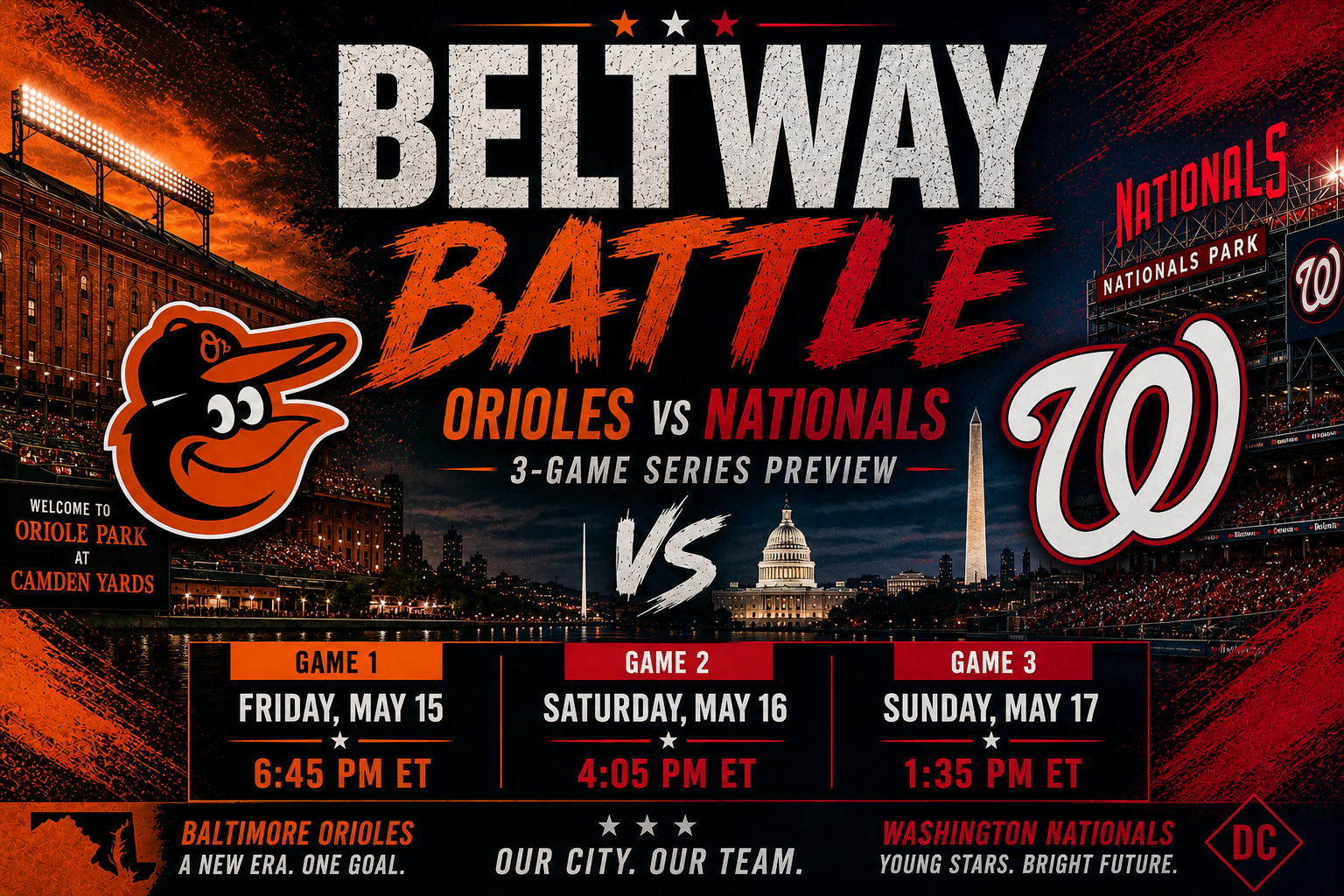
The Baltimore Orioles face the Washington Nationals in the Battle of the Beltway series. The Beltway Series always carries a little extra energy.
Maybe it is because Baltimore and Washington fans spend all year arguing about which franchise truly owns baseball in the Mid-Atlantic. Maybe it is because these games still feel personal after years of battles surrounding MASN rights, regional fandom, and roster comparisons. Or maybe it is because whenever the Orioles and Nationals meet, the games almost always turn chaotic.
This weekend’s series feels especially important for both clubs.
The Orioles enter the matchup still searching for consistency in a season that has featured flashes of dominance mixed with frustrating stretches of uneven baseball. Baltimore has remained competitive despite major questions surrounding the starting rotation, bullpen depth, and situational hitting. At times the Orioles have looked capable of making another postseason push. At other moments, they have looked vulnerable against teams willing to pressure their pitching staff early.
Washington enters the series in a different position.
The Nationals are still rebuilding, but the young talent finally feels real. CJ Abrams has developed into one of the most dynamic shortstops in baseball. James Wood is rapidly becoming one of the sport’s most dangerous young power hitters. Cade Cavalli is beginning to look like the frontline starter the organization envisioned years ago.
This is no longer a rebuilding roster simply waiting for the future.
The Nationals are starting to become dangerous right now.
That makes this series fascinating because both teams arrive with strengths capable of exposing the other’s weaknesses. Baltimore’s lineup still possesses more proven power, but Washington’s athleticism and aggressive offensive approach could create major problems for an Orioles pitching staff that has struggled with consistency all season.
And once again, the biggest story entering the weekend may come down to pitching.
Orioles Continue Fighting Through Rotation Questions
For much of the season, the Orioles have survived despite unstable starting pitching.
Baltimore’s offense has carried stretches of the season, but the rotation continues creating concerns that refuse to disappear. Entering the series, the Orioles remain near the bottom of the American League in several pitching categories, including ERA and rotation WAR.
The problem has not been a lack of talent.
It has been consistency.
Every Orioles starter seems capable of delivering one dominant outing followed immediately by a difficult one. The bullpen has repeatedly been forced into heavy workloads because starters have struggled to pitch deep into games, creating long-term stress on the entire pitching staff.
Against Washington’s aggressive lineup, that becomes dangerous quickly.
The Nationals attack early in counts, force athletic pressure on defenses, and capitalize on mistakes over the plate. Baltimore’s starters must establish strike one consistently this weekend or risk constantly pitching from behind.
Gunnar Henderson Still Drives the Orioles Offense
Everything still revolves around Gunnar Henderson.
The Orioles shortstop continues developing into one of the premier young stars in Major League Baseball and enters the series once again leading Baltimore offensively in multiple categories. His power production remains elite, but the most important improvement this season may actually be plate discipline.
Pitchers attacked Henderson aggressively with elevated fastballs and sliders away earlier in his career. This season, he has adjusted beautifully.
His chase rate has improved significantly. His walk percentage continues rising. His expected slugging numbers remain among the best in baseball.
The advanced metrics paint the picture of a superstar:
- Elite barrel percentage
- Outstanding hard-hit rate
- Strong expected batting average
- Excellent damage against velocity
- Improved two-strike approach
Washington’s young pitchers face an enormous challenge trying to neutralize him.
If they challenge him inside with velocity, Henderson can turn around pitches with elite bat speed. If they pitch away too carefully, he is patient enough to take walks and force mistakes later in counts.
Few hitters in baseball feel more dangerous right now when ahead in the count.
Adley Rutschman Remains Baltimore’s Stabilizer
While Henderson provides explosiveness, Adley Rutschman still stabilizes the entire Orioles lineup.
Even during offensive droughts, Baltimore’s lineup functions differently when Rutschman is producing quality at-bats. His ability to extend innings and force pitchers into difficult counts changes the flow of games.
That becomes particularly important against Washington’s young rotation.
The Nationals possess talented arms, but several starters continue struggling with pitch efficiency. Rutschman’s patient approach could become one of the defining factors of the series because long at-bats may expose Washington’s bullpen earlier than expected.
Baltimore becomes significantly more dangerous offensively when Rutschman reaches base consistently ahead of Henderson and Coby Mayo.
Coby Mayo’s Emergence Adds Another Layer
The Orioles continue waiting for Coby Mayo to fully break out at the major league level, but the flashes are becoming impossible to ignore.
Mayo’s raw power may be unmatched anywhere in Baltimore’s organization. When he connects, the baseball leaves differently.
Statcast metrics continue supporting the idea that Mayo’s offensive ceiling remains enormous:
- Elite exit velocities
- Outstanding raw power
- Strong hard-hit profile
- Excellent pull-side power potential
The challenge remains consistency against advanced pitching.
Mayo can still become vulnerable against quality secondary stuff when behind in counts, but Washington’s pitchers must avoid predictable fastball sequences against him because mistakes disappear quickly.
If Mayo continues adjusting at the major league level, Baltimore’s lineup becomes dramatically deeper.
Game 1: Shane Baz vs. Zack Littell
The opening matchup immediately creates questions for both clubs.
Orioles Starter: Shane Baz
- Record: 1-4
- ERA: 5.48
- IP: 44.1
- Strikeouts: 38
- WHIP: 1.556
Baz enters with electric raw stuff but frustrating inconsistency.
The velocity remains excellent. The slider continues generating swing-and-miss. But command issues and inefficiency have prevented him from consistently dominating games.
Baz’s advanced numbers remain intriguing because hitters still struggle making quality contact against him when he gets ahead in counts. The problem is getting there consistently.
Walks and deep counts continue driving pitch totals upward quickly.
Against Washington’s aggressive offense, first-pitch execution becomes critical.
CJ Abrams and James Wood both thrive against pitchers forced to challenge them in hitter-friendly counts. If Baz falls behind early, the Nationals could generate traffic quickly.
Nationals Starter: Zack Littell
- Record: 1-4
- ERA: 6.94
- IP: 36.1
- Strikeouts: 17
- WHIP: 1.60
Littell’s numbers entering the series are rough.
The biggest concern may actually be the strikeout totals. Littell simply has not missed enough bats consistently, which becomes dangerous against Baltimore’s power-heavy lineup.
The Orioles match up well against pitchers who rely heavily on contact management rather than swing-and-miss stuff. Henderson, Mayo, and Ryan Mountcastle all punish mistakes aggressively when ahead in counts.
Littell’s path to success likely depends on weak contact and avoiding walks because Baltimore can flip games quickly with one swing.
Advantage: Orioles offense.
Game 2: Chris Bassitt vs. Cade Cavalli
This feels like the most fascinating pitching matchup of the series.
Orioles Starter: Chris Bassitt
- Record: 3-2
- ERA: 5.21
- IP: 38.0
- Strikeouts: 26
- WHIP: 1.737
Bassitt’s ERA and WHIP numbers look ugly entering the weekend, but the veteran still gives Baltimore something valuable: experience.
Bassitt survives differently than most pitchers.
He manipulates timing, changes sequencing constantly, and disrupts rhythm better than almost anyone in baseball. Younger lineups often struggle adjusting to him because every at-bat feels different.
Washington’s aggressive approach could either help or hurt them.
If Nationals hitters attack early and force contact, they may prevent Bassitt from controlling counts. But if they become impatient chasing secondary pitches, Bassitt can still dominate stretches of games despite diminished velocity.
The concern for Baltimore is traffic.
Bassitt’s elevated WHIP suggests too many hitters continue reaching base consistently. Against an athletic Nationals team capable of taking extra bases, that becomes dangerous.
Nationals Starter: Cade Cavalli
- Record: 1-2
- ERA: 4.02
- IP: 40.1
- Strikeouts: 44
- WHIP: 1.587
This version of Cade Cavalli is exactly what Nationals fans have been waiting for.
The strikeout numbers immediately jump off the page.
Forty-four strikeouts in just over forty innings confirms the pure stuff remains elite. His fastball-slider combination has become increasingly difficult for opposing hitters to handle.
The advanced metrics are encouraging:
- Strong whiff rates
- Improved fastball command
- Better pitch tunneling
- Increased chase percentage
- Elite swing-and-miss slider
The challenge remains command consistency.
Cavalli’s WHIP still indicates too many baserunners, which could become dangerous against Baltimore’s lineup if traffic builds ahead of Henderson or Mayo.
Still, Cavalli may possess the highest upside of any starter appearing in the series.
Game 3: Brandon Young vs. Miles Mikolas
The finale has all the ingredients for complete chaos.
Orioles Starter: Brandon Young
- Record: 3-1
- ERA: 4.15
- IP: 26.0
- Strikeouts: 19
- WHIP: 1.385
Young quietly enters the series with solid numbers despite limited innings.
The ERA is respectable. The WHIP remains manageable. Most importantly, Young has consistently competed even without overpowering stuff.
He relies heavily on command and sequencing rather than velocity, which creates thin margins against aggressive lineups like Washington’s.
The Nationals will likely attack him early because Young can become vulnerable when forced into hitter-friendly counts.
Still, compared to several other Orioles starters, Young has actually provided relative stability recently.
Nationals Starter: Miles Mikolas
- Record: 1-3
- ERA: 7.44
- IP: 32.2
- Strikeouts: 22
- WHIP: 1.53
Mikolas enters as arguably the most vulnerable starter appearing this weekend.
The ERA speaks for itself.
Hitters have consistently squared him up this season, and Baltimore’s lineup profiles as a difficult matchup because the Orioles excel against pitchers who struggle missing bats.
The Orioles should aggressively attack early-count fastballs against Mikolas.
If Baltimore forces him into deep counts, the Nationals bullpen may once again become exposed early.
This game has serious slugfest potential.
CJ Abrams Has Become a Franchise Star
Washington’s rebuild feels different because CJ Abrams is becoming a legitimate star.
The shortstop continues evolving offensively while remaining one of the most athletic players in baseball. His combination of speed, improving power, and defensive range gives Washington a centerpiece capable of anchoring the organization long term.
The biggest offensive improvement has been maturity.
Abrams is chasing fewer pitches, handling left-handed pitching more effectively, and consistently punishing mistakes over the plate.
His expected metrics strongly support the breakout:
- Improved contact quality
- Better swing decisions
- Increased hard-hit rate
- Better slugging against fastballs
Baltimore cannot allow Abrams to become a constant table-setter ahead of James Wood.
That combination becomes dangerous quickly.
James Wood Looks Like a Future Superstar
Few young hitters in baseball feel more intimidating than James Wood right now.
Every at-bat feels dangerous.
The Nationals outfielder combines enormous physical tools with rapidly improving plate discipline. His power profile already ranks among the best young hitters in the sport.
Wood’s advanced metrics are terrifying:
- Elite exit velocity
- Outstanding barrel rate
- Massive hard-hit percentage
- Exceptional expected slugging
Pitchers trying to overpower him with velocity continue failing.
Baltimore will likely attempt expanding the strike zone with breaking pitches away, but falling behind against Wood becomes a nightmare because his damage potential changes games instantly.
Nationals Offense Quietly Becoming Dangerous
Nationally, people still discuss Washington like a rebuilding franchise.
That may not last much longer.
The Nationals offense has quietly become one of the more exciting young lineups in baseball thanks to athleticism, speed, and improving power throughout the roster.
Washington excels in several important areas:
- Sprint speed
- Extra-base hit production
- Aggressive baserunning
- First-pitch damage
- Contact quality against fastballs
This lineup creates pressure constantly.
Baltimore’s defense and pitching staff must remain sharp because Washington thrives when games become chaotic.
Bullpen Concerns Could Define the Series
Neither bullpen enters the series feeling completely trustworthy.
Baltimore’s relief corps has shown flashes of dominance but remains inconsistent in leverage situations. Washington’s bullpen has struggled with both injuries and role definition throughout the season.
That creates dangerous late-game situations.
No lead may feel safe all weekend.
And honestly, that probably benefits Baltimore slightly because the Orioles still possess more proven late-inning power capable of instantly changing games.
Final Prediction
This series feels destined for offense.
Too many vulnerable starters.
Too many dangerous young hitters.
Too many inconsistent bullpens.
Expect momentum swings, crooked innings, and at least one complete slugfest before the weekend ends.
Baltimore still possesses the more proven lineup overall, particularly in terms of pure power production. Washington may be slightly more athletic and aggressive offensively, but the Orioles remain capable of changing games faster with one swing.
Prediction:
- Orioles take Game 1 behind offensive firepower
- Nationals win Game 2 behind Cade Cavalli’s strikeout ability
- Orioles edge the finale in a high-scoring game
Series prediction: Orioles win 2 of 3.
But more importantly, this series feels like a glimpse into the future of baseball in the Mid-Atlantic.
And for the first time in years, that future looks genuinely exciting.