
Orioles Reload the Farm System: Breaking Down Baltimore’s Complete 2026 MLB Draft Class
The Baltimore Orioles entered the 2026 MLB Draft with one mission: replenish one of baseball’s most successful player development pipelines while staying true to the organizational philosophy that has transformed the franchise into a perennial contender.
Armed with the No. 7 overall pick, executive vice president and general manager Mike Elias and scouting director Matt Blood assembled one of the most athletic draft classes in baseball. Rather than drafting strictly for organizational need, Baltimore once again emphasized premium athletes, up-the-middle defenders, projectable high school talent, and polished college pitching.
It’s a blueprint Orioles fans have seen before. That same philosophy helped bring Adley Rutschman, Gunnar Henderson, Jordan Westburg, Colton Cowser, Jackson Holliday, Coby Mayo, and Samuel Basallo into the organization. Now, Baltimore hopes this newest group will become the next wave of impact talent.
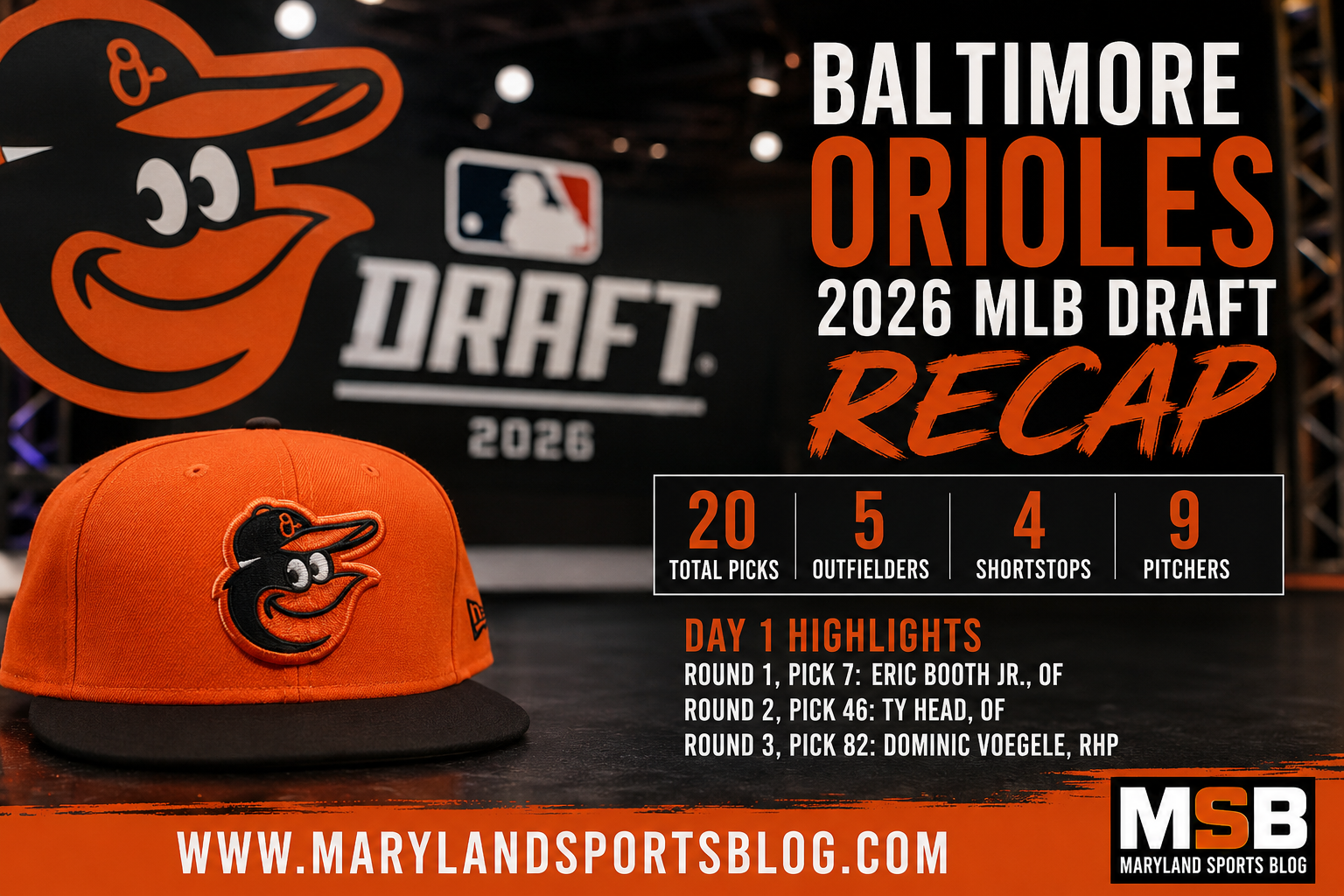
The Orioles finished the draft with 20 selections, including:
- 9 pitchers
- 5 outfielders
- 4 shortstops
- 1 catcher
- 1 utility player
The balance of the class was intentional. Baltimore added explosive athletes capable of sticking in premium defensive positions while also strengthening a pitching pipeline that has become one of the organization’s greatest strengths.
Maryland Sports Blog has already taken an in-depth look at first-round selection Eric Booth Jr., second-round pick Ty Head, and third-round right-hander Dominic Voegele. Here’s a complete look at the rest of the Orioles’ impressive 2026 draft class and why it could become another cornerstone for the franchise.
Day One Set the Tone
Baltimore’s first three selections perfectly represented the organization’s draft philosophy.
Eric Booth Jr. — OF, Oak Grove HS (Miss.)
Round 1, Pick 7
The Orioles selected one of the most dynamic athletes in the entire draft.
Ranked among the top prep prospects nationally, Booth combines elite speed, developing power, advanced defensive instincts, and outstanding athleticism. His blazing 6.33-second 60-yard dash was among the fastest recorded in the class, while scouts believe his offensive upside could eventually translate into a rare 30-home run, 30-steal major league player.
A Vanderbilt commit, Booth represents the type of premium athlete Baltimore has prioritized throughout the Elias era. Although his swing still needs refinement against advanced pitching, few players in the draft possess his overall ceiling.
MSB Take: Booth has all the tools to become Baltimore’s center fielder of the future.
Ty Head — OF, NC State
Round 2, Pick 46
Head gives Baltimore one of the safer offensive players in the class.
The left-handed hitter starred at NC State, displaying excellent bat speed, developing power, defensive versatility, and mature strike-zone judgment. Unlike Booth, whose game centers on projection, Head already owns a polished offensive approach that could allow him to climb the minor league ladder relatively quickly.
Dominic Voegele — RHP, Kansas
Round 3, Pick 82
The Kansas right-hander headlines Baltimore’s college pitching haul.
Voegele attacks hitters with multiple quality pitches, pounds the strike zone consistently, and profiles as one of the college arms most capable of reaching the upper minors in short order.
Day Two and Three: Value Throughout the Draft
Round 4 (110): Kevin Roberts Jr., OF, Jackson Prep (Miss.)
One of the most physically gifted players Baltimore selected.
Standing 6-foot-5 and 220 pounds, Roberts combines enormous raw power with surprising athleticism, speed, and a plus throwing arm. Although many project him as a corner outfielder, his upside is among the highest in the draft class.
A Florida commit, Roberts is expected to begin his professional career after signing.
MSB Take: Roberts could ultimately become one of the biggest steals of the draft if Baltimore unlocks his offensive consistency.
Round 5 (142): Jimmy Anderson, SS, Heartland Community College
The Orioles clearly never forgot about Anderson.
Baltimore drafted him once before but was unable to sign him. After an outstanding junior college season, they came back and selected him again.
Anderson brings:
- Excellent defensive instincts
- Strong baseball IQ
- Gap-to-gap offensive approach
- Ability to remain at shortstop
Players with his versatility often become valuable organizational pieces.
Round 6 (171): Zane Adams, LHP, Alabama
Perhaps one of Baltimore’s best value selections.
After facing SEC competition throughout his collegiate career, Adams arrives with one of the more polished pitching resumes in the class.
The 6-foot-4 southpaw features:
- Low-to-mid 90s fastball
- Sharp breaking ball
- Starter’s frame
- Excellent strike throwing
Baltimore’s pitching development staff has built an outstanding reputation over the past several seasons, making Adams an intriguing candidate to move quickly.
Round 7 (200): Ryan Piech, RHP, Xavier
Piech features a lively fastball and improving secondary pitches.
The Orioles believe additional development could unlock even more velocity and sharpen his command, giving him starter or late-inning bullpen potential.
Round 8 (230): Will Plunkett, SS, Mamaroneck HS (N.Y.)
Baltimore continued adding athletic high school infielders.
Plunkett possesses smooth defensive actions, soft hands, solid instincts, and plenty of physical projection. If his offensive game catches up, he could become another intriguing middle-infield prospect.
Round 9 (260): Collin McKinney, RHP, Arizona
McKinney’s 6-foot-5 frame creates outstanding downhill plane.
The Arizona right-hander has experience against elite collegiate competition and profiles as a durable starter capable of eating innings.
Round 10 (290): Carlos Sanchez, UTIL, LSU Shreveport
Versatility defines Sanchez.
He has experience throughout the infield and outfield while providing organizational depth at multiple positions.
Those types of players often become invaluable over the course of a long professional season.
Round 11 (320): Ross Norman, RHP, Coastal Carolina
At 6-foot-7, Norman immediately becomes one of the tallest pitchers in Baltimore’s system.
His extension and downhill angle make his fastball especially difficult for hitters to square up.
Round 12 (350): Leo Marrero, C, Hardee HS (Fla.)
Baltimore continues investing in catching.
Marrero owns a strong throwing arm, physical frame, and offensive upside that should benefit from the Orioles’ outstanding player development system.
Round 13 (380): Garrison Sumner, RHP, BYU
An experienced college pitcher whose command stands out.
Rather than overpowering hitters, Sumner succeeds through location, pitchability, and competitiveness.
Round 14 (410): Miguel Hugas, RHP, Mercer
Originally from Venezuela, Hugas brings an intriguing international background.
The Mercer standout combines solid stuff with a competitive mentality and projects as another quality organizational pitching prospect.
Round 15 (440): Braden Smith, RHP, UCF
Smith offers another live arm for Baltimore’s growing pitching pipeline.
His athleticism and fastball give the Orioles another intriguing development project.
Round 16 (470): Brayden Fry, SS, Cranford HS (N.J.)
A smooth defensive shortstop with advanced actions.
Baltimore values middle infielders who can remain at premium defensive positions while offering positional flexibility later in their careers.
Round 17 (500): Diego Gutierrez, RHP, San Diego
Gutierrez enters professional baseball as one of the more polished late-round college pitchers.
His strike throwing and experience should allow him to move quickly.
Round 18 (530): Gunnar Garrison, RHP, Eaton HS (Colo.)
One of the biggest upside selections late in the draft.
Standing 6-foot-5, Garrison possesses a projectable frame that could add velocity as he matures physically.
Round 19 (560): Victor Salazar, OF, Patricia E. Paetow HS (Texas)
Another athletic center fielder.
Salazar brings speed, defensive range, a left-handed bat, and exciting base-stealing ability. His selection further illustrates Baltimore’s emphasis on athleticism throughout this draft.
Round 20 (590): Ross Davis, RHP, Rusk HS (Texas)
The Orioles wrapped up the draft by selecting another projectable high school arm.
Davis possesses intriguing physical tools that Baltimore’s development staff will look to refine over the coming years.
The Draft’s Biggest Themes
Several clear trends emerged throughout Baltimore’s 20 selections.
Athleticism Came First
Booth, Roberts Jr., Head, and Salazar headline a group of explosive athletes capable of remaining in center field or other premium defensive positions.
Middle-Infield Depth
Jimmy Anderson, Will Plunkett, Brayden Fry, and Carlos Sanchez continue Baltimore’s long-standing emphasis on versatile infield defenders with strong baseball instincts.
Pitching Pipeline Continues to Grow
College arms including Voegele, Adams, Piech, McKinney, Norman, Sumner, Hugas, Smith, and Gutierrez provide both organizational depth and potential fast movers. The Orioles also added projectable prep pitchers Gunnar Garrison and Ross Davis to develop over the long term.
Balance Between Upside and Polish
Rather than leaning heavily toward either high school or college players, Baltimore struck an excellent balance. Booth, Roberts, Plunkett, Fry, Garrison, Salazar, and Davis offer tremendous long-term upside, while Head, Voegele, Adams, Anderson, McKinney, and the rest of the college class provide higher floors and quicker paths through the system.
MSB Final Take
The Orioles didn’t simply draft talent—they drafted players who fit their identity.
Mike Elias and Baltimore’s scouting department remained disciplined, selecting athletic position players, premium defenders, and pitchers with projection rather than chasing immediate organizational needs. It’s the same philosophy that helped build one of baseball’s deepest farm systems and laid the foundation for the Orioles’ return to contention.
No one knows how this class will ultimately develop, but the ingredients are there. Eric Booth Jr. has legitimate superstar potential, Ty Head looks like a polished everyday player, Dominic Voegele could become another successful Orioles pitching development story, and several Day 2 and Day 3 selections have the tools to outperform their draft positions.
If Baltimore’s player development staff continues its recent success, this 2026 draft could be remembered as another pivotal chapter in sustaining the franchise’s winning window.
MSB Draft Grade: A-
The Orioles stayed true to their organizational philosophy, adding elite athleticism, premium defensive talent, and significant pitching depth. While the true impact of any draft won’t be known for years, Baltimore once again appears to have assembled a class capable of producing multiple future major leaguers and keeping the organization’s talent pipeline among the best in baseball.