Should Baltimore Get Pro Hockey Back? The Case for the Clippers, Skipjacks or a New Era on Ice
Baltimore has always been a better hockey city than people outside Maryland realize.
That sentence might surprise people who only think of Baltimore as Ravens, Orioles, lacrosse, crab cakes and Camden Yards summers. It should not surprise anyone who remembers the Baltimore Clippers, the Baltimore Skipjacks, the Baltimore Bandits, the brief World Hockey Association run of the Baltimore Blades or the way Baltimore-area fans still show up for Washington Capitals games, local ice rinks, youth hockey, adult league hockey and college club hockey across the state.
Baltimore has hockey history. Baltimore has hockey people. Baltimore has a downtown arena again that looks and feels like a real modern event building. The real question is not whether Baltimore likes hockey.
The real question is this: What level of pro hockey actually makes sense?
The answer is probably not the NHL right now. It might not even be the AHL unless the right ownership group, NHL partner and building deal come together. But an ECHL team, a strong independent minor-league team or a carefully built lower-level pro franchise could absolutely work if Baltimore learns from its own history.
Baltimore should get pro hockey again. It just has to be done the right way.
Baltimore’s Hockey History Is Deeper Than People Remember
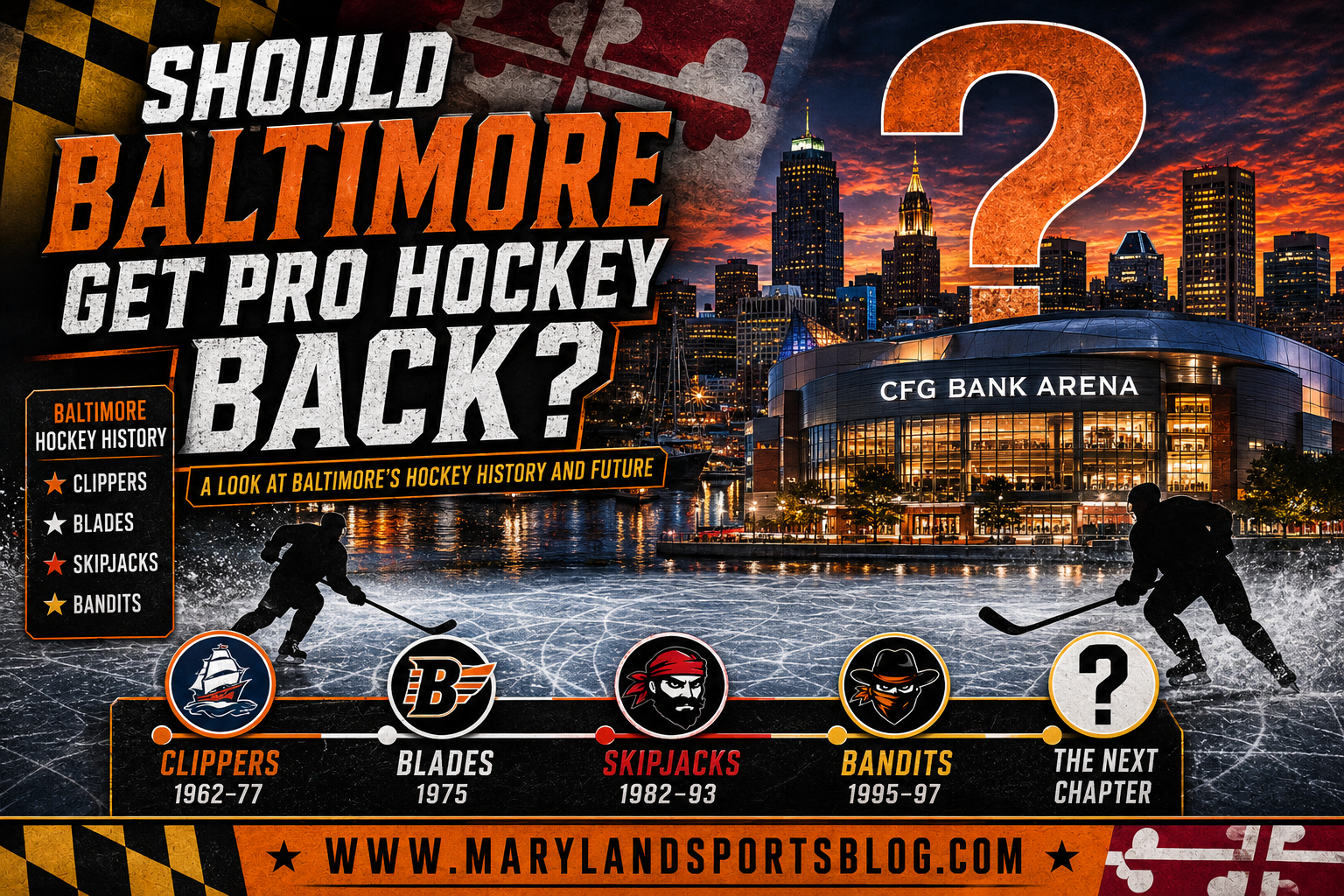
Baltimore’s pro hockey roots go back decades. The city had multiple versions of the Baltimore Clippers, with the most remembered run coming in the American Hockey League from 1962 to 1977. The Clippers played at the Baltimore Civic Center and gave the city a real hockey identity before the Capitals existed as an NHL franchise.
Those Clippers teams were not just a novelty. They drew legitimate crowds for minor-league hockey. In the 1960s and early 1970s, Baltimore’s attendance often compared well with the rest of the league. The Clippers averaged more than 5,000 fans per game in several seasons and reached more than 6,000 per game in 1969–70. That matters because modern minor-league hockey can survive very well in that range if the lease, sponsorships and game-day operation are healthy.
The Clippers also played during a different Baltimore sports era. The city still had the Colts. The Bullets were around. The Orioles were a powerhouse. The arena was busy. Hockey was part of the local sports diet, not the main course, but it had a place.
Baltimore even flirted with major-league hockey. The city was connected to NHL expansion talk in the late 1960s and later had a brief WHA team, the Baltimore Blades, in 1975 after the Michigan Stags relocated midseason. That run was short and messy, but it showed that Baltimore was at least in the orbit of major professional hockey discussions.
After the Clippers era, the Baltimore Skipjacks became the city’s best-known hockey brand. The Skipjacks played in the AHL for most of the 1980s and early 1990s and were affiliated at different times with NHL teams including the Pittsburgh Penguins and Washington Capitals. That Capitals connection still matters because it tied Baltimore hockey fans to the organization many Maryland hockey fans still follow.
The Skipjacks had memorable players, a great local identity and one of the best names in minor-league hockey. The name fit Maryland. The logo fit the city. The team felt like Baltimore.
But the business side was not strong enough. The Skipjacks battled poor dates, limited marketing, competition from indoor soccer and the challenge of getting suburban fans downtown consistently. Eventually, the franchise moved to Portland and became the Pirates.
The Baltimore Bandits arrived later in the 1990s as an AHL team affiliated with the Mighty Ducks of Anaheim. The Bandits had a fun look and gave Baltimore another shot at pro hockey, but the franchise lasted only two seasons. The team faced financial problems almost immediately and struggled to build enough consistent attendance.
That is the pattern of Baltimore hockey history. The fan interest was real. The identity was real. The problem was not that hockey could never work in Baltimore. The problem was ownership, scheduling, marketing, arena economics and the lack of a long-term plan.
The Viewership Argument: Baltimore Already Watches Hockey
Baltimore is not a cold-weather Canadian hockey market, but it is also not a non-hockey city. The Washington Capitals have carried much of the region’s NHL attention for decades, and Baltimore fans have often adopted the Caps as their hockey team.
That matters in two ways.
First, it proves there is a hockey audience in the Baltimore market. Fans in the Baltimore area watch the NHL, follow the Capitals and know the sport. The Capitals’ 2018 Stanley Cup run pulled in Baltimore sports fans who were proud to support a regional team. The Ravens and Orioles publicly supported the Caps, and many Baltimore fans treated that Cup run like a Maryland sports moment.
Second, it complicates any NHL dream for Baltimore. A Baltimore NHL team would not be entering an empty hockey market. It would be entering a market that already has a nearby NHL team with decades of history, a Stanley Cup, regional TV presence, youth hockey ties and a massive fan base.
That does not kill the possibility forever. But it makes the NHL option much harder.
The Capitals are too close. Washington is not a far-away rival. It is part of the same sports and media region. A Baltimore NHL team would need a billionaire owner, a major arena solution, massive corporate support and league approval in a region where the NHL already has a strong franchise.
For now, that is a long shot.
CFG Bank Arena Changes the Conversation
The biggest reason Baltimore hockey deserves a new look is CFG Bank Arena.
For years, one of the biggest knocks on Baltimore was the arena. The old Baltimore Arena/Royal Farms Arena had history, but it felt dated. It lacked the modern premium areas, concourses, suites, food options and event presentation that modern pro sports need.
That changed with the renovation into CFG Bank Arena. The building is now a modern downtown entertainment venue with more than 14,000 seats, improved suites, upgraded concourses and a much better overall fan experience.
That does not automatically mean hockey works. Concerts are still the building’s main business. A minor-league hockey team needs prime weekend dates, ice-making logistics, storage, staff, sponsorship support and a lease that allows a team to make money.
But the arena no longer feels like an automatic excuse.
Baltimore now has a building that could host pro hockey again. The question is whether hockey could get enough good dates and whether the economics would work.
That is why the level matters.
NHL: Great Dream, Bad Timing
Baltimore having an NHL team would be incredible. A Baltimore NHL team would instantly create a rivalry with Washington, Philadelphia and Pittsburgh. It would give Maryland its own big-league hockey identity. It would make for an electric atmosphere if the team was branded correctly.
Imagine the Baltimore Clippers back in navy, orange and white. Imagine a packed downtown arena against the Capitals. Imagine playoff hockey in Baltimore.
It sounds awesome.
It also does not make much sense right now.
The NHL’s next expansion fee is expected to be massive, likely north of $2 billion. That is only the franchise fee. Ownership would still need arena commitments, operating money, practice facilities, sponsorships and a long-term media plan. Baltimore’s current arena is improved, but it is still smaller than most modern NHL buildings for hockey and was renovated as a concert-first entertainment venue.
The NHL also has more obvious expansion markets. Houston, Atlanta, Quebec City, Salt Lake City, Kansas City and other markets have been discussed at different times. Some of those cities have larger corporate bases, newer arenas or fewer territorial issues.
Baltimore would also have to fight the perception that it is already covered by the Capitals. The NHL may not want to split the Washington-Baltimore regional audience unless the business case is overwhelming.
Verdict: NHL hockey in Baltimore is a great fantasy, but not the practical next step.
AHL: The Best Brand Fit, But Hard to Pull Off
The American Hockey League would be the best hockey level from a prestige standpoint. Baltimore has AHL history with the Clippers, Skipjacks and Bandits. The AHL is one step below the NHL. The players are real prospects. The quality of play is excellent. Fans would get to see future NHL players, rehab assignments and strong rivalries.
AHL hockey would also allow Baltimore to lean into history. A revived Baltimore Skipjacks or Baltimore Clippers brand would feel natural in the AHL because that is where much of the city’s best hockey history happened.
The problem is affiliation and geography.
The Washington Capitals already have one of the best AHL relationships in hockey with the Hershey Bears. Hershey is a powerhouse minor-league market and consistently draws huge crowds. The Bears are not just a farm team. They are an institution. The Capitals have no obvious reason to move their AHL affiliate to Baltimore.
Philadelphia, Pittsburgh, New Jersey, the New York teams and other nearby NHL organizations also have established AHL relationships. An AHL team in Baltimore would likely need either relocation of an existing franchise or a major NHL partner that sees Baltimore as better than its current setup.
That is not impossible, but it is difficult.
The AHL also needs strong attendance. The league has been drawing extremely well. Many AHL teams average well over 5,000 fans per game, and the top teams draw much more than that. Baltimore would need to prove it can consistently draw in that range, especially on weeknights.
Could Baltimore do it? Maybe. But an AHL team at CFG Bank Arena would need strong weekend inventory, big local sponsorships, a smart ticket plan, youth hockey partnerships and a real marketing budget.
Verdict: The AHL would be the dream minor-league level, but it is not the easiest or most likely path.
ECHL: The Sweet Spot for Baltimore
The ECHL is the level that makes the most sense.
The ECHL is a strong Double-A professional league with NHL and AHL affiliations. It has grown into a serious business, and league attendance has been strong. The ECHL recently topped 5,000 fans per game leaguewide, which shows that mid-level pro hockey is healthy when teams are placed in the right markets.
Baltimore fits that model better than people might think.
An ECHL team would not need to pretend it is the NHL. It would not need to compete directly with the Capitals. It could be affordable, family-friendly, physical, local and fun. It could sell Friday and Saturday nights, youth hockey nights, Ravens crossover nights, Orioles theme nights, college nights and Maryland pride nights.
The ECHL also allows more flexibility. The team could seek an affiliation with an NHL organization, but the brand could still be Baltimore-first. Fans could support the Capitals and still support a Baltimore ECHL team. That is important. The team should not ask fans to abandon the Caps. It should give Baltimore fans live pro hockey of their own.
A Baltimore ECHL team could also build natural rivalries. Norfolk has long had hockey history. Reading, Wheeling, Adirondack, Worcester and other eastern markets show how regional ECHL rivalries can work. A Baltimore team could create bus-trip games and weekend rivalry nights.
The key would be avoiding the mistakes of the past.
Bad weeknight-heavy schedules hurt Baltimore hockey before. Poor marketing hurt Baltimore hockey before. A team buried behind other arena events would struggle again. Ownership would need to secure enough strong dates at CFG Bank Arena or consider a smaller hockey-first building if one ever became available.
The ECHL works best when the building feels full and the team feels local. A 14,000-seat arena can look empty with 3,500 fans, even if 3,500 is not a terrible minor-league crowd. Baltimore would need smart seating configurations, strong lower-bowl energy and a game presentation that makes the arena feel alive.
Verdict: ECHL is the best realistic pro hockey option for Baltimore.
SPHL or FPHL: Affordable, But Maybe Too Low for Baltimore
Baltimore could also look at lower-level pro hockey like the SPHL or Federal Prospects Hockey League. Those leagues have lower costs and can work in smaller buildings. They offer physical hockey, local entertainment and affordable tickets.
But Baltimore may be too large a market and CFG Bank Arena may be too large a building for that level. A lower-level team would only work if the arena deal was extremely favorable or if the team played in a smaller suburban venue.
That might be worth exploring if a new or upgraded ice facility existed in Baltimore County, Howard County, Harford County or Anne Arundel County. A suburban pro team could potentially draw families and youth hockey communities without the challenges of downtown scheduling.
But if the goal is bringing pro hockey back to Baltimore as a city, the SPHL or FPHL would probably feel too small. The brand would have to work harder to earn credibility.
Verdict: Possible, but not the best fit unless the team plays in a smaller venue with low costs.
Could Women’s Pro Hockey Work?
This is an option Baltimore should keep an eye on.
Women’s hockey is growing, and the Professional Women’s Hockey League has created new energy around the sport. Baltimore is not likely to jump straight to the front of that line, but the region has enough hockey interest, youth sports participation and proximity to Washington, Philadelphia and New York to be part of future conversations.
A women’s pro hockey event at CFG Bank Arena would be a smart test. A neutral-site PWHL game, college hockey event or women’s hockey showcase could help measure Baltimore’s appetite for the sport.
Baltimore has supported women’s sports before, and the growth of women’s basketball and women’s soccer shows that markets can build quickly when the product is marketed properly.
Verdict: Not the immediate answer, but Baltimore should try to host women’s pro or elite hockey events.
The Branding Matters
If Baltimore gets hockey back, the name should matter.
The best options are obvious.
The Baltimore Skipjacks would be the strongest local brand. It is unique, Maryland-specific and already connected to the city’s hockey history. The skipjack boat is part of Maryland identity, and the name feels different from generic minor-league sports branding.
The Baltimore Clippers also works because of history. It connects to the Port of Baltimore and the city’s older hockey tradition. It sounds classic and professional.
The Baltimore Bandits has 1990s nostalgia, but it does not feel as tied to Maryland. It could work, but Skipjacks and Clippers are stronger.
A new name could work if done properly, but Baltimore sports fans respect history. Bringing back the Skipjacks or Clippers would immediately give the team an identity older than its first new game.
The uniforms should lean into Baltimore and Maryland. Navy, orange, white, black, gold, red, Maryland flag accents or harbor-inspired colors could all work. The team should not look like a generic affiliate. It should look like Baltimore.
The Business Plan: How Baltimore Hockey Could Work
A new Baltimore hockey team would need to be built around five things.
First, the schedule has to be strong. The team needs Friday nights, Saturday nights and Sunday family dates. Too many Tuesday and Wednesday games would repeat old mistakes.
Second, the team needs youth hockey partnerships. Piney Orchard, Columbia, Ice World, Reisterstown, Mount Pleasant, Gardens Ice House and other regional rinks should all be part of the plan. Youth teams should be in the building constantly. Players should visit practices. Coaches should build clinics. The team should own the local hockey community.
Third, ticket prices must be family-friendly. Baltimore fans will pay for good entertainment, but minor-league hockey cannot price itself like the NHL. The team needs affordable season-ticket packages, group sales, student nights and local business packages.
Fourth, the game presentation has to be modern. Baltimore’s old teams often suffered from limited marketing and presentation. A new team needs strong social media, theme nights, local food, local music, Baltimore sports crossovers and a real in-arena show.
Fifth, ownership has to be local or deeply committed. Baltimore has seen too many sports projects fail when ownership was undercapitalized or not fully connected to the market. A hockey team needs patient ownership that understands it may take several years to rebuild trust.
Final Verdict: Yes, Baltimore Should Get Pro Hockey Again
Baltimore should absolutely pursue pro hockey again, but it should not chase the NHL first.
The smartest path is the ECHL.
An ECHL team would give Baltimore real professional hockey, possible NHL affiliations, affordable tickets and a chance to rebuild the city’s hockey identity without the impossible financial burden of NHL expansion. The AHL would be a great long-term dream, especially because of the city’s history with the Clippers and Skipjacks, but the Capitals-Hershey relationship makes that difficult. The NHL is not realistic right now because of expansion costs, arena size, market overlap and competition from other cities.
Baltimore hockey failed before for reasons that can be fixed. Bad dates can be fixed. Poor marketing can be fixed. Weak ownership can be fixed. A bad arena experience has already been improved by the CFG Bank Arena renovation.
The interest is still there. The history is still there. The nostalgia is still there. The regional hockey base is still there.
Baltimore does not need to prove it is a hockey city from scratch. The city already proved that years ago.
Now it needs the right league, the right owner, the right name and the right plan.
Bring back the Skipjacks. Bring back the Clippers. Bring back pro hockey in Baltimore.
Just do it smart.