
Craig Albernaz Was Never Much Of A Player. Should Orioles Fans Trust Him As A Manager?
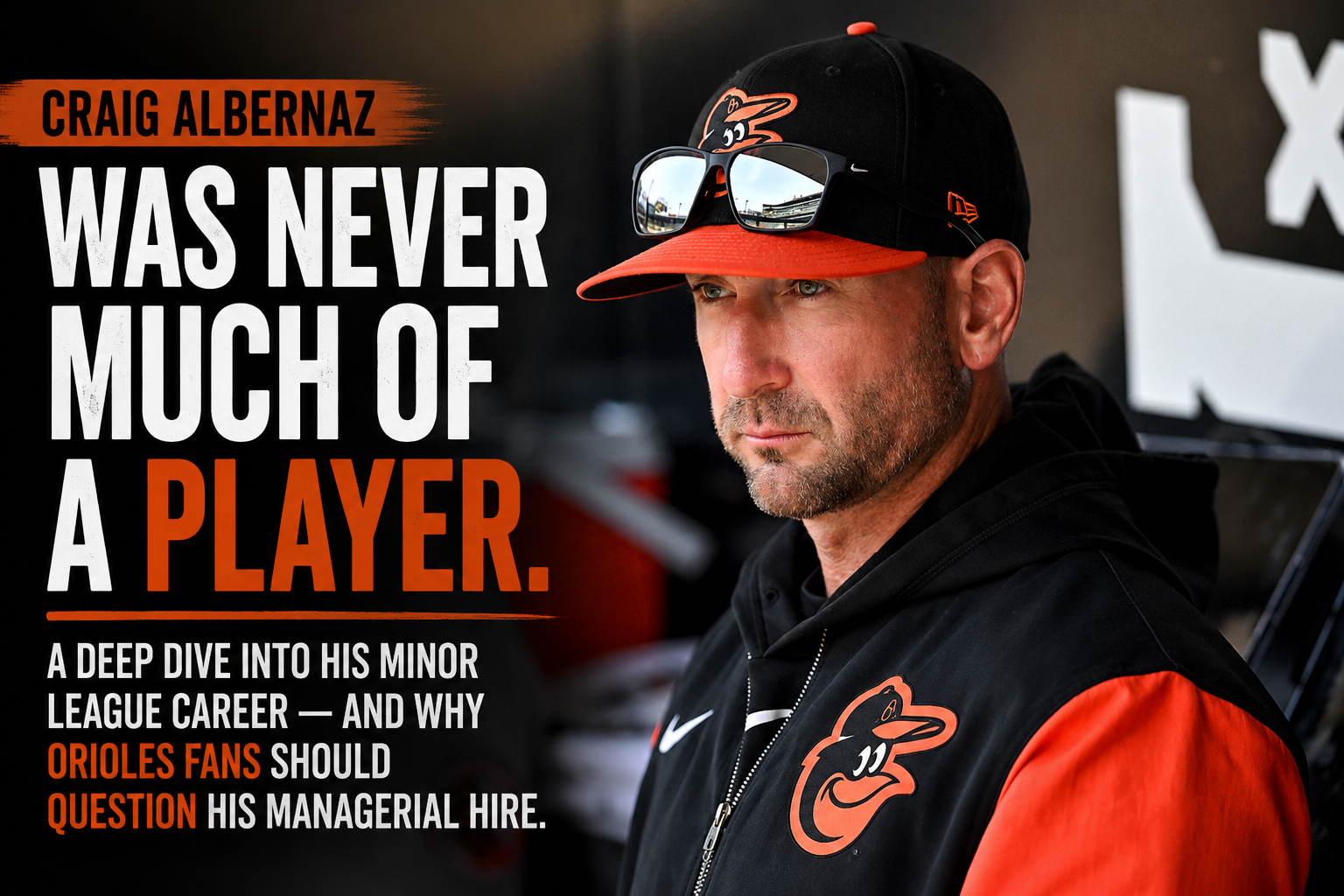
The Baltimore Orioles hired Craig Albernaz because of his reputation as a coach, communicator and player-development expert. Nobody hired Albernaz because of his accomplishments on the field.
That distinction matters.
As Orioles fans continue to question some of the decisions made from the dugout during the 2026 season, many have started asking a simple question: What exactly did Albernaz accomplish as a professional player that qualified him to manage a major league team?
The answer is surprisingly little.
Albernaz spent nine seasons in professional baseball after signing with the Tampa Bay Rays organization as an undrafted free agent in 2006. Despite nearly a decade in the minors, Albernaz never reached the major leagues and was never viewed as a legitimate prospect. He topped out at Triple-A and retired after a final season in the Detroit Tigers organization.
The offensive numbers were underwhelming throughout most of his career.
During his first professional season in 2006, Albernaz hit just .186 with a .484 OPS in rookie ball. The following season was even worse as he posted a .170 batting average and .463 OPS at Class A. In 2008, Albernaz managed only a .128 average and .403 OPS at High-A before a brief hot streak at Double-A inflated his overall numbers.
That 2008 Double-A performance often stands out because Albernaz hit .340 with an .881 OPS. However, those numbers came in only 47 at-bats. Outside of that small sample size, very little in his professional career suggested future major league success.
His Triple-A numbers paint an even clearer picture.
In 2009 with the Durham Bulls, Albernaz hit .183 with a .508 OPS across 73 games. Those are numbers that typically belong to organizational depth catchers rather than future major league contributors.
The best full season of his career came in 2010 when he hit .250 with a .656 OPS at Double-A Montgomery. While respectable, those numbers still fell well below what organizations generally expect from players pushing for a major league opportunity.
By the time his playing career ended, Albernaz had spent nearly a decade in professional baseball without appearing in a single major league game. Baseball Reference notes that he reached Triple-A but was never considered a serious prospect despite exceeding expectations for an undrafted player.
None of this automatically means Albernaz cannot become a successful manager.
Baseball history is filled with managers who had limited playing careers. Earl Weaver never played in the majors. Tony La Russa appeared in only six major league games. Many successful managers built careers through leadership, preparation and baseball intelligence rather than on-field production.
However, the criticism from Orioles fans becomes easier to understand when questionable in-game decisions pile up.
When a manager with a Hall of Fame résumé makes a mistake, fans often give him the benefit of the doubt. When a manager who never reached the majors makes the same mistake, scrutiny increases.
Fair or not, that is reality.
The Orioles hired Albernaz because of his coaching background, not because of anything he accomplished as a player. His managerial success will ultimately be judged by wins and losses in Baltimore, not by what happened in Montgomery, Durham or Erie years ago.
Still, if fans are looking for evidence that Albernaz was an accomplished professional player, they are unlikely to find it in the statistics.
The numbers show a hardworking catcher who maximized his ability, carved out a lengthy minor league career and earned respect throughout baseball.
The numbers do not show a star.
And in Baltimore, fans are beginning to wonder whether the Orioles need more than a respected baseball mind. They need a manager who consistently wins games.