
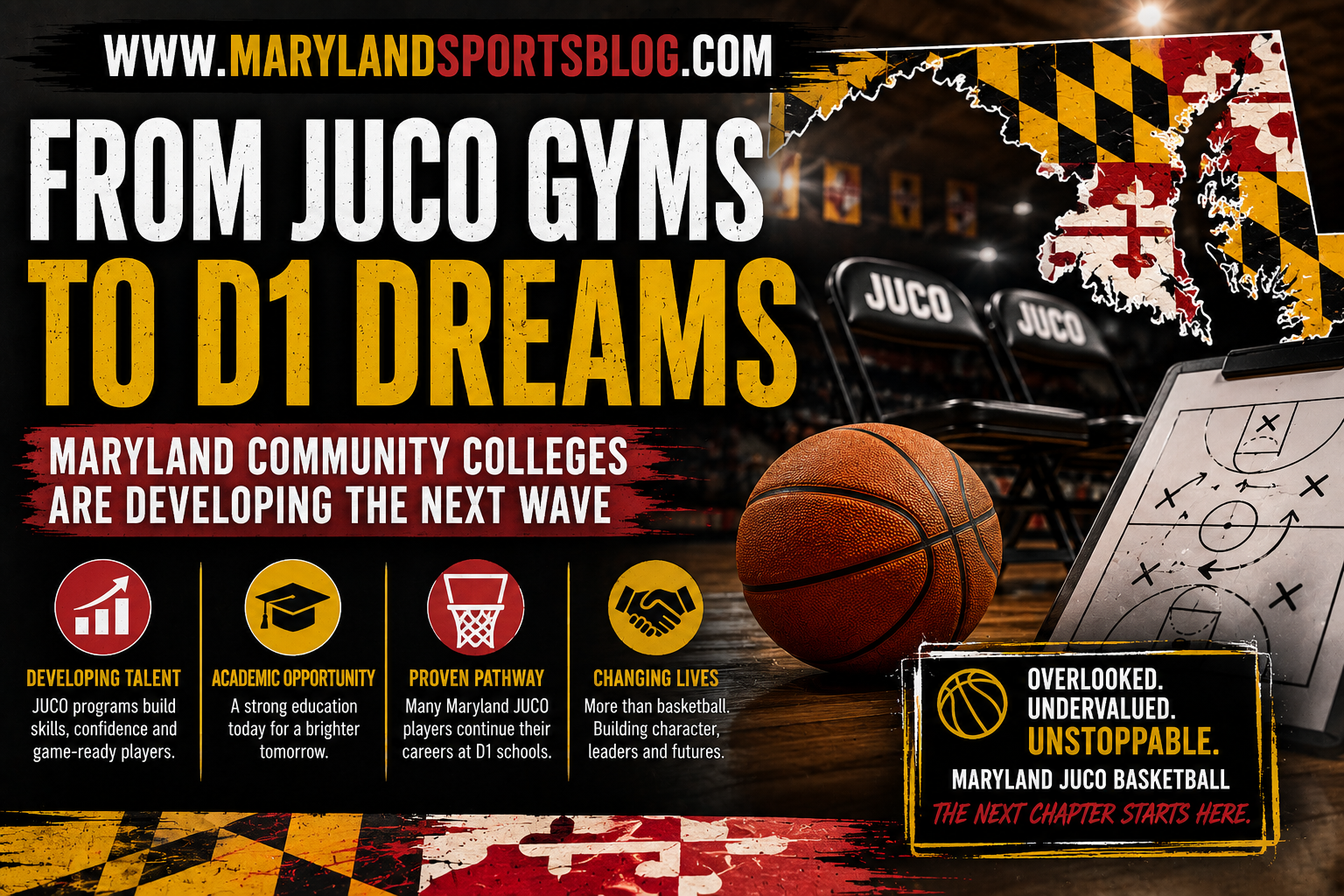
Maryland Community Colleges Quietly Becoming Basketball Recruiting Goldmines
Maryland basketball has always carried a national reputation.
The state consistently produces elite guards, tough defenders and high-level scorers from Baltimore to Prince George’s County. Most recruiting attention flows toward powerhouse high schools and Division I programs, but another pipeline continues growing quietly underneath the surface.
Maryland junior-college basketball programs have become major development hubs for overlooked athletes, transfer-portal rebuilds and late-blooming prospects chasing Division I opportunities.
Programs like CCBC Essex, Harford Community College, Cecil College and Allegany College of Maryland continue developing players capable of reaching NCAA Division I basketball.
Most Maryland sports outlets barely cover the scene.
That creates one of the state’s best untold basketball stories.
The JUCO Route No Longer Carries a Stigma
Junior-college basketball once carried unfair stereotypes.
Fans often viewed the JUCO route as a fallback option for athletes who missed Division I recruiting opportunities. Modern college basketball changed that perception completely.
The transfer portal transformed roster construction nationwide. Division I coaches now aggressively recruit experienced junior-college players because older athletes often adjust faster than freshmen.
JUCO basketball now functions as:
- a development pipeline
- an academic reset
- a recruiting second chance
- a pathway toward Division I exposure
Maryland programs continue benefiting from that shift.
Allegany College Built One of Maryland’s Strongest Basketball Histories
Allegany College of Maryland quietly owns one of the strongest basketball traditions in Maryland JUCO history.
The Trojans have produced more than 100 NCAA Division I transfers along with four NBA players, including Steve Francis.
Former Allegany guard Terrance Jacobs used the junior-college route before starring at Towson Tigers, where Jacobs won East Coast Conference Player of the Year honors in 1992.
Programs like Allegany thrive because coaches emphasize:
- toughness
- conditioning
- defense
- maturity
- accountability
That environment prepares players for higher-level basketball quickly.
Western Maryland rarely receives statewide basketball attention, but Allegany continues proving high-level talent exists outside Baltimore and Washington recruiting circles.
CCBC Essex Continues Producing Division I Talent
CCBC Essex remains one of the East Coast’s most respected junior-college basketball brands.
The Knights consistently recruit heavily throughout Baltimore’s deep basketball landscape. Players arrive from public-school powers, private-school programs and overlooked prep backgrounds searching for another opportunity.
Essex has long served as a stepping stone toward Division I basketball, especially for guards and athletic wings needing additional development.
The Baltimore basketball culture naturally feeds JUCO success.
Athletes grow up competing in aggressive, high-pressure environments. Many players possess Division I skill sets but need academic improvement, physical development or recruiting exposure.
JUCO basketball fills that gap perfectly.
Harford Community College Helping Players Reach Higher Levels
Harford Community College has also helped players continue their NCAA careers successfully.
Former Harford standout Isaiah White transferred to Maine Black Bears after earning All-Region honors with the Fighting Owls.
Harford’s coaching staff has consistently developed players capable of moving into NCAA Division I, II and III basketball. The program’s strong recruiting relationships throughout northeastern Maryland continue strengthening the roster annually.
The Fighting Owls benefit from recruiting athletes overlooked by larger programs despite possessing legitimate college-level talent.
Cecil College Keeps Developing Underrated Guards
Cecil College continues building a stronger basketball identity within Maryland JUCO competition.
Cecil won a national championship in men’s basketball in 2006 and remains competitive inside the Maryland JUCO system.
The Seahawks regularly feature athletic guards and high-motor defensive teams capable of upsetting stronger opponents.
Programs like Cecil often attract players who:
- developed late physically
- lacked recruiting exposure
- suffered injuries during high school
- needed academic rebuilding opportunities
Those athletes frequently thrive after entering structured JUCO systems.
The Transfer Portal Changed Everything
The transfer portal completely reshaped college basketball recruiting.
Division I programs now rebuild rosters every offseason. Coaches increasingly value experienced players who already understand college-level competition.
That trend dramatically increased JUCO importance nationwide.
Junior-college athletes now regularly fill roles such as:
- veteran point guards
- defensive specialists
- stretch forwards
- rebounders
- experienced scorers
Maryland JUCO programs continue benefiting from that national shift.
Baltimore Remains the Engine Behind Maryland JUCO Basketball
Baltimore’s basketball culture fuels much of Maryland’s JUCO success.
The city consistently produces more high-level guards and wings than available Division I scholarships. That reality creates a large pool of overlooked players capable of succeeding at the college level.
JUCO basketball gives those athletes another opportunity.
Many eventually transfer upward after one or two strong seasons.
That pipeline has become increasingly respected among Division I recruiters.
Community College Basketball Changes Lives Beyond The Court
The basketball side tells only part of the story.
Community-college athletics also creates affordable educational opportunities for athletes who might otherwise lose access to college completely.
Many coaches function as mentors, advisors and life counselors as much as basketball instructors.
Players often arrive facing:
- financial hardship
- academic instability
- family responsibilities
- recruiting disappointment
Successful JUCO programs help stabilize those situations while keeping athletic dreams alive.
That impact rarely receives enough recognition statewide.
Maryland JUCO Basketball Could Keep Growing Nationally
Exposure continues increasing through:
- recruiting websites
- livestream broadcasts
- transfer portal coverage
- social media highlights
- scouting services
Maryland’s basketball reputation already exists nationally.
As Division I programs continue trusting JUCO athletes more aggressively, Maryland community colleges could become even more important inside the recruiting landscape.
And many of the state’s best basketball stories may still be sitting inside overlooked community-college gyms.