
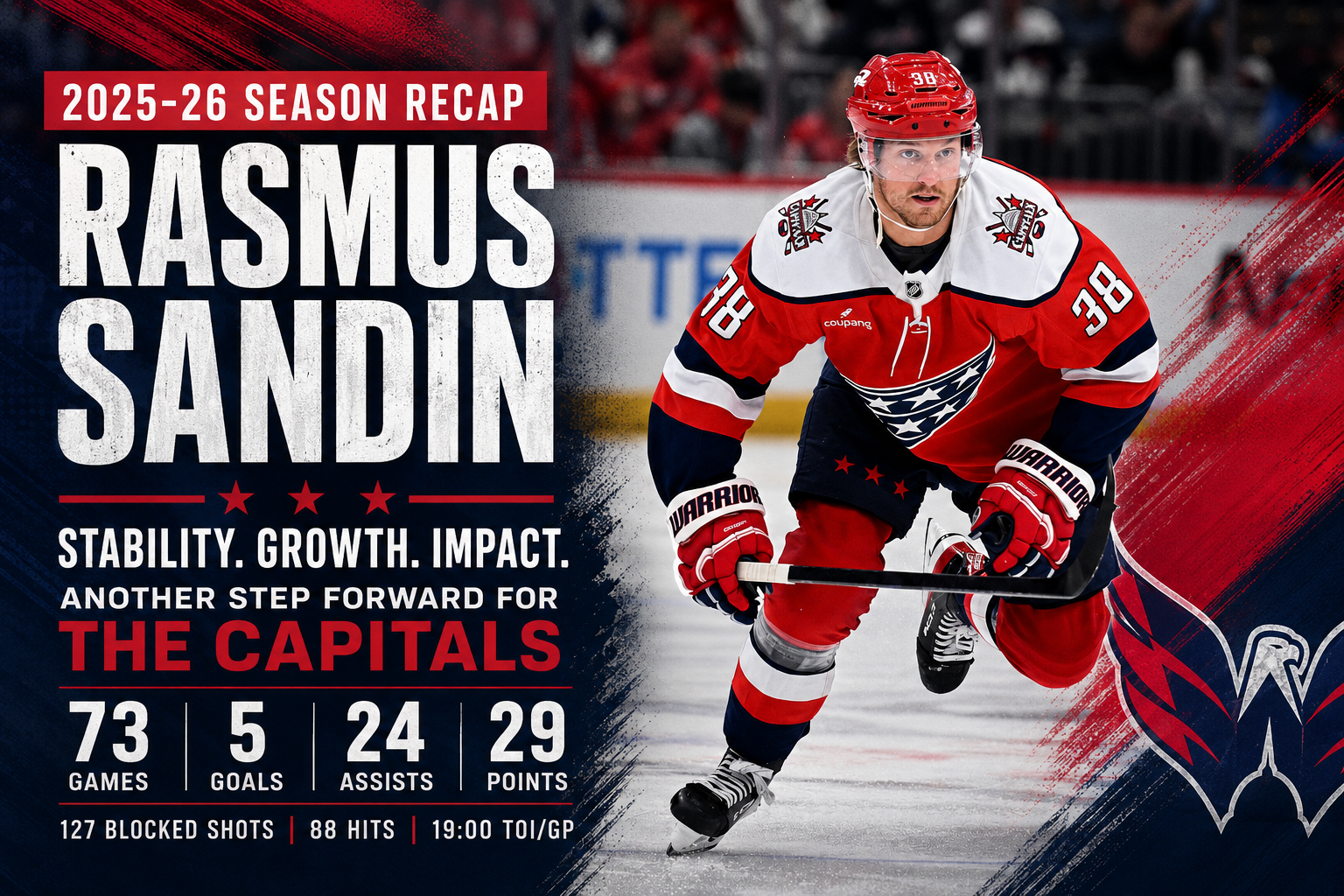
Rasmus Sandin’s 2025-26 Season Delivered Stability, Growth and Another Step Forward for the Capitals
Washington Capitals defenseman Rasmus Sandin entered the 2025-26 season with expectations that stretched far beyond raw point totals. Washington needed puck movement from the back end, cleaner breakouts through the neutral zone and steady minutes against top competition. Sandin answered those demands while continuing to grow into one of the most reliable young defensemen in the organization.
Early-season momentum around the Capitals centered on playoff positioning, roster balance and continued development from younger contributors. Coverage throughout the year on tracked Washington’s evolving blue line and the team’s push through the Eastern Conference schedule. Stories involving the Capitals’ defensive structure and roster evolution helped frame Sandin’s importance inside Spencer Carbery’s system.
Another major talking point throughout the season involved Washington’s transition toward a faster, more possession-driven attack. Sandin fit that identity perfectly. Additional Capitals coverage from highlighted how younger skaters carried larger workloads while veterans continued chasing postseason success. Sandin remained central to that balance from October through April.
Olympic conversation followed Sandin throughout the year as Sweden assembled talent for international competition. Strong NHL play strengthened Sandin’s case for meaningful minutes with Team Sweden, especially after consistent puck-possession numbers and dependable defensive-zone play. International hockey discussion and Capitals analysis on regularly pointed toward Sandin as one of Washington’s most important long-term pieces.
The 25-year-old finished the 2025-26 regular season with five goals, 24 assists and 29 points across 73 games. Sandin also recorded 127 blocked shots, 88 hits and 90 shots on goal while averaging just over 19 minutes per game. Numbers alone failed to tell the full story, though. Washington leaned heavily on Sandin’s transition ability, especially against faster teams in the Metropolitan Division.
Clean exits became one of Sandin’s biggest strengths during the season. Washington struggled at times against aggressive forechecks, yet Sandin consistently relieved pressure with calm puck handling and smart first passes. Defensive-zone retrievals improved dramatically compared with earlier seasons, and far fewer turnovers appeared along the boards. Carbery trusted Sandin in late-game situations because mistakes rarely snowballed into extended defensive-zone chaos.
Skating continued to separate Sandin from many younger NHL defensemen. Smooth edge work allowed quick directional changes without sacrificing positioning. Opposing forwards often tried to chip pucks behind Washington’s defense, but Sandin regularly recovered first thanks to strong backward mobility and anticipation. Quick reads prevented odd-man rushes before danger fully developed.
Washington’s power play showed flashes throughout the season, and Sandin contributed important secondary offense from the blue line. Point shots rarely served as the primary weapon, but quick puck movement opened lanes for Washington’s forwards. Passing decisions improved noticeably under pressure. Sandin looked far more confident distributing from the left point compared with previous seasons.
Offensive production came in waves during the year. Several multi-assist performances helped spark Washington victories during critical stretches of the season. One of the strongest games arrived during a March win against Calgary when Sandin logged three assists while quarterbacking transition opportunities throughout the night.
Physical play also improved. Sandin never projected as a punishing defenseman, yet increased willingness to engage along the boards added another layer to the overall game. Net-front positioning looked stronger, and stick placement limited second-chance opportunities. Washington needed that growth against heavier Eastern Conference opponents.
Another major development involved discipline. Earlier stages of Sandin’s NHL career occasionally featured rushed decisions under forechecking pressure. The 2025-26 season showed far greater patience. Controlled exits replaced panic clears, and smarter gap control reduced scrambling inside the defensive zone. That maturation process stood out game after game.
Sandin’s chemistry with fellow Capitals defensemen became another critical storyline. Rotating pairings throughout the year required constant adjustment, yet Sandin adapted well regardless of partner. Defensive communication improved substantially during road trips against playoff-caliber teams. Pairing flexibility gave Washington more matchup options late in the season.
Durability represented another important factor. Injuries affected several Capitals defensemen throughout the schedule, but Sandin still appeared in 73 games despite battling nagging issues during parts of the season. Washington desperately needed steady availability from younger contributors as the playoff race intensified.
Career trajectory continued trending upward. Since arriving in Washington during the 2023 trade with Toronto, Sandin steadily transformed from a promising offensive defenseman into a dependable top-four NHL contributor. Washington’s front office believed that upside existed immediately after the trade, and the organization’s patience continued paying dividends.
Statistical growth across recent seasons reinforced that progression. Sandin produced 23 points during the 2023-24 season before posting 30 points in 2024-25. Another 29-point campaign followed in 2025-26 despite missing games due to injury concerns. Consistency now defines Sandin far more than raw upside projection.
Washington’s defensive structure changed dramatically over the past several seasons. Veteran-heavy lineups slowly gave way to a faster roster with more emphasis on puck movement and transition offense. Sandin fit perfectly within that evolution because skating and puck distribution already represented core strengths.
Strong possession metrics further highlighted Sandin’s importance. Washington controlled play more effectively when Sandin handled breakout responsibilities. Offensive-zone entries looked cleaner, and neutral-zone transitions carried far less risk. Those details rarely dominate headlines, yet coaching staffs value them immensely.
Penalty-kill usage increased as the season progressed. Coaches trusted Sandin’s stick positioning and anticipation against cross-ice passing plays. Quick clears relieved pressure, and smarter reads prevented extended shifts trapped inside the defensive zone. Development in shorthanded situations marked another sign of Sandin’s growing maturity.
Leadership quietly expanded as well. Sandin never operated as the loudest player in the room, but teammates consistently praised composure and preparation habits. Younger defensemen gravitated toward that steady presence during difficult stretches of the season. Washington’s coaching staff clearly valued those intangibles.
International hockey added another layer to Sandin’s year. Sweden continued building toward major international competition with an extremely talented defensive pool. Sandin strengthened standing within that group through dependable NHL play and continued offensive growth.
Olympic discussion surrounding Swedish hockey focused heavily on established NHL stars, but Sandin carved out legitimate consideration because of versatility. Sweden values puck-moving defensemen capable of handling both special-teams situations and difficult transition responsibilities. Sandin checked each of those boxes.
Previous international tournaments already showcased offensive upside on bigger stages. Sandin produced 10 points during the 2020 IIHF World Junior Championship while helping Sweden remain among the tournament favorites. International experience helped shape calm decision-making visible throughout NHL competition today.
Sweden’s Olympic roster conversation became especially competitive because of elite NHL talent throughout the defensive pipeline. Victor Hedman, Rasmus Dahlin and several other high-profile names dominated headlines. Sandin still pushed into the conversation through reliability and system flexibility. Coaches love defensemen capable of adapting to different partners and varying game situations.
Performance against top NHL competition further strengthened Sandin’s Olympic profile. Metropolitan Division matchups often featured explosive offensive talent, yet Sandin routinely handled difficult defensive assignments without sacrificing transition offense. That balance matters tremendously in short international tournaments.
Washington’s season contained stretches of inconsistency offensively, which increased pressure on the defensive corps to contribute transition opportunities. Sandin repeatedly stepped into that responsibility. Quick outlet passes frequently initiated scoring chances before opposing defenses established positioning.
Point totals probably undersold Sandin’s actual offensive impact. Washington’s shooting percentages fluctuated throughout the year, and several strong playmaking sequences never translated into official assists. Underlying puck-possession trends painted a much stronger picture of overall influence.
Shot blocking also emerged as a major component of Sandin’s defensive game. Finishing with 127 blocked shots demonstrated improved willingness to sacrifice physically in dangerous situations. Blocking lanes became especially important late in close games when Washington protected narrow leads.
Confidence with the puck reached another level during the second half of the season. Sandin attacked open ice more aggressively and carried pucks deeper into offensive territory when opportunities developed. Those reads created additional pressure on opposing defenses.
Washington’s younger core benefited tremendously from Sandin’s development. The organization needed players capable of bridging the gap between veteran stars and future contributors. Sandin filled that role beautifully throughout 2025-26.
Cap management also increased Sandin’s importance. Washington committed five years and $23 million to the defenseman during a 2024 contract extension, signaling strong organizational belief in long-term value. Production during 2025-26 justified that investment.
Financial flexibility matters enormously in today’s NHL, and Sandin delivered top-four defensive minutes without carrying the salary attached to many comparable defensemen around the league. Efficient contracts allow contenders to build deeper rosters.
Several games during the season highlighted Sandin’s evolution perfectly. Road performances against playoff-caliber opponents often featured poised defensive-zone play, clean puck movement and smart situational awareness under pressure. Coaches value reliability more than highlight plays from defensemen.
Consistency against forechecking pressure represented perhaps the biggest improvement from earlier seasons. Opponents frequently targeted Washington’s defense with aggressive pressure schemes, yet Sandin rarely forced low-percentage passes. Calmness under pressure prevented momentum swings.
Washington’s transition game looked far more dangerous whenever Sandin controlled pace from the back end. Quick acceleration through the neutral zone opened space for forwards flying through the middle lane. Few Capitals defensemen matched Sandin’s ability to move pucks efficiently without unnecessary risk.
Another underrated aspect of Sandin’s game involved offensive-zone blue-line control. Holding pucks inside the zone extended possession time and generated additional scoring chances. Smart reads prevented odd-man rushes the other direction while still maintaining offensive pressure.
Faceoff support improved considerably too. Centers frequently relied on Sandin for quick support after defensive-zone draws. Strong positioning allowed Washington to establish possession more cleanly and avoid extended scrambling shifts.
Pressure surrounding Washington’s playoff push intensified late in the season. Veteran stars still drove national headlines, but younger contributors like Sandin played equally important roles in maintaining postseason positioning. Washington simply needed dependable minutes from the blue line every night.
Sandin delivered those minutes consistently. Mistakes still occurred occasionally because every NHL defenseman faces difficult situations over an 82-game season, but recovery ability and composure dramatically improved. That maturity defined the year.
Criticism earlier in Sandin’s career often centered on physicality and defensive-zone toughness. The 2025-26 season answered many of those concerns. Increased strength helped win more puck battles along the boards, and positioning limited dangerous scoring opportunities near the crease.
Swedish hockey development continued producing elite NHL defensemen, and Sandin strengthened reputation within that tradition during the season. Intelligent puck movement, strong skating and positional discipline all aligned with classic Swedish defensive development philosophies.
Washington’s coaching staff frequently trusted Sandin during difficult matchups against high-end offensive players. Defensive-zone starts against skilled lines demonstrated how much confidence coaches placed in overall awareness and positioning.
Special teams provided another example of Sandin’s value. Washington rotated defensive combinations throughout the season, but Sandin remained involved because adaptability allowed coaches to adjust based on opponent tendencies. Reliable execution matters tremendously during playoff races.
Fans also saw increased confidence offensively when Sandin activated below the circles. Timed pinches created additional scoring opportunities without sacrificing defensive structure. Better timing separated aggressive offensive involvement from reckless gambling.
The Capitals needed that offensive support from defensemen because secondary scoring occasionally disappeared during tougher stretches. Sandin helped offset those droughts through puck movement and offensive-zone pressure.
Another encouraging sign involved reduced panic under extended defensive pressure. Earlier NHL seasons sometimes featured rushed clears or poor passing decisions after long shifts trapped inside the zone. The 2025-26 campaign showed a calmer, more controlled player.
International scouts certainly noticed those developments. Olympic tournaments demand quick decision-making because mistakes become magnified against elite competition. Sandin’s improved poise strengthened value considerably for Team Sweden discussions.
Washington’s blue line overall looked younger and more mobile than previous seasons. Sandin played a major role in shaping that identity. Speed through transition and improved puck retrievals allowed Washington to spend less time defending.
Offensive confidence never crossed into recklessness either. Sandin understood game flow and rarely forced unnecessary risks while protecting leads. Situational awareness improved enormously throughout the season.
Teammates consistently trusted Sandin as an outlet option during difficult shifts. Reliable puck support often prevents turnovers before danger develops. Those details rarely appear in traditional box scores, yet they influence winning tremendously.
Road performance remained particularly impressive. Hostile environments and aggressive forechecking schemes challenged Washington repeatedly throughout the schedule, but Sandin usually responded with composed play and intelligent puck management.
Growth since the Toronto trade became impossible to ignore. Washington acquired Sandin believing greater opportunity would unlock another level of development. The 2025-26 season provided more evidence supporting that belief.
Statistical milestones continued building as well. Career totals climbed steadily, and Sandin moved closer toward establishing long-term status as one of Washington’s foundational defensemen.
Skating mechanics remained elite throughout the season. Efficient stride generation helped recover quickly defensively while still supporting offensive transition. NHL pace continues increasing yearly, making mobility more valuable than ever for defensemen.
Washington’s offensive-zone cycling also benefited from Sandin’s patience at the blue line. Smart puck distribution created cleaner shooting lanes for forwards positioned lower in the zone. Better puck retention extended offensive pressure dramatically.
Contract value increasingly looked favorable for Washington management. Top-four NHL defensemen capable of handling transition responsibilities usually command significant salaries. Sandin delivered those responsibilities at a manageable cap hit.
Olympic expectations for Sweden continued rising as international competition approached. Sandin’s balanced skill set fit modern international hockey extremely well because mobility and puck movement dominate tournament play.
Defensive-zone communication with goaltenders also improved during the season. Better coordination on puck retrievals and breakout timing reduced confusion behind the net. Small improvements like those often separate average defensive teams from strong ones.
Washington fans watched Sandin mature from promising young defenseman into a dependable nightly contributor capable of handling difficult assignments. Another developmental leap now seems realistic heading into the 2026-27 season.
Goal scoring totals probably never define Sandin’s value, but five goals and 29 points still represented meaningful offensive contribution from the back end. Defensive reliability combined with secondary offense makes extremely valuable NHL defensemen.
Future projections around the Capitals increasingly include Sandin as a long-term cornerstone. Washington still features veteran leadership, but younger contributors must eventually carry larger responsibilities. Sandin already appears prepared for that challenge.
Every successful NHL organization needs defensemen capable of handling pressure minutes without constant matchup protection. Washington found that type of player in Sandin. The 2025-26 season reinforced exactly why the organization committed long term to the Swedish blueliner.