
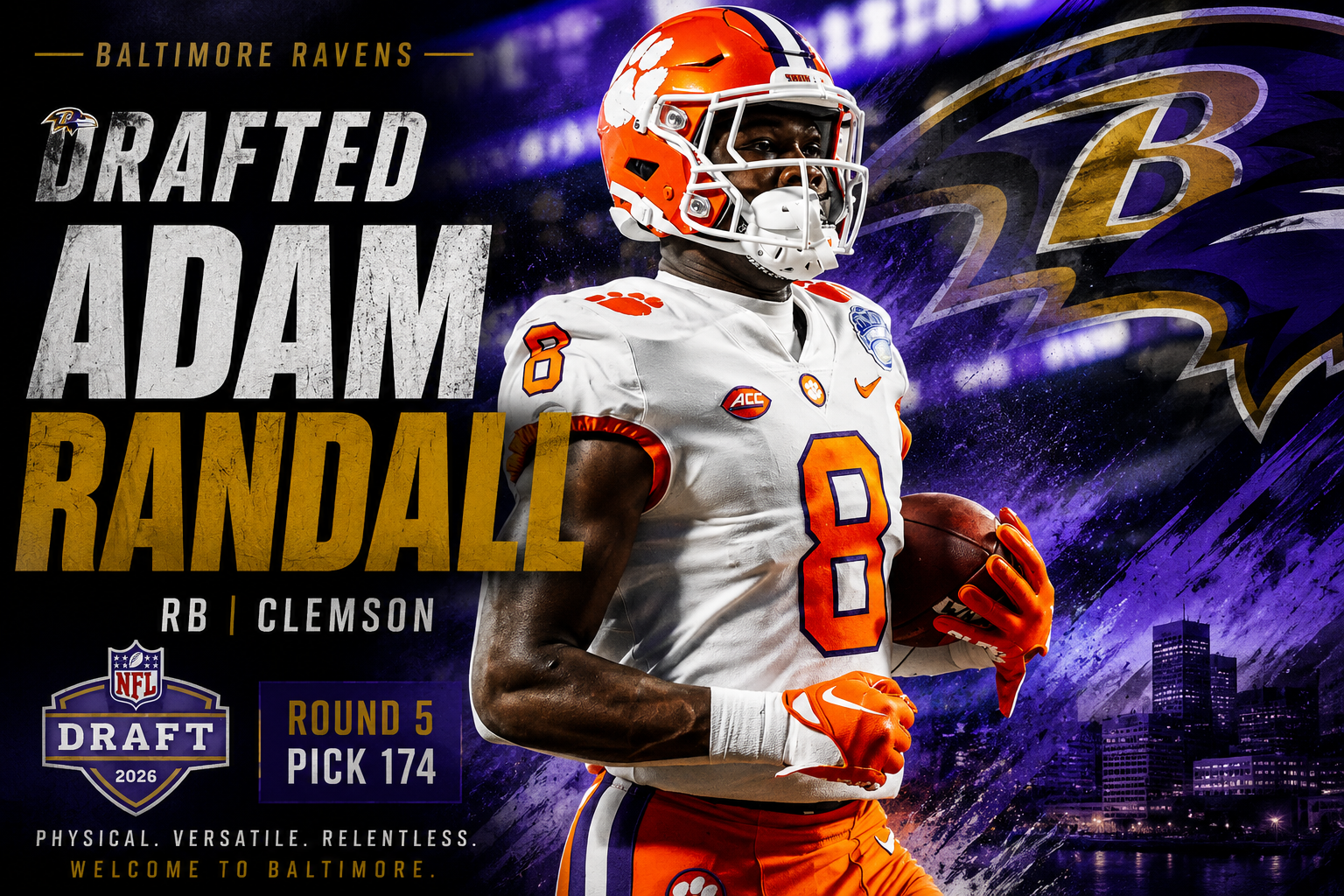
Ravens Add Versatility With Clemson Standout Adam Randall
The Baltimore Ravens continued their tradition of targeting versatile, physical football players during the 2026 NFL Draft when the franchise selected Adam Randall in the fifth round with the No. 174 overall pick. General manager Eric DeCosta and coach John Harbaugh rarely chase one-dimensional prospects. Randall fits the Ravens’ identity perfectly because the former Clemson Tigers standout brings size, toughness, receiving skills and positional flexibility to Baltimore’s offense.
Baltimore already features one of the NFL’s most dangerous offenses behind Lamar Jackson and Derrick Henry. Randall now joins a crowded but explosive backfield that values physical runners who can also contribute in the passing game. The Ravens believe Randall’s upside remains untapped because Clemson only moved him to running back during his final collegiate season.
Readers who want more Ravens draft coverage can also check out features on the team’s rookie class, offensive outlook and draft strategy throughout the offseason.
Another Ravens offseason story at examined Baltimore’s push to add younger offensive playmakers around Jackson after another playoff run ended short of a Super Bowl appearance.
Coverage at also highlighted the organization’s continued emphasis on toughness, versatility and athletic upside during the 2026 NFL Draft.
From Myrtle Beach To Clemson
Randall arrived in college football with major expectations. The Myrtle Beach, South Carolina, native dominated high school competition at Myrtle Beach High School and established himself as one of the top athletes in the state. Recruiting services praised Randall for his rare combination of size, speed and body control as a receiver. At 6-foot-3 and more than 220 pounds even during high school, defenders struggled to match his physicality near the line of scrimmage or in contested catch situations.
Randall starred on both sides of the ball while helping Myrtle Beach remain one of South Carolina’s premier football programs. Coaches trusted him in critical moments because of his competitiveness and ability to create explosive plays. Recruiting attention quickly followed.
Power Five schools pursued Randall heavily before Clemson secured his commitment. Coach Dabo Swinney viewed Randall as another elite athlete capable of developing into a future NFL contributor. Clemson’s coaching staff loved Randall’s work ethic and willingness to embrace difficult coaching.
That mentality later helped save his football career.
Overcoming Early Adversity
Randall’s Clemson career never followed a straight line. Injuries slowed his development early. Clemson also featured a crowded receiver room loaded with young talent. Instead of transferring or complaining about touches, Randall stayed patient and continued working.
The perseverance impressed coaches inside the program.
Randall played in 12 games during the 2022 season and caught 10 passes for 128 yards. The production looked modest, but Clemson coaches continued praising his physical tools and toughness.
The 2023 season brought incremental growth. Randall appeared in 13 games and finished with 22 receptions for 250 yards. Defenses respected his ability to stretch the field vertically because of his long stride speed and size advantage against defensive backs.
Still, Randall never fully emerged as Clemson’s featured receiver.
Instead of allowing frustration to define his career, Randall embraced a completely new challenge heading into the 2025 season.
The Position Switch That Changed Everything
Clemson coaches approached Randall with a bold idea before the 2025 campaign. The Tigers needed a bigger, more physical presence at running back. Randall already possessed the frame, toughness and ball skills to thrive there.
Rather than resisting the transition, Randall attacked it.
The move transformed his NFL future.
Randall rushed for 814 yards and 10 touchdowns during his lone season as Clemson’s primary running back. The former receiver also caught 36 passes for 254 yards and three touchdowns. Clemson suddenly featured one of the ACC’s most versatile offensive weapons.
The numbers only tell part of the story.
Randall’s tape revealed a player who punished defenders after contact while still moving fluidly in space. Clemson frequently aligned him in multiple formations because linebackers struggled covering him and smaller defensive backs struggled tackling him.
NFL scouts noticed immediately.
Draft evaluators loved Randall’s upside because he remained relatively new to the running back position. Many believed his best football still sat ahead of him.
College Production Breakdown
Randall’s college numbers show the unusual path that eventually led him to Baltimore.
2022 Season
- 10 receptions
- 128 receiving yards
- 12 games played
2023 Season
- 22 receptions
- 250 receiving yards
- 13 games played
2024 Season
- 16 receptions
- 115 receiving yards
- 2 receiving touchdowns
- 4 rushing attempts
- 44 rushing yards
2025 Season
- 168 rushing attempts
- 814 rushing yards
- 10 rushing touchdowns
- 36 receptions
- 254 receiving yards
- 3 receiving touchdowns
Career Totals
- 84 receptions
- 787 receiving yards
- 5 receiving touchdowns
- 172 rushing attempts
- 858 rushing yards
- 10 rushing touchdowns
The versatility stands out immediately.
Most college running backs never develop Randall’s receiving instincts. Most college receivers never learn to absorb punishment between the tackles. Randall now brings both traits to Baltimore.
NFL Combine And Athletic Testing
Randall strengthened his draft stock during the pre-draft process with impressive athletic testing.
At roughly 6-foot-3 and 232 pounds, Randall posted a 4.50-second 40-yard dash while also recording a 37-inch vertical jump and 26 bench press repetitions.
Those numbers reinforced why scouts viewed Randall as such an intriguing developmental prospect.
Large running backs often struggle changing direction or catching passes naturally. Randall moves differently because of his receiver background. Clemson frequently split him wide or motioned him into favorable matchups against linebackers.
Baltimore clearly envisions similar opportunities.
The Ravens already stress defenses horizontally with Jackson’s mobility and vertically through play-action concepts. Randall’s skill set creates another chess piece for offensive coordinator Todd Monken.
Why The Ravens Loved Randall
Baltimore values football intelligence, versatility and toughness more than flashy combine numbers alone. Randall checks every box.
DeCosta described Randall as a “jackknife” player because of his ability to contribute in multiple phases of the game. The Ravens also praised his maturity and willingness to embrace coaching.
Those characteristics matter inside Baltimore’s culture.
The Ravens consistently compete because the organization identifies players willing to sacrifice individual statistics for team success. Randall already proved that mentality at Clemson when he changed positions for the benefit of the offense.
The Ravens also love Randall’s special teams potential. His size and speed could make him valuable on coverage units immediately while he develops offensively.
That versatility often determines whether Day 3 draft picks survive final roster cuts.
Randall enters training camp with a legitimate opportunity to earn Baltimore’s No. 3 running back role behind Henry and Justice Hill.
Learning Behind Derrick Henry
Few rookie running backs could ask for a better mentor than Henry.
The future Hall of Famer dominates defenders with physical running and relentless conditioning. Randall already acknowledged his eagerness to learn from Henry during rookie minicamp.
The similarities between the two backs stand out physically.
Both runners possess towering frames uncommon for NFL running backs. Both thrive through contact. Both force defenses to make difficult business decisions in the fourth quarter.
Randall obviously still needs significant development before reaching Henry’s level, but Baltimore believes the rookie landed in an ideal environment.
The Ravens will not ask Randall to carry the offense immediately. That patience gives coaches time to refine his vision, pass protection technique and route running details from the backfield.
The long-term upside remains substantial.
Pass Catching Could Separate Randall
Modern NFL offenses demand versatility from running backs. Randall’s receiving background gives Baltimore another dynamic option.
Linebackers already struggle containing Baltimore’s tight ends and scrambling threats. Randall could create even more matchup problems because of his natural hands and ability to run routes like a receiver.
Clemson frequently targeted Randall on screens, angle routes and wheel concepts during his breakout season. Defensive backs struggled matching his size while linebackers struggled matching his quickness.
Monken loves exploiting those mismatches.
Baltimore could eventually deploy Randall in creative formations alongside Henry or Hill. The Ravens also value backs who protect Jackson in blitz pickup situations. Randall’s size should help him develop there.
Pass protection likely determines how quickly Randall earns meaningful snaps.
Areas That Need Improvement
Randall still enters the NFL as a developmental player.
Vision between the tackles remains inconsistent because of his limited experience at running back. NFL rushing lanes close significantly faster than college lanes. Randall must learn how to anticipate blocks and make quicker decisions.
Ball security also remains critical for young running backs.
The Ravens demand reliability from rotational players. Randall cannot afford assignment mistakes in pass protection or situational football.
Some scouts also questioned whether Randall possesses elite top-end acceleration compared to other NFL backs.
Baltimore likely views those concerns as coachable issues rather than fatal flaws.
The upside simply outweighs the risk at a fifth-round price.
Steve Bisciotti’s Personal Pick
One fascinating detail surrounding Randall’s selection immediately grabbed headlines.
Reports revealed that Ravens owner Steve Bisciotti personally pushed for the Randall pick during the draft process. DeCosta later confirmed it marked the first time Bisciotti directly made a Ravens draft selection.
That fact alone shows how strongly the organization believes in Randall’s character and upside.
Owners rarely insert themselves into draft decisions, especially within one of the NFL’s most respected front offices. Baltimore clearly saw something unique in Randall’s combination of size, versatility and mentality.
Now the rookie must reward that confidence.
How Randall Fits Baltimore’s Offense
Baltimore’s offense thrives because defenses constantly face conflicting responsibilities.
Jackson forces edge defenders to hesitate. Henry punishes lighter defensive fronts. Tight ends attack the middle of the field. Speed threats stretch coverage vertically.
Randall potentially enhances every element.
The rookie can align in the backfield, motion into the slot or operate in screen concepts. Defenses must respect his receiving ability while also preparing for physical inside runs.
Monken could create devastating play-action packages involving Henry and Randall together.
Imagine a defense attempting to stop Henry downhill while Randall leaks into open space against a linebacker. Baltimore’s creativity already causes nightmares for opposing coordinators.
Randall gives the Ravens another versatile weapon.
Special Teams Value
Roster battles often hinge on special teams contributions for Day 3 picks.
Randall’s size, speed and willingness to embrace physical contact should help him immediately there. Baltimore consistently fields strong special teams units under coach John Harbaugh, largely because younger players buy into those responsibilities.
Randall already demonstrated a team-first mentality at Clemson.
That mindset could help secure his roster spot quickly.
The Ravens also hinted Randall might contribute as a kick return option because of his open-field athleticism.
Any additional versatility only strengthens his value.
Expectations For Year One
Baltimore probably won’t overload Randall immediately, but meaningful opportunities should arrive.
Henry remains the featured back. Hill still handles many passing-down responsibilities. Randall’s path likely starts through special teams and rotational offensive packages.
Injuries always test NFL depth, though.
The Ravens learned repeatedly over recent seasons that running back depth matters enormously during long playoff pushes. Randall’s physical profile makes him an intriguing insurance option behind Henry.
Some inside Baltimore already view him as a sleeper contributor.
The organization clearly believes his development curve could rise quickly with NFL coaching.
The Brian Hradsky Style Projection
Randall feels like the exact type of Ravens pick that frustrates opponents two years from now.
Baltimore constantly identifies athletic players who lack polished résumés but possess elite traits and toughness. Randall’s story screams “future contributor” because adversity never pushed him off course. Position changes never scared him. Bigger opportunities only motivated him further.
That mentality matters in Baltimore.
The Ravens demand physical football. Randall embraces contact naturally. Defensive backs rarely enjoy tackling players built like linebackers in the open field. Randall creates that problem every snap.
The rookie also enters one of football’s healthiest organizational cultures for player development. Veterans hold younger players accountable. Coaches emphasize fundamentals. Competition defines every roster spot.
Randall should thrive there.
If the position switch at Clemson represented only the beginning of his growth as a running back, the Ravens may have stolen one of the draft’s most intriguing developmental prospects in the fifth round.
Baltimore doesn’t need Randall to become a superstar immediately.
The Ravens simply need continued growth.
Based on Randall’s journey from Myrtle Beach standout receiver to Clemson position-switch success story and now NFL rookie, betting against that growth feels unwise.