
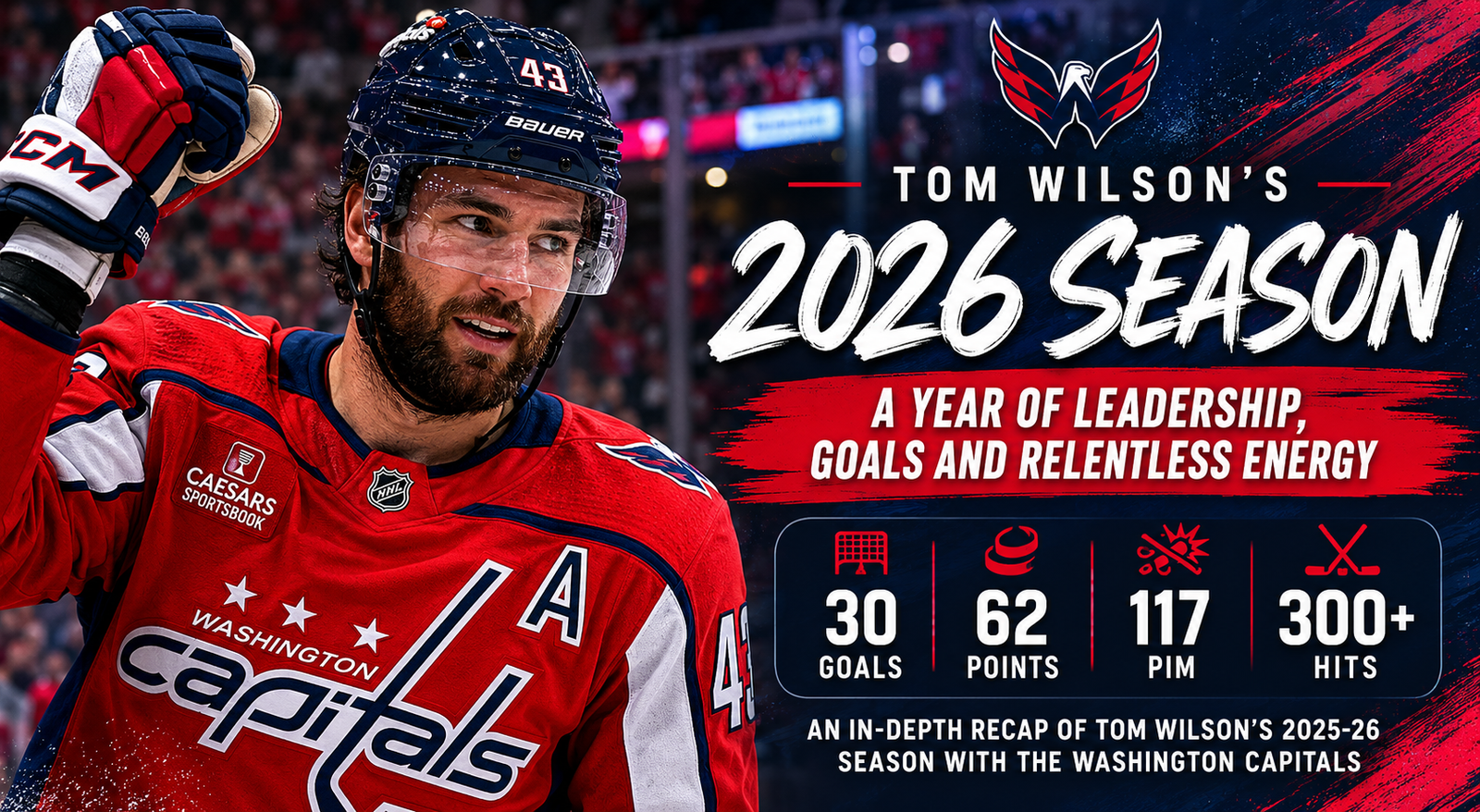
Tom Wilson’s 2025-26 Season Delivered Leadership, Goals and Relentless Energy for the Capitals
Physical hockey still matters in the NHL, and Tom Wilson reminded the league why during the 2025-26 season. Scoring touch, leadership and intimidation all fueled another productive campaign for the veteran winger as the Washington Capitals battled through an uneven season that featured offensive highs and frustrating defensive lapses.
Thirty goals and 62 points in 72 games marked another major offensive season for Wilson. Career-best consistency around the net, stronger puck movement in transition and continued dominance on the forecheck helped push the Capitals offense during key stretches of the year. Wilson also delivered 117 penalty minutes, more than 300 hits and heavy minutes in every situation.
Coverage of the Capitals all season long at tracked the franchise’s transition period as veterans carried larger workloads and younger players tried to establish themselves. Stories such as , and highlighted the supporting cast that helped shape Washington’s season.
Wilson entered the season carrying momentum from a career year in 2024-25. Another strong offensive campaign quickly erased any doubt about whether the production spike represented a one-year anomaly. Shot selection improved dramatically during the past two seasons, and Wilson started converting chances at an elite rate. Hockey Reference credited Wilson with 30 goals, 32 assists and 153 shots while averaging nearly 19 and a half minutes per game.
A player once known almost entirely for fighting and physicality has evolved into one of the NHL’s most complete power forwards. Wilson still punished defenders below the goal line and crushed opponents along the boards, but smarter offensive positioning changed the trajectory of his career. Better puck support in the offensive zone opened cleaner scoring opportunities, especially on rush chances and net-front deflections.
Washington leaned heavily on Wilson when momentum swung against the club. Coaching staffs trusted him on the power play, penalty kill and late-game defensive situations. Penalty killing especially showcased Wilson’s hockey IQ. Anticipation in passing lanes frequently created transition opportunities, and aggressive pressure disrupted opposing zone entries.
Wilson’s season also carried emotional importance for the organization. The Capitals continue navigating the final competitive years of the Alex Ovechkin era, and leadership inside the locker room matters more than ever. Wilson embraced that responsibility. Younger forwards consistently mentioned his work ethic, preparation habits and accountability.
Another memorable milestone arrived during the season when Wilson climbed the Capitals’ all-time scoring rankings. Multiple reports noted that a two-goal performance against the New York Islanders pushed Wilson into eighth place on the franchise’s all-time goal-scoring list.
Physicality never disappeared from Wilson’s game either. Opponents still feared entering corners against him. Defensemen still rushed outlet passes under pressure. Goaltenders still absorbed punishment during net-front scrambles. Hockey Reference listed Wilson among league leaders in hits once again, reinforcing his reputation as one of hockey’s most punishing forwards.
Several stretches defined Wilson’s season.
Fast Offensive Start Set the Tone
Wilson opened the season attacking defenders with confidence off the rush. Early chemistry with Washington’s top-six forwards helped create sustained offensive pressure. Offensive-zone puck retrievals frequently turned into scoring opportunities because Wilson won battles along the walls.
Quick-release shooting became another major storyline. Previous seasons often featured Wilson overhandling pucks near the crease. The 2025-26 campaign featured far more instinctive finishing. Wrist shots from the slot and quick redirections near the crease boosted his goal totals.
Advanced numbers also reflected the improvement. Wilson generated offense efficiently despite relatively modest shot totals compared to pure volume shooters. A shooting percentage near 20 percent showcased elite finishing ability throughout the season.
Leadership During Difficult Stretches
Washington struggled with defensive consistency throughout portions of the season. Injuries, inconsistent goaltending and uneven special teams created pressure on veteran leaders. Wilson often responded with his best hockey during those moments.
Several late-season games featured Wilson carrying the emotional pace of play. Big hits sparked energy. Timely goals shifted momentum. Penalty kills stabilized chaotic stretches.
That leadership mattered immensely for a roster balancing veterans and developing players. Wilson’s willingness to play physically every night established the identity Washington still wants to maintain.
Physical Dominance Remained Elite
Modern NHL discussions sometimes downplay physicality, but Wilson proved elite power forwards still impact winning. Few players combine scoring, intimidation and durability at Wilson’s level.
Opponents constantly targeted Wilson because frustration builds quickly against physical players who also score goals. Wilson handled that attention effectively for most of the season. Rather than chasing unnecessary penalties, Wilson picked smarter moments to engage physically.
The balance between discipline and aggression represented one of the strongest elements of his season.
Offensive Evolution Continued
Wilson’s offensive development deserves enormous credit.
Early-career versions of Wilson primarily created chaos around the net. Current versions manipulate defenders with puck protection and smarter passing reads. Assists climbed because Wilson now anticipates second-layer offensive opportunities instead of forcing low-percentage plays.
Thirty goals no longer look surprising. Back-to-back elite scoring seasons established Wilson as a legitimate top-line power forward instead of merely an agitator with offensive upside.
Washington also benefited from Wilson’s versatility. Injuries forced lineup shuffling throughout the year, but Wilson adapted seamlessly between different linemates and systems.
International Recognition Added Another Achievement
Wilson also earned recognition beyond Washington. Reports during the season connected Wilson to Canada’s Olympic roster discussions, reinforcing how far his overall game has progressed.
National team consideration once seemed unrealistic because discipline concerns overshadowed offensive production. Current evaluations focus far more on Wilson’s complete toolkit: forechecking, finishing, physicality, defensive responsibility and leadership.
Areas That Still Need Improvement
Even strong seasons contain flaws.
Penalty discipline occasionally hurt Washington during emotional games. Wilson still walks a fine line between effective aggression and unnecessary retaliation penalties. Better restraint in key moments would help maximize his value.
Durability also remains important moving forward. Wilson’s punishing style creates tremendous wear and tear over long seasons. Heavy minutes, constant collisions and playoff-style hockey every night create long-term physical challenges.
Washington also needs more offensive support around Wilson. Opponents focused heavily on neutralizing the Capitals’ veteran core during important stretches because secondary scoring disappeared too often.
Wilson’s Importance to Washington’s Future
Few players define a franchise identity the way Wilson defines Washington hockey.
Fans love the edge. Teammates feed off the emotion. Opponents hate playing against him. Coaches trust him in every situation.
That combination remains extremely rare in the modern NHL.
Wilson also represents continuity during organizational transition. Younger Capitals forwards can study his preparation, physical conditioning and in-game competitiveness as they develop into larger roles.
The contract extension signed previously now looks far more team-friendly than critics predicted. Wilson continues outperforming expectations while maintaining top-line production.
Final Grade: A-
Wilson delivered another outstanding season for Washington.
Thirty goals, 62 points, relentless physicality and consistent leadership made Wilson one of the Capitals’ most valuable players from opening night through the final stretch of the season. Offensive growth transformed Wilson from a supporting power winger into one of the NHL’s premier two-way physical forwards.
Washington still faces major questions entering the future, especially regarding roster depth and long-term contention. Wilson, however, remains one of the organization’s foundational pieces.
Every contender covets players who score, intimidate and lead simultaneously.
Very few possess all three traits at Wilson’s level.
For more statistics and season information: